










Introduction & Drive Details
Recently, Phison, the world's largest fabless controller company, lost its position as the sole purveyor of the world's highest-performing consumer SSD controller. For about two years or so, Phison stood alone atop the retail PCIe Gen5 performance mountaintop, but recently, that changed with the launch of Silicon Motion's first PCIe Gen5 controller, the SM2508.
Now, it's really no surprise that Silicon Motions' recently emerged 6nm architecture SM2508 controller has shown itself as superior to Phison's 12nm architecture E26 controller. The SM2508, when paired with fast flash, is not only more powerful than Phison's 12nm-based E26 controller but also, at the same time, is roughly twice as efficient due to its more advanced 6nm base architecture.
Our first hands on with a partner-built SSD built around Silicon Motion's SM2508 came back in February of this year with the launch of Micron's first PCIe Gen5 OEM client SSD, the Micron 4600. Micron's G9 flash arrayed 4600 2TB delivered like no other 14,000 MB/s capable M.2 PCIe Gen5 SSD we had ever encountered. Not only did the OEM SSD show itself to be slightly more powerful than its E26-controlled counterparts, but it did so also without the usual byproduct of excessive heat. In fact, Micron's 4600 SSD generates no more heat than a typical PCIe Gen4 SSD. Amazing.
Fast forward to today, and we find Silicon Motion's SM2508 controller currently taking over the SSD enthusiast consumer space, with nearly every purveyor of SSDs jumping on board. Some of the plethora of these freshly minted SM2508-based SSDs are more powerful than their Phison E26-controlled counterparts, some are not, but all of them are massively more power efficient and none require anything special in the way of cooling. In this respect, it could be said that the SM2508 has taken 14,000 MB/s mainstream.
With all of that said, you didn't think Phison was just gonna sit there and take it, did you? Today the Phison Electronics controller empire is putting the world on notice that its newest is ready to power SSDs that can potentially outperform the highest performing SM2508 controlled SSDs and do so while being even more power efficient. Amazing.
According to Phison's own testing, its E28 SSD controller beats the SM2508 controller in efficiency, as demonstrated by these charts:
Our Latest SSD Article Coverage
- Phison E37T SSD Controller Exclusive Preview - The Fastest DRAMless SSD Platform Yet
- Seagate FireCuda X1070 4TB SSD Review - A New Mainstream Contender
- Micron 3610 2TB SSD Review - DRAMless QLC at 11,000 MB/s
- SK hynix Platinum P51 2TB SSD Review - A Powerful Gen5 Alternative
- Biwin Black Opal X570 Pro 8TB SSD Review - Massive Capacity with Elite Performance

Best Deals: WD_BLACK SN8100 2TB NVMe SSD


So far, we have no independent verification of these claims. However, we can get a decent feel for the accuracy of these claims by running our standard heat test:


A maximum of 55c with nothing but a motherboard heatsink and zero airflow is within the range we would expect to encounter from an 8-channel SSD running at 6-7 watts. Efficiency looks great and indeed falls within where it needs to be to find its way into laptop computers.
Efficiency is important and all, but that's not what most of you are here for, nor is it where the majority of our interest lies either. We want to know whether or not the E28 has the potential to dethrone the SM2508 as the highest performing PCIe Gen5 consumer controller.
What we are looking for doesn't have to be an outright win for our E28 controlled preview drive because it is running on immature firmware and what is, in all likelihood, a lower grade flash array than our current SM2508 controlled performance champion Sandisk WD_BLACK SN8100 2TB. It doesn't need to be a win, but it's got to be close, that's for sure.
Well, let's dive in and see what the empire is striking back with.
Drive Details
| Item | Details |
|---|---|
| Model | Phison PS5028-E28 SSD Controller |
| MSRP | NA |
| Model Number | PS5028-E28 |
| Interface | PCIe Gen5 x4 |
| Form Factor | 6nm BGA |
| Performance | Up to 14.900 MB/s |
| Warranty | NA |


Jon's Test System Specifications
Intel Test System
| Item | Details |
|---|---|
| Motherboard | ASUS Z890 Apex (Buy at Amazon) |
| CPU | Intel Core Ultra 9 285K (Buy at Amazon) |
| GPU | MSI SUPRIM X RTX 3080 12GB (Buy at Amazon) |
| Cooler | Alphacool Eissturm Hurricane Copper 45 (Buy at Amazon) |
| RAM | Patriot Viper Xtreme 5 8000 48GB (Buy at Amazon) |
| Power Supply | be quiet! Dark Power Pro 12 1200W (Buy at Amazon) |
| Case | PrimoChill's Praxis Wetbench (Buy at Amazon) |
| OS | Microsoft Windows 11 Pro (Buy at Amazon) |
AMD Test System
| Item | Details |
|---|---|
| Motherboard | GIGABYTE X870E AORUS Master (Buy at Amazon) |
| CPU | AMD Ryzen 9 9950X (Buy at Amazon) |
| GPU | MSI SUPRIM X RTX 3080 12GB (Buy at Amazon) |
| Cooler | Alphacool Eissturm Hurricane Copper 45 (Buy at Amazon) |
| RAM | Sabrent Rocket DDR5 32GB (Buy at Amazon) |
| Power Supply | be quiet! Dark Power Pro 12 1200W (Buy at Amazon) |
| Case | PrimoChill's Praxis Wetbench (Buy at Amazon) |
| OS | Microsoft Windows 11 Pro (Buy at Amazon) |
Sony PlayStation 5 - M.2 Storage Expansion
PS5 Read Performance
With Sony's wildly popular PlayStation 5 console now enabled for M.2 NVMe SSDs to be used as fast storage expansion, we are including results for PS5-compatible SSDs we test as a part of our reviews going forward.


For SSDs that don't have an adequately sized PS5 compatible heatsink or other SSDs where the heatsink provided doesn't fit right and can be removed, we both use and recommend Sabrent's unparalleled PS5 heatsink available HERE.


We only chart SSDs that can deliver a minimum of 5,500 MB/s read, which is Sony's original recommendation.
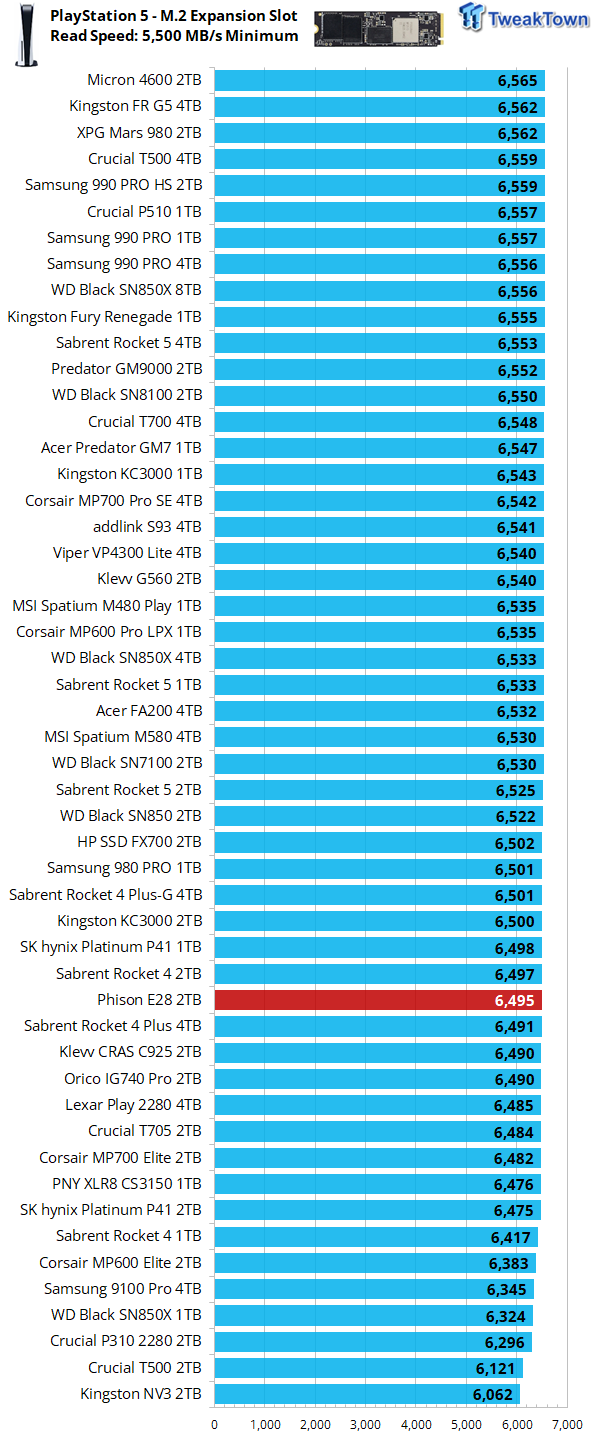
Although an unlikely use case scenario for the E28, if employed for PS5 M.2 storage expansion, it can get the job done nicely.
Synthetic Benchmarks: CDM, Max IOPS, ATTO
CrystalDiskMark
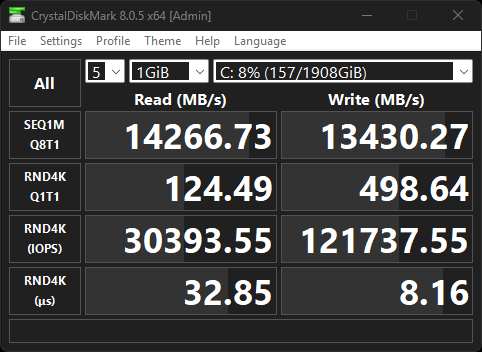
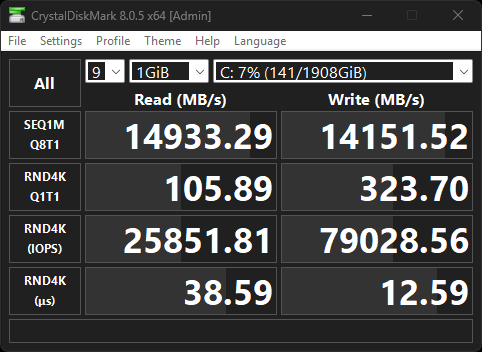
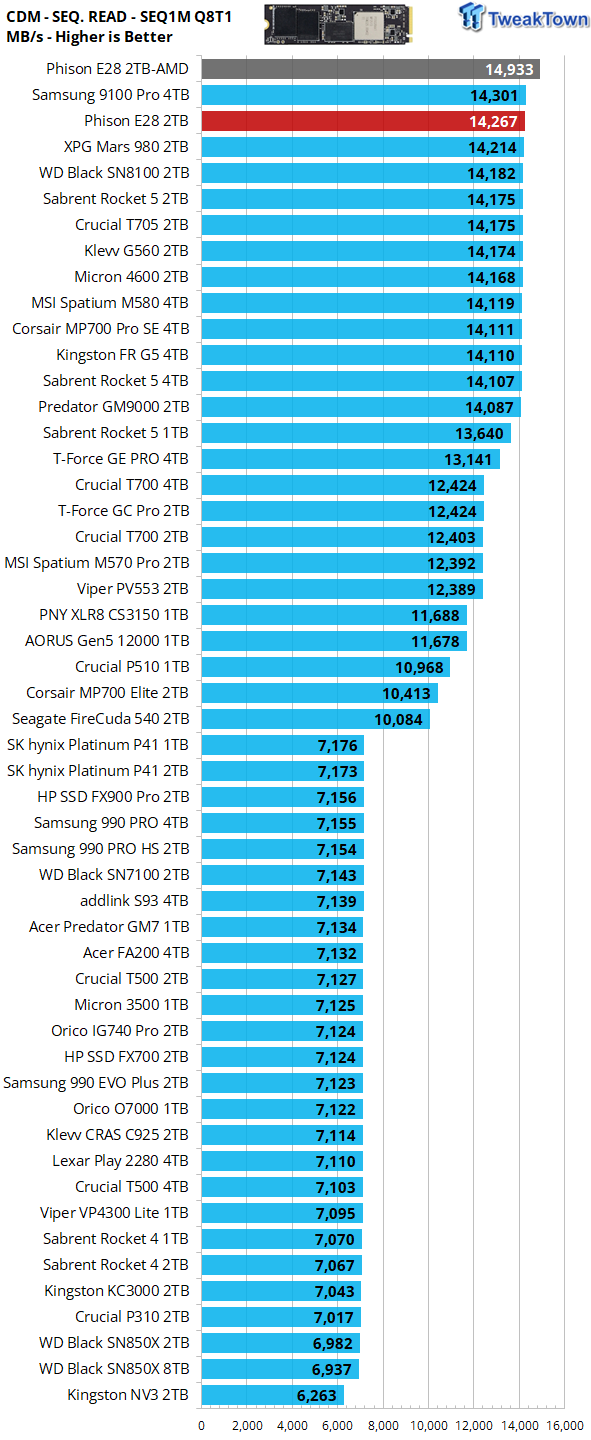
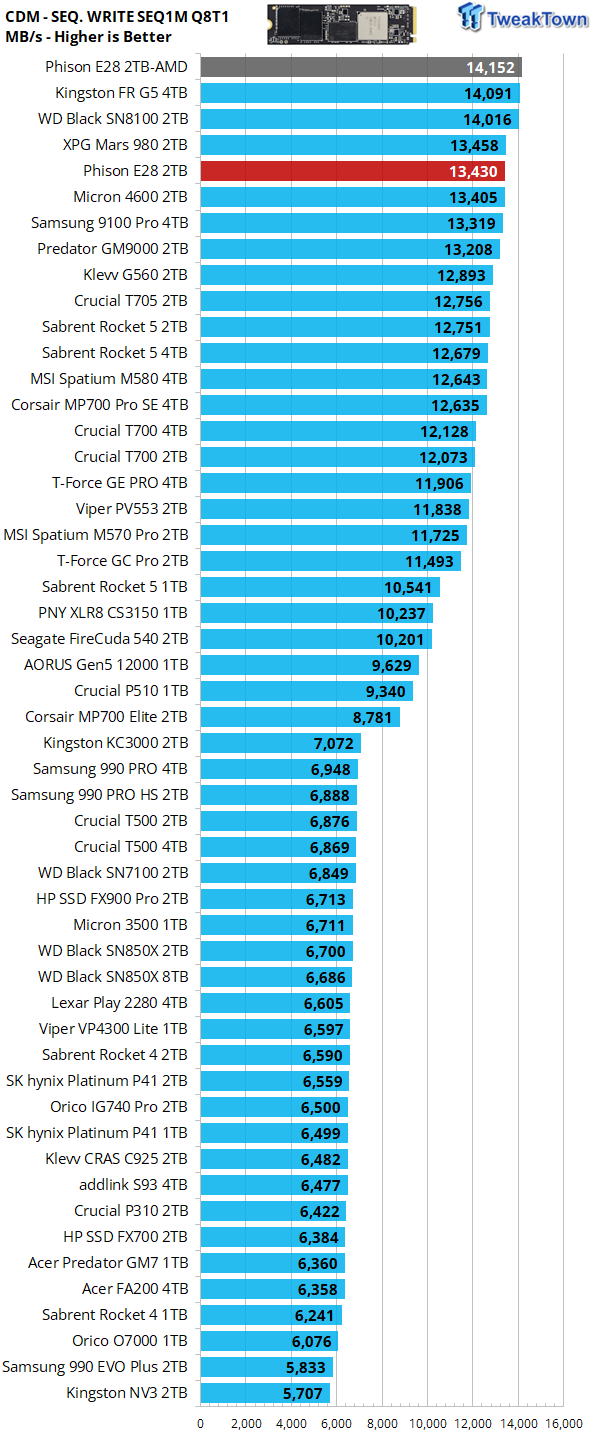
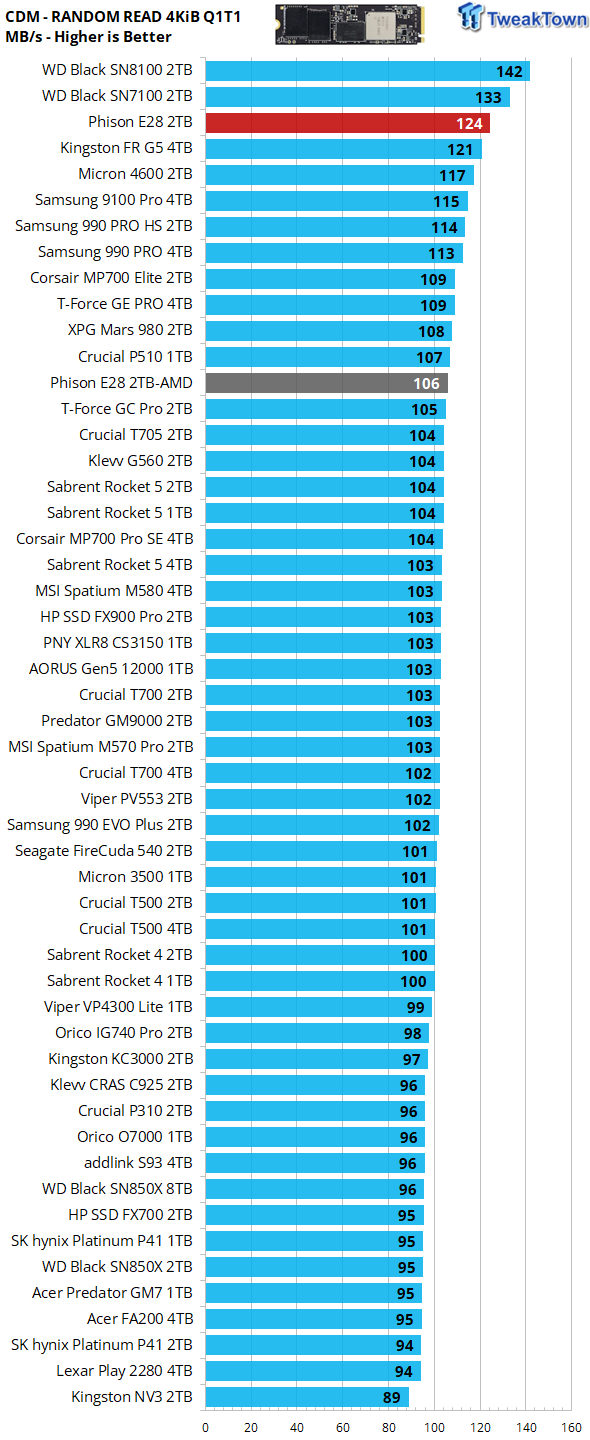
We employ CDM as our standard measurement for both sequential throughput and Q1T1 random read. In terms of sequential throughput, the drive delivers exactly as advertised and then some, even in our more demanding user state.
Sequential read checks in as the second best we've achieved to date and exceeds Phison's up-to-sequential read performance quote of 14,900 MB/s. Impressive. Sequential write throughput comes in as advertised via our AMD platform. Excellent.
4K QD1 random read is looking great here as well. Our test subject is arrayed with the same grade flash as the Kingston Fury G5, yet it delivers more. This is a good sign and why we are of the opinion that the SN8100 is arrayed with higher grade or faster flash, as all three of these SSDs are arrayed with flash from the same family tree.
Max IOPS
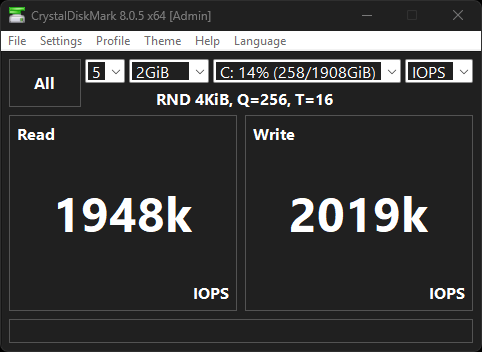
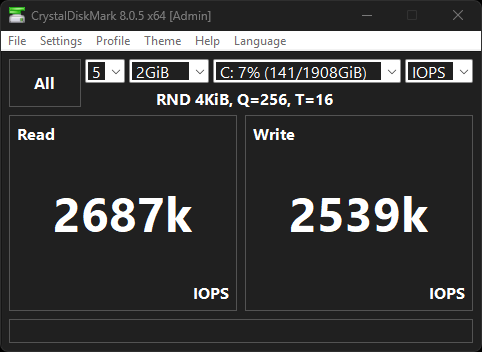
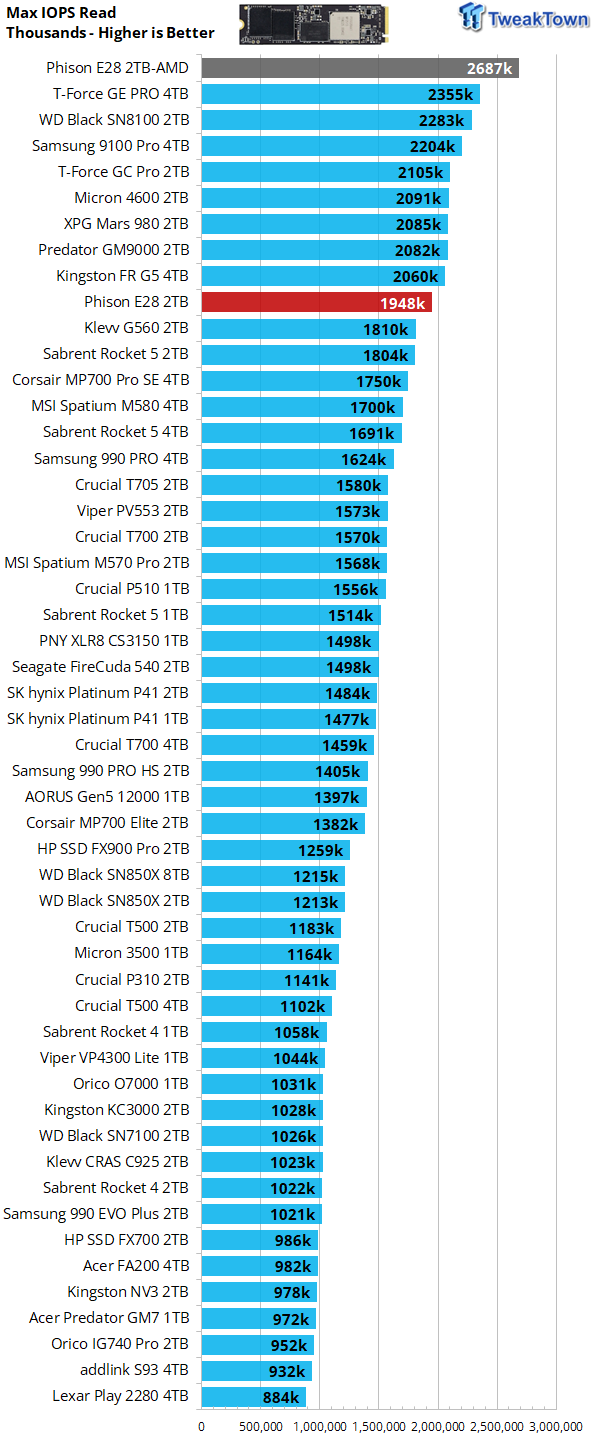
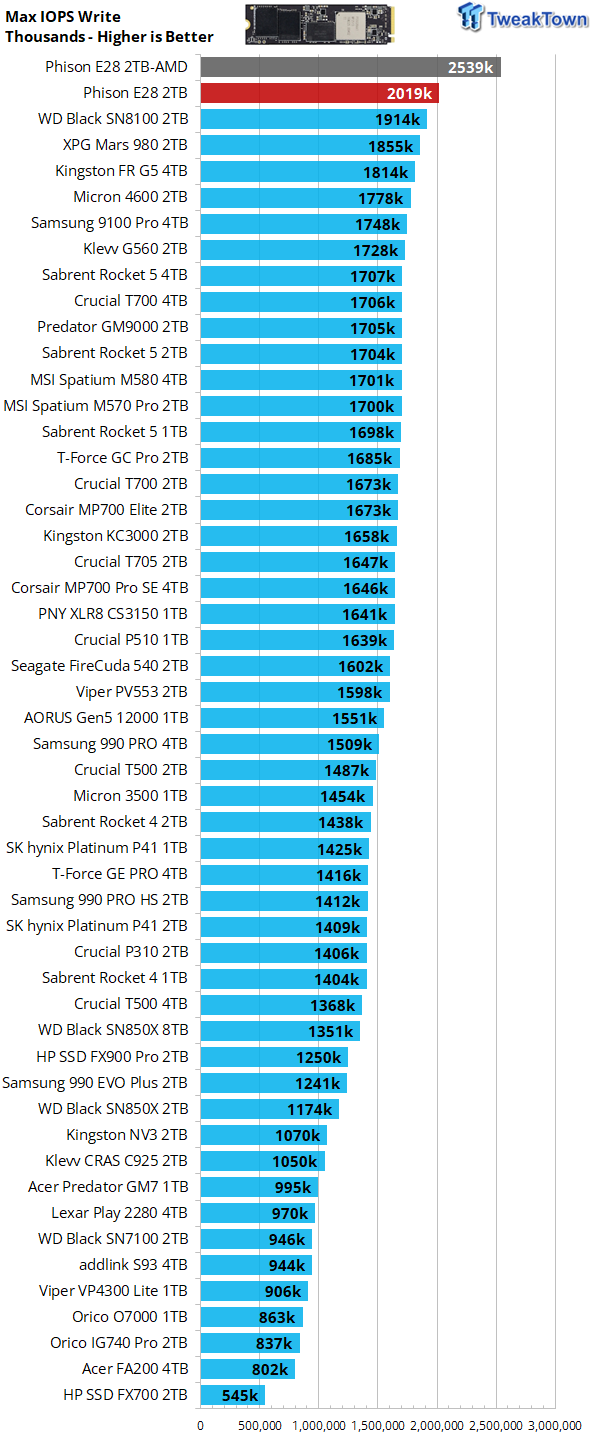
Max 4K random performance for our E28 controlled preview SSD is stated as up to 2.6 million IOPS for random read. Random writes are specified at up to 3 million IOPS. Our Intel platform falls short on both quoted numbers, but we get there where it really matters (read) with our AMD platform.
Results here are plenty good enough for our liking, especially considering our far more demanding user state of OS disk vs. empty secondary device. These results, except for random read on our Intel platform, are new lab records. Impressive.
ATTO
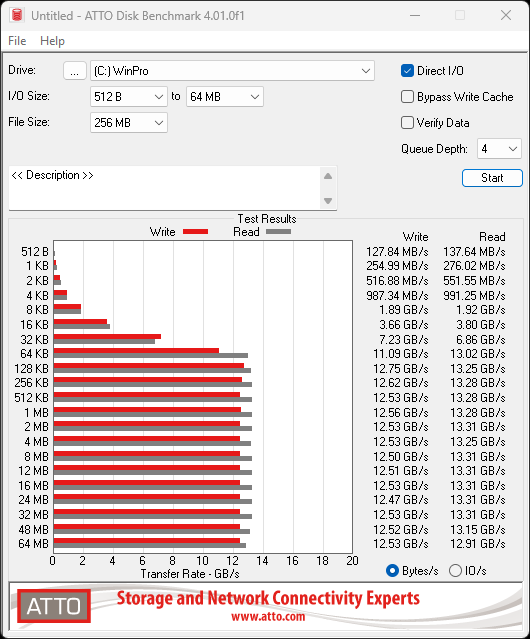
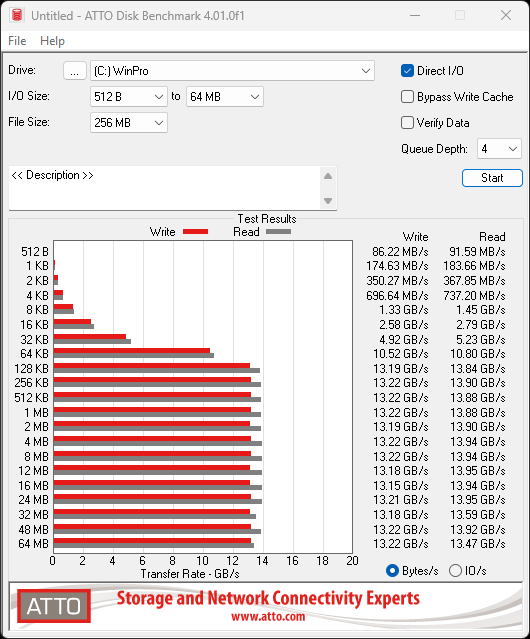
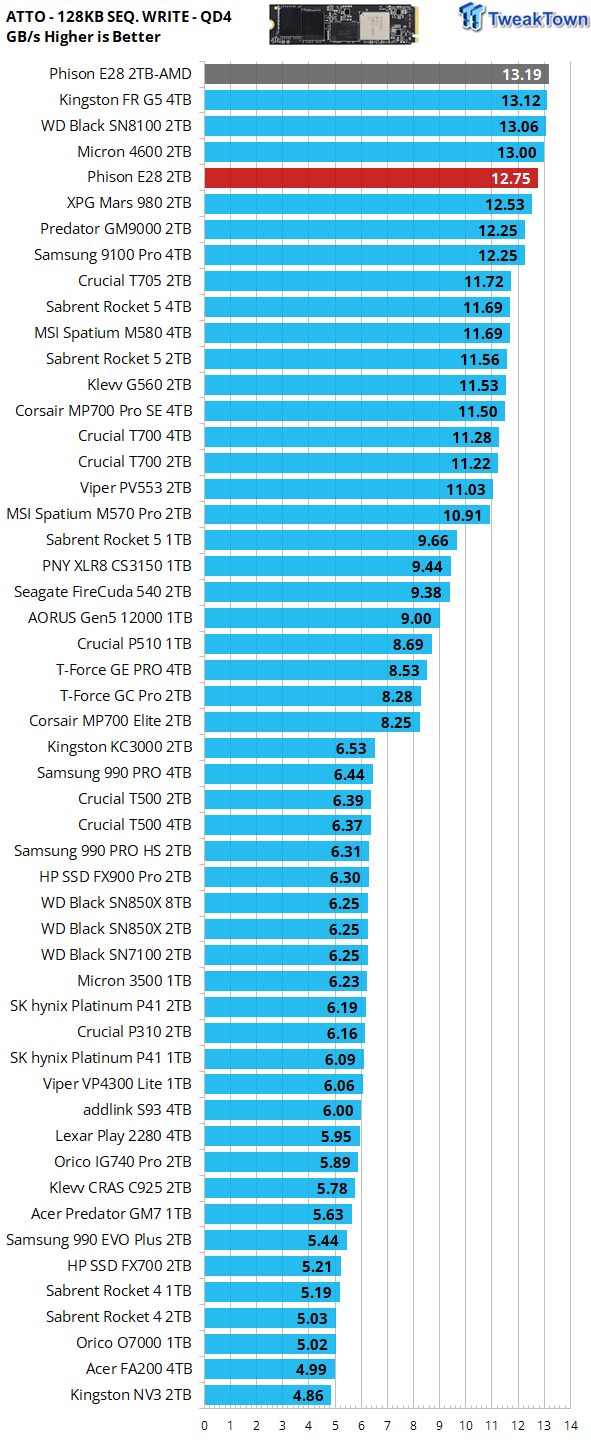
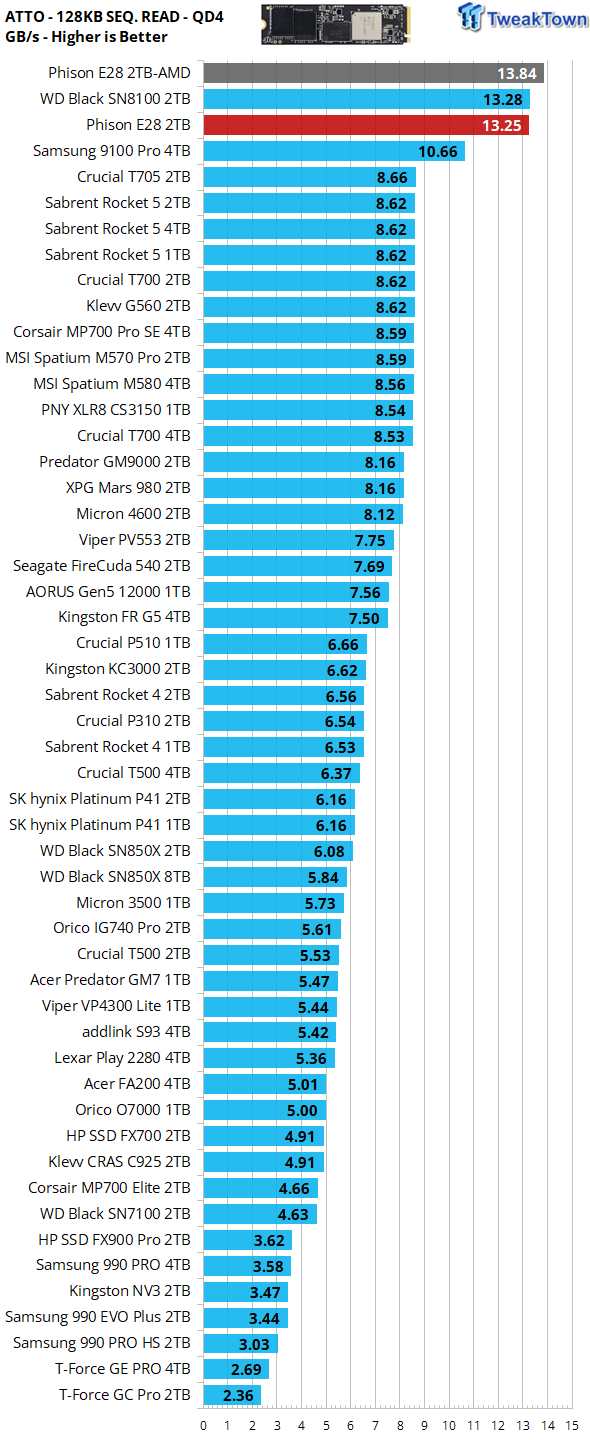
ATTO gives us a clear picture of what transfer sizes a particular SSD favors in terms of QD4 sequential throughput. We chart 128K transfers. At a queue depth of four, our 2TB preview SSD favors sequential transfers of 128KB or larger when serving data to the host (reading) and 128KB or larger when programming (writing) data. Stunning small file performance - exactly what we are looking for but have only seen coming from this SSD and the SN8100.
Real-World Testing: Transfers, 3DMark SSD Gaming Test, PCM10 Storage
Transfer Rates
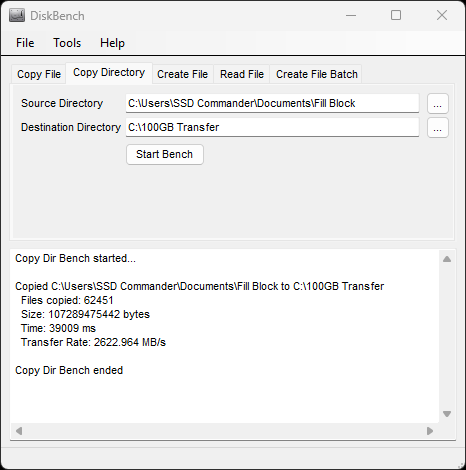
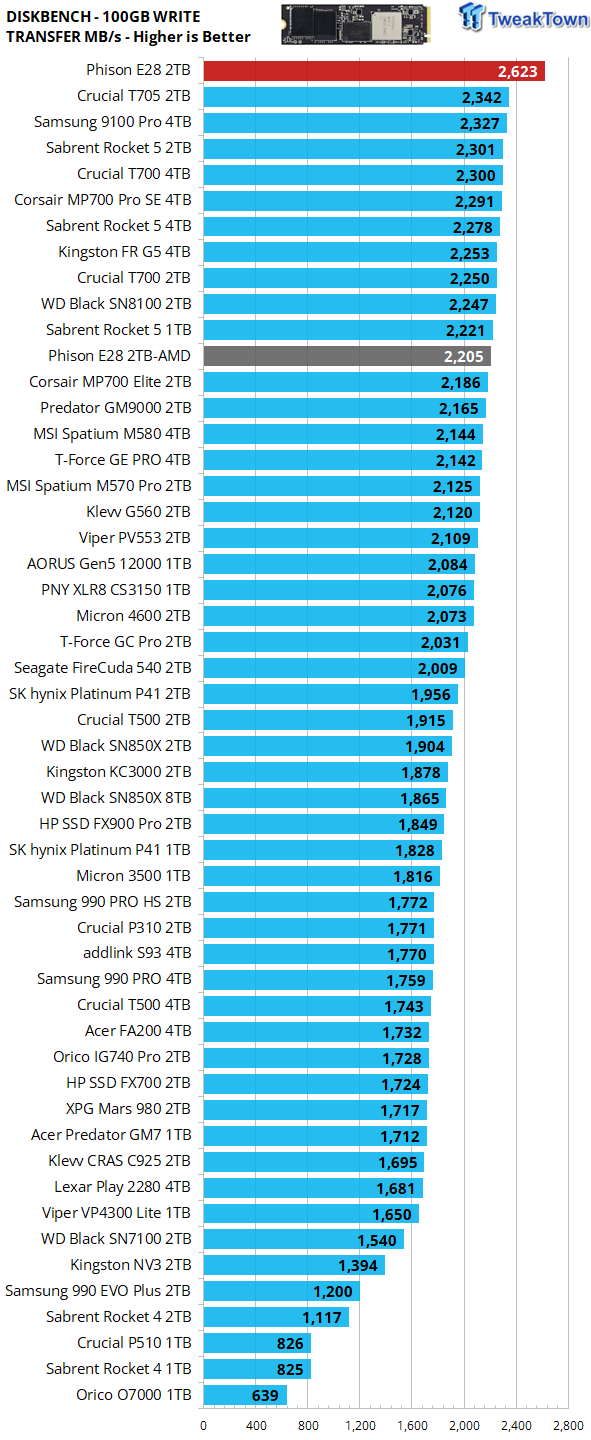
Our 100GB data transfer test is not your ordinary 100GB of data, ours is a crushing mix composed of more than 62K files. Write performance random or sequential is an infrequent operation and such, we do not consider it to be an important performance metric in the consumer space. An example being how many times a game is installed vs. how many times it's played. A new lab record via our Intel platform.
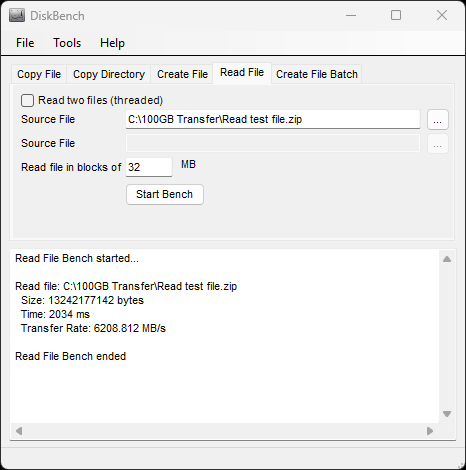
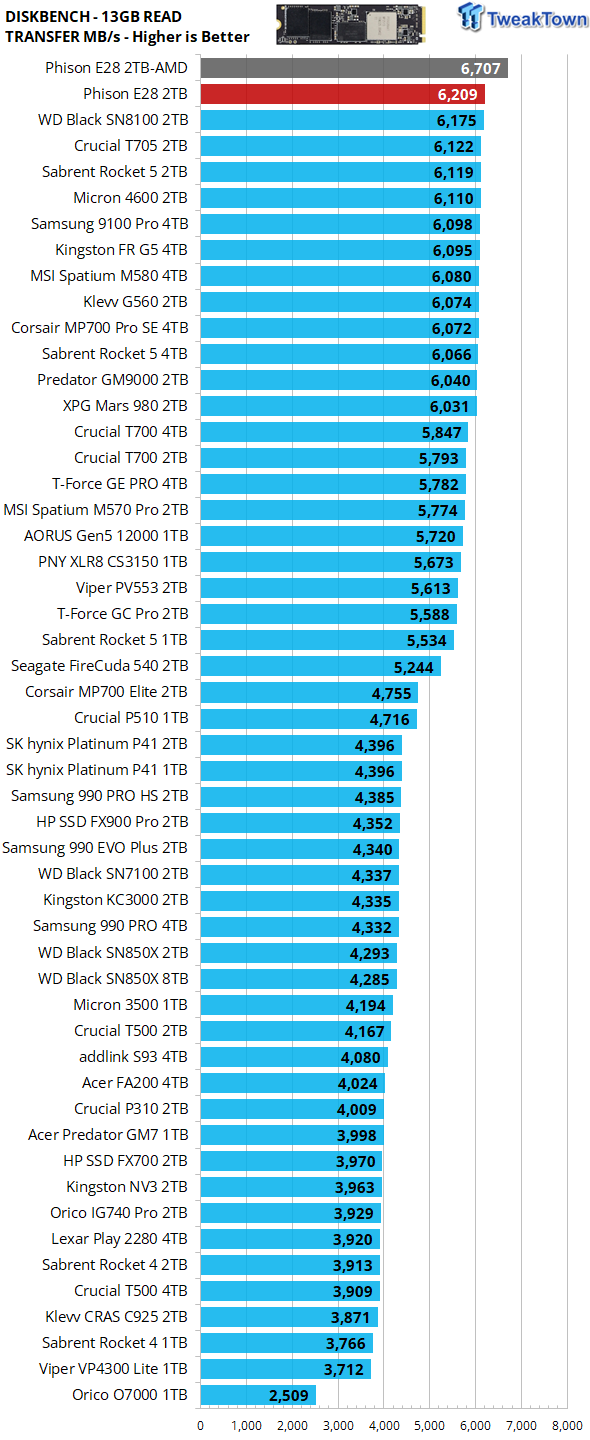
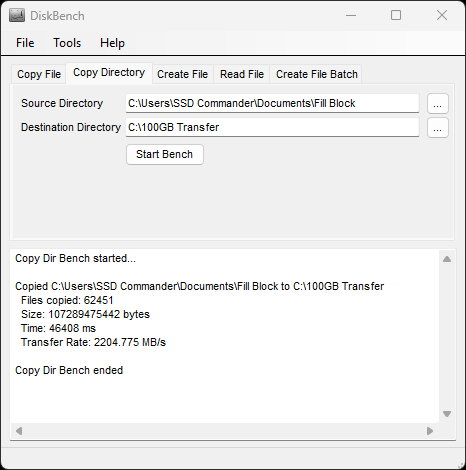
Unlike programming (writing) data, serving data to the host (reading) is typically an important performance metric as it relates to the consumer space. This is where transfer rates matter most, and we like what we see from our test subject. Another lab record via our Intel platform. Outstanding.
3DMark SSD Gaming Test
UL's newest 3DMark SSD Gaming Test is the most comprehensive SSD gaming test ever devised. We consider it superior to testing against games themselves because, as a trace, it is much more consistent than variations that will occur between runs on the actual game itself. This test is the same as running the actual game, just without the inconsistencies inherent to application testing. In short, we believe that this is the world's best way to test an SSDs gaming prowess and accurately compare it against competing SSDs. The 3DMark SSD Gaming Test measures and scores the following:
- Loading Battlefield V from launch to the main menu.
- Loading Call of Duty Black Ops 4 from launch to the main menu.
- Loading Overwatch from launch to the main menu.
- Recording a 1080p gameplay video at 60 FPS with OBS (Open Broadcaster Software) while playing Overwatch.
- Installing The Outer Worlds from the Epic Games Launcher.
- Saving game progress in The Outer Worlds.
- Copying the Steam folder for Counter-Strike Global Offensive from an external SSD to the system drive.


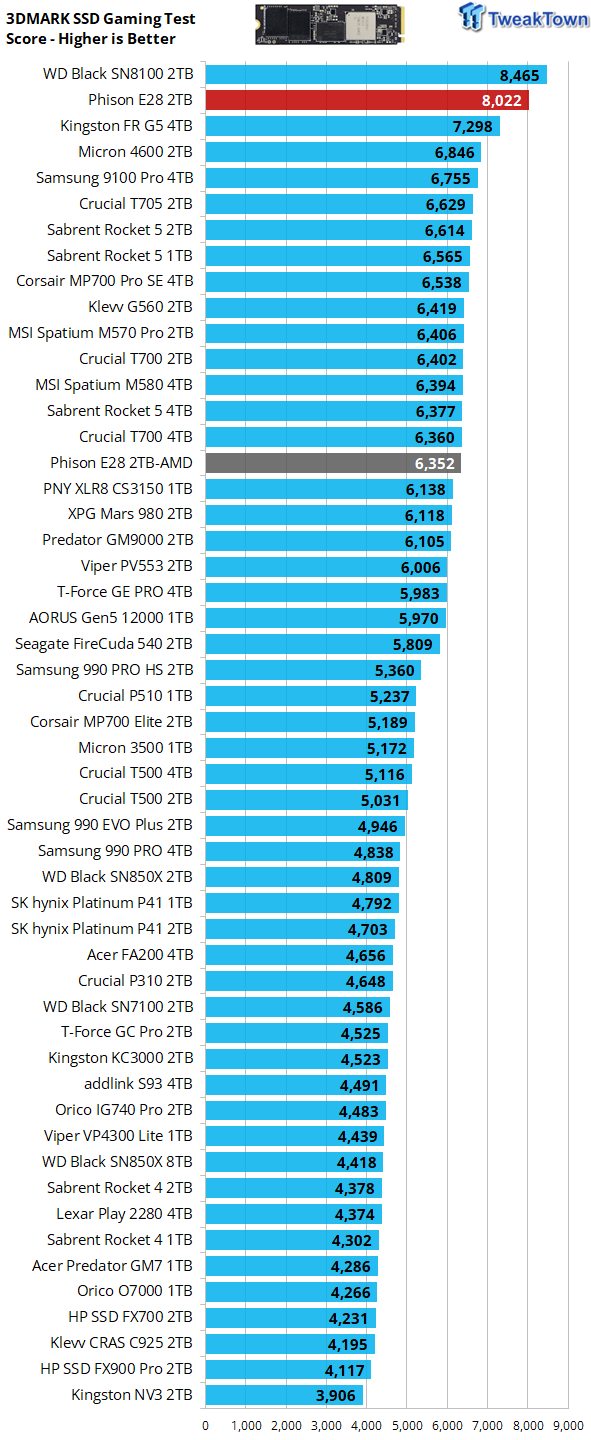
Gaming is a performance metric that matters to most DIY consumers, especially for the enthusiast crowd that TweakTown caters to. Now we've reached the point where results start to matter as they are a direct reflection of user experience.
We consider a score of 8,000 here to be a milestone achievement, and our test subject delivers that and a bit more. Again, we are of the opinion that the difference here between our E28-controlled SSD and the SM2508-controlled SN8100 comes down to the flash and/or firmware maturity.
PCM10 Storage Tests
PCMark 10 Storage Test is the most advanced and most accurate real-world consumer storage test ever made. There are four different tests you can choose from; we run two of them. The Full System Drive Benchmark and the Quick System Drive Benchmark. The Full System Drive Benchmark writes 204 GB of data over the duration of the test. These tests directly correlate with mainstream user experience.
PCMark 10 Full System Drive Benchmark
This test writes 204GB of data and covers a broad range of common consumer tasks, including booting Windows 10, file transfers, Adobe and Office applications, and startup times for games such as Battlefield V, COD Black Ops 4, and Overwatch. Unlike synthetic numbers, this is comprehensive real-world data, which is why we use it to rank SSDs in terms of user experience.


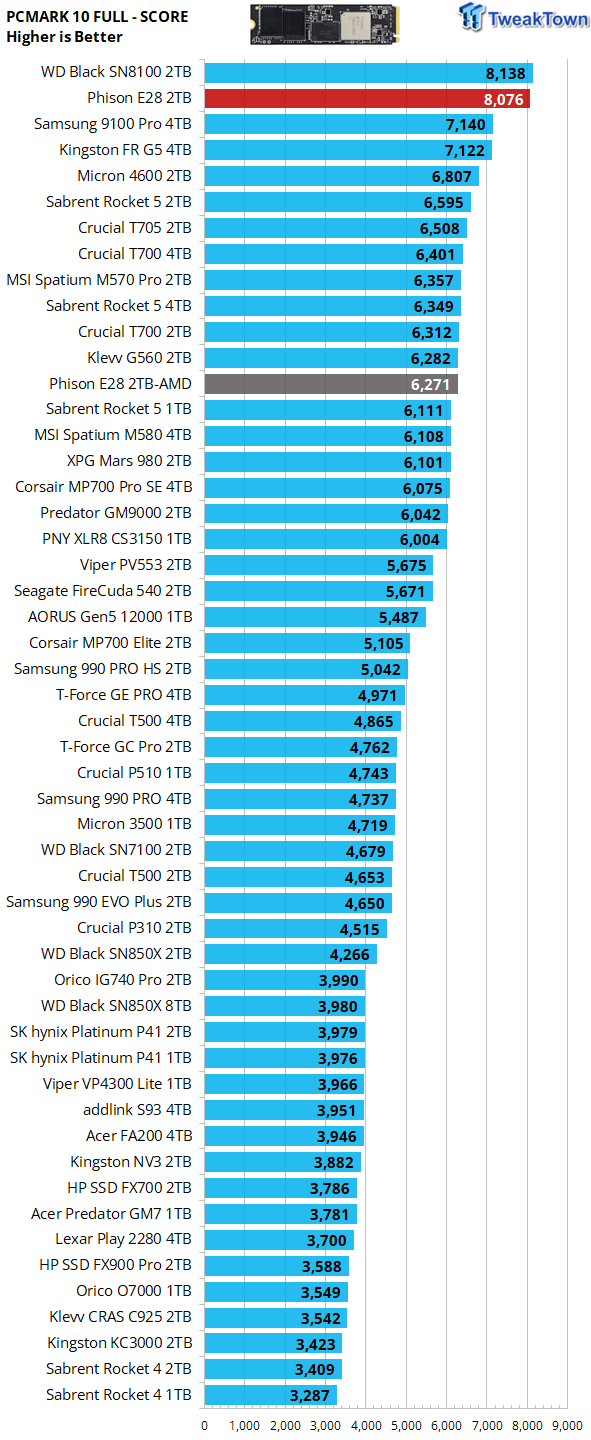
Exactly like the previous test, we consider a score of 8,000 here to be a milestone achievement, and our test subject indeed delivers that to us and more, this time nipping at the heels of our current performance champion WD_BLACK SN8100. Wow.
PCMark 10 Quick System Drive Benchmark
The Quick System Drive Benchmark writes 23 GB of data over the duration of the test.


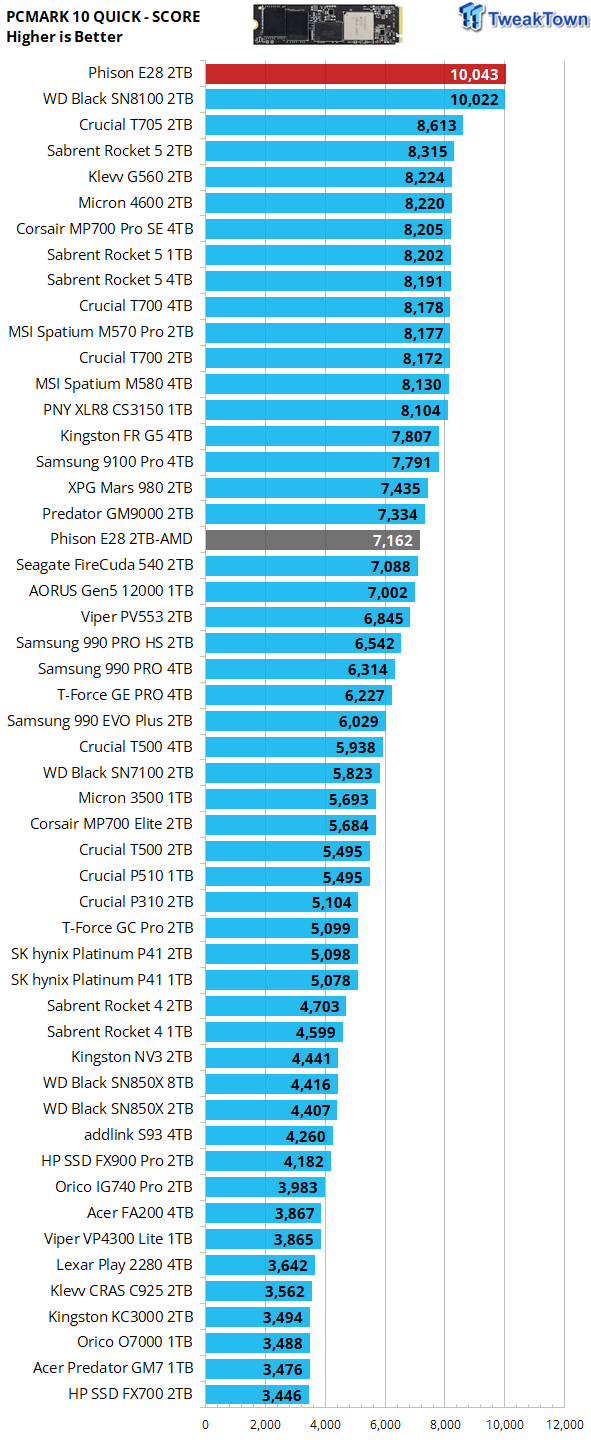
Of all the benchmarks we run, it can be argued that this one offers the best reflection of a typical consumer use case scenario. Well, look at that! Another lab record for a flash-based SSD falls to our E28-controlled engineering sample. The most performance where it matters most. A score of 10K here is charging into Optane P5800X territory, and including the P5800X, has only been achieved three times. Incredible.
Final Thoughts
The Phison Empire Strikes Back in a huge way. The E28 engineering sample SSD that we tested today delivered what we would consider to be equivalent real-world performance to that of our current performance champion, the WD_BLACK SN8100 2TB. Additionally, we are solidly of the opinion that with firmware maturity and a better-grade flash array, the E28 controller will indeed deliver the consumer performance crown back to the Phison Storage Empire.
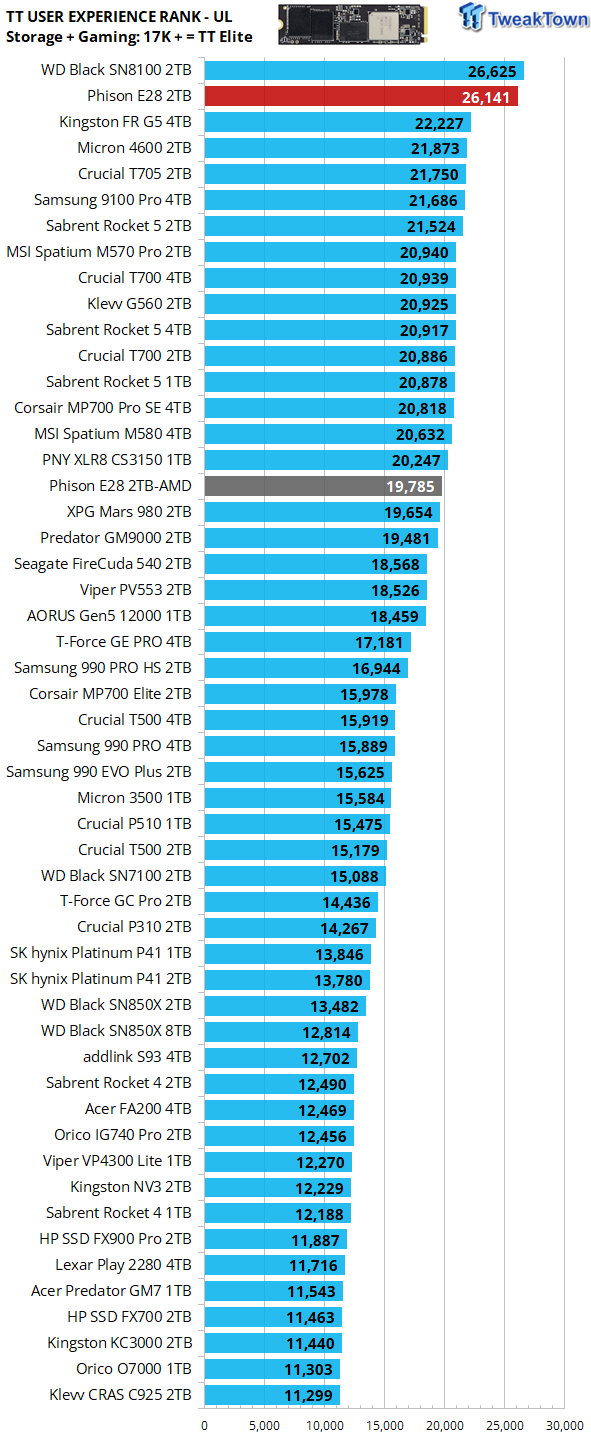
We rank SSDs in terms of overall user experience (performance where it matters most) as expressed by PCMark 10 storage and 3DMark gaming storage tests. Currently, we consider a user experience score of 17K or more to verify an SSD as a TweakTown Elite performer. 26K here is insane, and only the second time it's ever been attained. Incredible.

Massive performance, along with the potential for even more, has Phison's E28 controller looking unstoppable.


 UGREEN NASync DXP4800 GT Review: powerful 4-bay NAS with AMD Ryzen and dual 10GbE ports
 Phison E37T SSD Controller Exclusive Preview - The Fastest DRAMless SSD Platform Yet
 Seagate FireCuda X1070 4TB SSD Review - A New Mainstream Contender
 ASUSTOR Lockerstor 2 Gen2+ AS6702T v2 NAS Review - Fast Performance
 TERRAMASTER D1 SSD Pro Thunderbolt/USB Portable Enclosure Review - Incredible Potential
 Intel's dual-tile Nova Lake-S CPUs reportedly carry a 474W PL2 target, according to leaked Z990 power guidance
 Micron has signed agreements locking in record-high memory prices with major customers through 2030
 Microsoft quietly extends Windows 10 security updates to 2027
 Analyst believes Call of Duty, EA FC, and NBA 2K will move to $80 pricing
 Valve engineers claim release cadence for future Steam Machine versions will be shorter than the Steam Deck
 AMD engineer builds a Steam Machine competitor with a 3D printer, has an RTX 5060 inside
 GTA 6 listed as 'offline play only' on console PlayStation Store, 'offline play enabled' on other Sony portals
 Scalpers are already selling the Steam Machine for over $3000 on eBay despite Valve's efforts
 Valve silently removes 4K 60 FPS marketing claim from the Steam Machine, console is now only rated for up to 4K
 GTA 6 leak suggests it'll have 'NPCs with their own routines' and social networks so you can follow in-game influencers
 Lian Li B4-mATX Review: a compact mATX SFF case with excellent airflow and premium features
 MSI MPG 322UR QD-OLED X24 Review: A Brighter, Tougher 4K 240Hz QD-OLED for $1099
 Dell XPS 14 (2026) Laptop Review - Premium Quality, Impressive Performance
 Ocypus Sigma F36 BK ARGB Cooling Fan Review: high airflow and unified design in one frame
 PCCooler CPS RZ820 Display Review: a flagship-level CPU air cooler with an LCD screen
 UGREEN FineTrack Mini 2 Air Tracker Tag Review - Long battery life, lesser performance
 Speed Racer (2008) 4K Ultra HD Blu-ray Review: a stunning remaster of the cult classic
 MOAIPLAY ORA PRO G1 850W ATX 3.1 PSU Review: high efficiency and 10-year warranty for $119.99
 Navman MiVue Smart True 4K Surround Dashcam Review - Seeing In All Directions At Once
 Hisense U7SG 4K TV: Modern Entertainment for the New Age
 6 underrated Microsoft Word features worth using to boost your productivity
 Level Up Your PC Gaming with these Fantastic ASUS Prime Day Deals on GPUs, Motherboards, and More
 GIGABYTE Wants to Kickstart Your New Gaming PC or Upgrade with These Limited-Time Deals
 7 Windows settings to change right after installation for better privacy, security, and performance
 I stopped Windows 11 notifications from interrupting me with Do Not Disturb, Focus, and a priority list
 7 ways to transfer data from Android to Windows PC quickly and easily
 I read the Windows Backup app screen carefully, and it does not back up what most people think
 Low Sound Volume on Windows 11? How to fix audio issues and restore normal volume
 8 Critical Warning Signs You Should Never Ignore in Windows 11