













Our Verdict
Pros
- Cool temperatures
- Highest sequential write performance
- Best 8K random read performance
Cons
- None
Should you buy it?
Introduction and Drive Details
The E1.S form factor has indeed become the standard for read-intensive AI storage compute. This compact and hot-pluggable form factor is perfectly suited for ideal placement in the AI server rack to minimize latency and maximize density, and as such has indeed become the standard going forward for this application.
At its early inception, the E1.S form factor, with its limited footprint and cooling surfaces, presented a challenge for most purveyors of the form factor. The typical response to the thermal challenge brought on by the new form factor was to limit voltage/throughput in comparison with more easily cooled form factors like U.2 and E3.
Micron's 9550 E1.S 15mm read-intensive 1-DWPD offering is fitted with an incredibly effective heatsink designed to maximize cooling efficiency in standard air-cooled server environments. Because the drive can be so easily and effectively air-cooled, no performance limitations are necessary, thereby enabling the 9550 E1.S to deliver the very same class-leading performance available from its other form factors.

Pictured above are temperatures taken nearing the end of 2-loops of 128K sequential write preconditioning, where we feel temperatures are likely their highest. Typically, we would see temperatures near 70c here with standard air cooling, but not with our test subject. Here, we see the 9550 Pro E1.S 15mm SSD running at a cool 53c as it pumps away at record-breaking 11,200 MB/s. Outstanding.
Micron describes its 9550 Series enterprise SSDs as follows: "The ideal SSD for AI. AI workloads need more performance and power, and this drive is built for the most demanding workloads. The Micron 9550 outperforms competitors' AI workload performance and power efficiency with Big Accelerator Memory (BaM) using NVIDIA technology. It delivers up to 33% faster workload completion times and 60% faster feature aggregation performance - while using up to 43% less average SSD power."
Best Deals: Micron 5300 PRO 7.68TB SSD
Price Trend:
Prices last scanned 2 hours and 47 minutes ago


Micron further states: "Comparing the Micron 9550 SSD to competitive SSDs shows that a training system using the Micron 9550 SSD offers up to 33% faster Graph Neural Network (GNN) training workload completion times, 60% higher SSD performance, and decreased system energy consumption by up 29%."
Micron's 9550 SSD is another product of Micron's vertical integration capabilities. The drive features a Micron-designed controller ASIC, NAND, DRAM, and firmware. It supports NVMe 2.0 and OCP 2.0, with OCP 2.5 for telemetry data logging. Designed for end-to-end security, it safeguards data with features like SED, SPDM 1.2, SEE, and encryption.
Our Latest SSD Review Coverage
- Micron 6600 ION 245.76TB Enterprise SSD Review - Best in Class Programming Speeds
- Memblaze PBlaze 7 7A40 Ocean 61.44TB Enterprise SSD Review - Oceans of QLC at 3.3 million IOPS
- KIOXIA CD9P-R 7.68TB E3.S Review - The Best-In-Class Data Center SSD
- DapuStor Roealsen6 R6060 E1.L 245.76TB SSD Review - Massive Capacity with Fast Retrieval
- Phison Pascari X200P 7.68TB Enterprise SSD Review - Sequential Read Champion
Okay, now that we are familiar with some of the main features Micron's 9550 E1.S 15mm SSD brings to the table, let's see what kind of performance it can deliver via our enterprise test bench.
Specs/Comparison Products
| Item | Details |
|---|---|
| Model | Micron 9550 Pro E1.S 7.68TB |
| MSRP | NA |
| Model Number | MTFDLCE7T6THA-1BK1DABYY |
| Interface | PCIe Gen5 x4 |
| Form Factor | E1.S |
| Sequential BW | Up to 14,000 MB/s |
| Random IOPS | Up to 3300K IOPS |
| Warranty | 5-Years Limited |
Micron 9550 Pro E1.S 15mm 7.68TB PCIe Gen5 x4 SSD


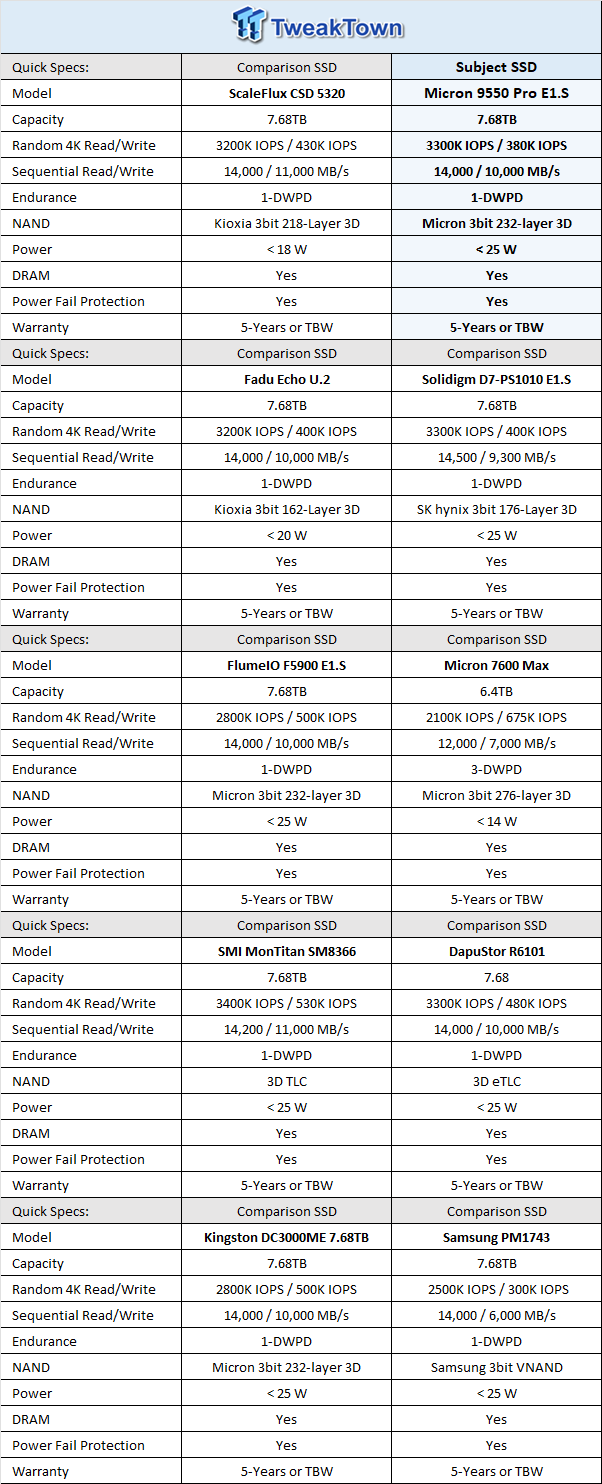
The drive we have in hand is a 1-DWPD design, E1.S form factor, 7.68TB in capacity, Micron G8 TLC arrayed, and 16-channel controlled. This configuration is rated for up to 3.3 million IOPS and up to 14 GB/s sequential throughput. Micron 9550 Series SSDs are compatible with major operating systems such as RHEL, SLES, CentOS, Ubuntu, Windows Server, and VMware ESXi.
Test System Specs & Enterprise Testing Methodology
Enterprise SSD Test System
| Item | Details |
|---|---|
| Motherboard | ASUS Pro WS W790E-SAGE SE (Buy at Amazon) |
| CPU | Intel Xeon w7-2495X (Buy at Amazon) |
| GPU | GIGABYTE GeForce GTX 1650 (Buy at Amazon) |
| Cooler | Alphacool Eissturm Hurricane Copper 45 (Buy at Amazon) |
| RAM | Micron DDR5-4800 RDIMM (Buy at Amazon) |
| Power Supply | be quiet! Dark Power Pro 12 1200W (Buy at Amazon) |
| Case | PrimoChill's Praxis Wetbench (Buy at Amazon) |
| OS | Ubuntu 24.04.1 LTS |
A special thank you goes to Allyn Malventano, without whose help we wouldn't be where we are with our Linux-based Enterprise SSD testing platform.
Testing Methodology
TweakTown strictly adheres to industry-accepted Enterprise Solid State Storage testing procedures. Each test we perform repeats the same sequence of the following steps:
- Secure Erase SSD
- Write the entire capacity of SSD 2x (2 loops) with 128KB sequential write data, seamlessly transition to the next step (sequential testing skips step 3)
- Precondition SSD by filling the drive twice with 4K or 8K random writes
- Run test-specific workload with a 30-second ramp up for 5 minutes at each measured Queue Depth, and record average result
Benchmarks - Sequential
128K Sequential Write/Read

We precondition the drive with 100 percent sequential 128K writes at QD256 using 1-thread for 2-drive fills, receiving performance data every second. We plot this data to observe the test subject's descent into steady-state and to verify that steady-state is in effect as we seamlessly transition into testing at queue depth. A steady-state is achieved after 1-drive fill. Average steady-state 128K sequential write performance at QD256 is approximately 11,200 MB/s.


Micron specs its 9550 Series SSDs as capable of delivering up to 10,000 MB/s 128K sequential write throughput. We are getting up to 11,200 MB/s, so that is amazing and is also class leading. Impressive.


Here, the drive is factory spec'd for up to 14,000 MB/s 128K sequential read throughput. We are hitting up to 14,734 MB/s, so it is better than advertised and at a place where throughput matters most for read-intensive AI applications. Overall, this level of sequential read throughput is among the highest we've ever encountered. Excellent.
Benchmarks - Random
4K Random Write/Read

We precondition the drive using 100 percent random 4K writes at QD256 for 2-drive fills, receiving performance data every second. We plot this data to observe the test subject's descent into steady-state and to verify that steady-state is in effect as we seamlessly transition into testing at queue depth. A steady-state is achieved after 1-drive fill. Average steady-state 4K random write performance at QD256 is approximately 410K IOPS.


Our 7.68TB model is rated at up to 380K 4K random write IOPS. We are getting up to 418K, so we are doing a bit better than advertised.


Factory spec here is up to 3.300K IOPS. We are getting 3,384K with our configuration. Excellent random throughput, especially for its form factor.
4K 7030


The performance curve at queue depths of up to 64 here is impressive for a 1-DWPD SSD. Additionally, and worth noting at QD64, our test subject is delivering more than any 1-DWPD E1.S SSD we've encountered.
4K 5050


As we add more programming into the mix, our test subject responds well for a 1-DWPD SSD. This time delivering the most we've encountered to date from its type at QD16.
8K Random Write/Read

We precondition the drive using 100 percent random 8K writes at QD256 for 2-drive fills, receiving performance data every second. We plot this data to observe the test subject's descent into steady-state and to verify that steady-state is in effect as we seamlessly transition into testing at queue depth. A steady-state is achieved after 1-drive fill. Average steady-state 8K random write performance at QD256 is approximately 215K IOPS.


We expect 8K random to track pretty much the same as 4K random here, just at a lower IOPS rate because it's moving twice the amount of data. Our test subject delivers better than half of what we saw at 4K. Excellent.


Outstanding performance curve here. This is where the 9550 is at its best - 8K random reads where we find our test subject cranking out the most IOPS we've encountered coming from the E1.S form factor. Impressive.
8K 7030


8K 7030 is representative of a common database workload. We note especially strong performance at QD8-64, where our test subject delivers better than any competing 1-DWPD E1.S SSD we've tested to date.
8K 5050


Again, we note especially strong performance, this time at queue depths between 2 and 32, where our test subject delivers better than any competing 1-DWPD E1.S SSD we've tested to date.
Final Thoughts
Read-intensive AI storage compute in the E1.S form factor is where much of the action in the modern datacenter is taking place, and Micron's 9550 Pro E1.S SSD makes for one of the most, if not the most compelling choices available today. Especially compelling is its exceptional 8K random read throughput, where it delivers more than any of its kind that we've ever encountered. Additionally, the 9550 delivers the most 128K sequential write throughput we've ever encountered from any non-compressed SSD, regardless of formfactor - both metrics are highly sought-after attributes where E1.S SSDs are designed to slot into the modern AI storage compute structure.

In our opinion, it's among the best of its kind ever made. Editor's Choice.


 Micron 6600 ION 245.76TB Enterprise SSD Review - Best in Class Programming Speeds
 Memblaze PBlaze 7 7A40 Ocean 61.44TB Enterprise SSD Review - Oceans of QLC at 3.3 million IOPS
 KIOXIA CD9P-R 7.68TB E3.S Review - The Best-In-Class Data Center SSD
 DapuStor Roealsen6 R6060 E1.L 245.76TB SSD Review - Massive Capacity with Fast Retrieval
 Phison Pascari X200P 7.68TB Enterprise SSD Review - Sequential Read Champion
 Samsung Foundry raises manufacturing prices, may impact the Nintendo Switch 2
 Modder manages to run DOOM on a 16-year-old Canon EOS 550D DSLR Camera
 Leaked Steam Frame unboxing video hints at an imminent launch
 Call of Duty: Modern Warfare 4's PC Shader Compilation will run before you even launch the game
 Call of Duty Modern Warfare 4 will run on a GPU with only 3GB of VRAM
 LG unveils FLiPP, its 'dream next-generation OLED technology'
 AMD on track for a 20X increase in AI rack-scale energy efficiency by 2030
 Windows 11 is finally adding per-app controls for desktop programs accessing your microphone, camera, and location
 PlayStation is rebooting Horizon Hunters Gathering to be a traditional co-op game and not a live-service thing
 Redditor grabs a Radeon RX 7900 XT for just $226, even when it appeared 'out of stock'
 GIGABYTE MO27Q2A Gaming Monitor Review: 1440p, 280Hz, and QD-OLED is a winning combination
 Cooler Master V8 ACE 3DHP BLACK CPU Cooler Review
 ASUS ROG Strix XG129C Review: A $199 Gaming Monitor You Don't Play Games On
 Cooler Master HAF II 500 Mid-Tower Chassis Review
 Corsair HS35 v3 Wireless Gaming Headset Review - An Affordable Winner
 D-Link F518 5G Wi‑Fi 6 AX1800 Mobile Hotspot Review: All-Day Mobile Hotspot
 Bose Lifestyle Ultra Speaker Review - Impressively Detailed Room-Filling Sound
 MSI Z890 Gaming Plus WIFI6E Review - Z890 for under $200
 Mortal Kombat (1995) 4K Ultra HD Blu-ray Review
 CPS PCCOOLER YS1200 ATX 3.1 80 PLUS Gold PSU Review
 Using Multiple Monitors? Change these Windows settings for a Better Experience
 Windows Sandbox is The Windows Security Feature Most People Never Use
 I ditched the Windows 11 context menu for this open-source tool, and here's why
 Windows 11 may be encrypting your drive already, and I checked where my recovery key went
 GIGABYTE's 40 Days of INFINITY celebrates 40 Years of Innovation with stunning GeForce RTX graphics cards and rewards
 I swapped File Explorer for this free file manager and finally got the layout I wanted
 How to tell if someone has been using your Windows PC without your permission
 6 Task Manager tips for troubleshooting Windows performance problems
 ASUS ROG's 20th Anniversary Line-up of Premium PC Gaming Gear has Arrived - Here's Everything You Need to Know
 Six File Explorer tips every Windows user should know