
Our Verdict
Pros
- Random throughput performance
- Sequential throughput performance
- Mixed workload performance
Cons
- None
Should you buy it?
Introduction and Drive Details
DapuStor has launched a new variant within the company's Roealsen6 Series. The new SSD, like the others within the Roealsen6 Series, is built on DapuStor's in-house developed DP800 controller and firmware. The series features a PCIe 5.0 interface and 3D eTLC NAND Flash across the board. Supporting the NVMe 2.0 protocol, the R6 Series in x8 AIC form factor can deliver up to 4x the performance of the best PCIe 4.0 SSDs. Amazing
DapuStor's Roealsen6 R6301 x8 AIC (Add-In-Card) SSD is built with workstations in mind. This is because the x8 lane AIC form factor isn't designed for dense arrays typically found in a server/datacenter environment, but rather as a directly attached storage (DAS) device via a x8 or x16 PCIe slot with direct CPU lanes as found in quantity on most modern workstation motherboards.
Popular Now: Linus Tech Tips leaks Steam Frame first impressions, and Valve may be working on native Half-Life: Alyx supportFor us at TweakTown, we have to reach all the way back to 2015 and Intel's DC P3608 SSD to find an x8 enterprise SSD. The DC P3608 SSD was much different than what we have on our test bench today in that Intel used two x4 controllers over an x8 interface to accomplish the x8 transfer rates - today's test subject is powered by a natively x8 DP800 controller.
We first caught wind of today's test subject at Flash Memory Summit 2025 at the DapuStor booth. We were not only amazed by the lofty throughput rates of this SSD being advertised at up to 5 million random read IOPS and up to 30GB/s sequential throughput, but also by the fact that, apparently, DapuStor's widely employed in-house DP800 controller is natively an x8 controller even though we've only ever seen it previously in x4 configurations.
Now, as you might imagine, a beast such as this is going to be on the power-hungry side, which is the case at 28 watts. However, 28 watts is actually not bad at all, considering many high-performance x4 enterprise SSDs consume 25 watts. Additionally, when we take into account the massive IOPS to watt output our test subject can deliver, it actually seems to be quite power efficient by that metric.
Now, let's dive into our review and see what kind of real-world numbers we can get out of this beast via our workstation hardware and Linux testing configuration.
Best Deals: Intel Optane M10 16GB Memory
Price Trend:
Prices last scanned 3 hours and 52 minutes ago

7 days ago: $36.81 USD30 days ago: $37.88 USD
7 days ago: $74.49 CAD30 days ago: $80.29 CAD
7 days ago: £57.8230 days ago: £60.97


Specs/Comparison Products
| Item | Details |
|---|---|
| Model | DapuStor R6301 AIC 12.8TB |
| MSRP | NA |
| Model Number | DPRP62016TTF12T8000 |
| Interface | PCIe Gen5 x8 |
| Form Factor | AIC |
| Sequential BW | Up to 30,000 MB/s |
| Random IOPS | Up to 4450K IOPS |
| Warranty | 5-Years Limited |
DapuStor Roealsen6 R6301C 12.8TB PCIe Gen5 x8 AIC SSD


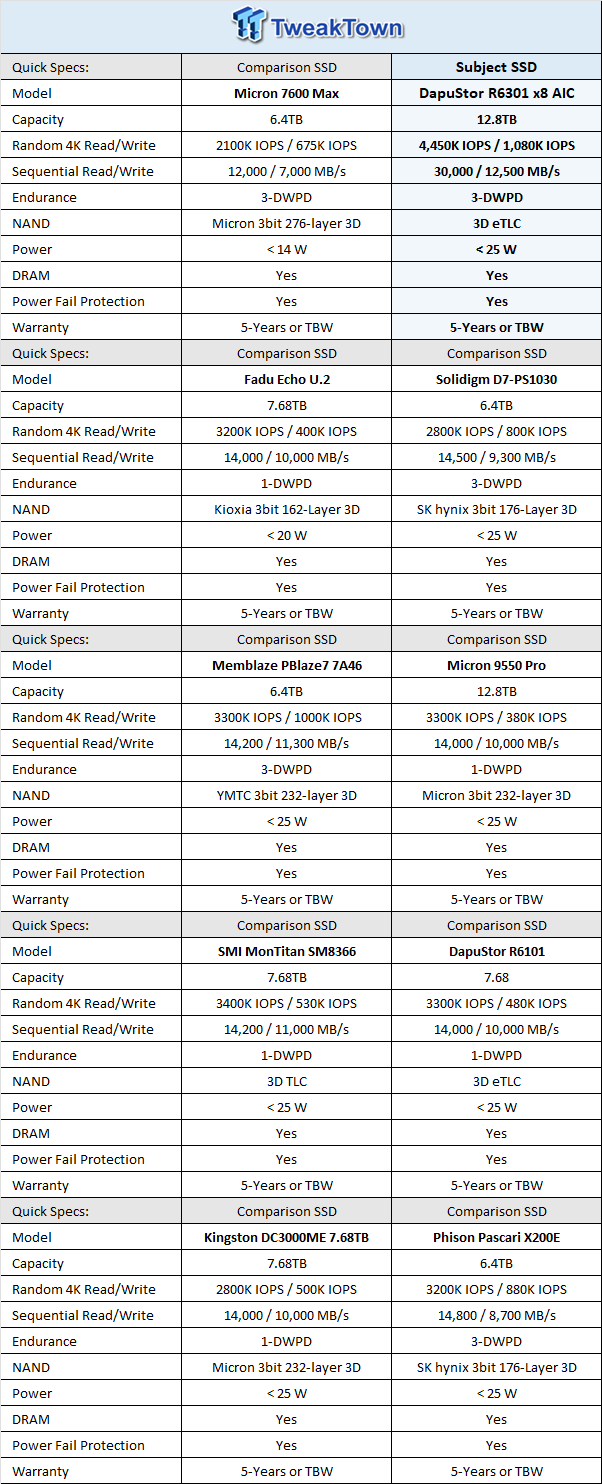
The drive we have in hand is a 3-DWPD design, x8 AIC form factor, 12.8TB in capacity, 3D eTLC arrayed, and 16-channel DP800 controlled. This configuration is rated for up to 4.4 million IOPS and up to 30 GB/s sequential throughput. DapuStor SSDs are compatible with major operating systems such as RHEL, SLES, CentOS, Ubuntu, Windows Server, and VMware ESXi.
Our Latest SSD Review Coverage
- Micron 6600 ION 245.76TB Enterprise SSD Review - Best in Class Programming Speeds
- Memblaze PBlaze 7 7A40 Ocean 61.44TB Enterprise SSD Review - Oceans of QLC at 3.3 million IOPS
- KIOXIA CD9P-R 7.68TB E3.S Review - The Best-In-Class Data Center SSD
- DapuStor Roealsen6 R6060 E1.L 245.76TB SSD Review - Massive Capacity with Fast Retrieval
- Phison Pascari X200P 7.68TB Enterprise SSD Review - Sequential Read Champion
Advanced features include NVMe 2.0 - enabling online firmware upgrades, up to 128 name spaces, atomic writes, and more. OCP 2.5 telemetry, latency monitoring, and NVMe-MI send/receive. NVMe-MI 1.2, end-to-end data protection, secure boot, thermal throttling, and more.
Test System Specs & Enterprise Testing Methodology
Enterprise SSD Test System
| Item | Details |
|---|---|
| Motherboard | ASUS Pro WS W790E-SAGE SE (Buy at Amazon) |
| CPU | Intel Xeon w7-2495X (Buy at Amazon) |
| GPU | GIGABYTE GeForce GTX 1650 (Buy at Amazon) |
| Cooler | Alphacool Eissturm Hurricane Copper 45 (Buy at Amazon) |
| RAM | Micron DDR5-4800 RDIMM (Buy at Amazon) |
| Power Supply | be quiet! Dark Power Pro 12 1200W (Buy at Amazon) |
| Case | PrimoChill's Praxis Wetbench (Buy at Amazon) |
| OS | Ubuntu 24.04.1 LTS |
A special thank you goes to Allyn Malventano, without whose help we wouldn't be where we are with our Linux-based Enterprise SSD testing platform.
Testing Methodology
TweakTown strictly adheres to industry-accepted Enterprise Solid State Storage testing procedures. Each test we perform repeats the same sequence of the following steps:
- Secure Erase SSD
- Write the entire capacity of SSD 2x (2 loops) with 128KB sequential write data, seamlessly transition to the next step (sequential testing skips step 3)
- Precondition SSD by filling the drive twice with 4K or 8K random writes
- Run test-specific workload with a 30-second ramp up for 5 minutes at each measured Queue Depth, and record average result
Benchmarks - Sequential
128K Sequential Write/Read

We precondition the drive with 100 percent sequential 128K writes at QD256 using 1-thread for 2-drive fills, receiving performance data every second. We plot this data to observe the test subject's descent into steady-state and to verify that steady-state is in effect as we seamlessly transition into testing at queue depth. A steady-state is achieved after a 1-drive fill. Average steady-state 128K sequential write performance at QD256 is approximately 12,000 MB/s.


DapuStor factory specs its R6301 12.8TB AIC SSD as capable of delivering up to 12,500 MB/s 128K sequential write throughput. We are getting up to 12,300 MB/s, so the factory spec here seems spot on. Its performance curve here is the best we've ever seen coming from a single non-compressed enterprise SSD. Especially impressive is its QD1 performance of over 10GB/s


Here, the drive is factory spec'd for up to 30,000 MB/s 128K sequential read throughput. We are hitting up to 23,800 MB/s, which is another lab record for a single PCIe Gen5 x4 SSD. Now 23.8GB/s is far less than the 30GB/s quoted by DapuStor, but there is a caveat here. We test sequential throughput with a single CPU thread, and DapuStor's 30GB/s spec is derived by employing 32 threads or streams. 32 threads streaming from a single SSD is not an unrealistic real-world use case scenario, and we are fully convinced that in this scenario our test subject can indeed deliver 30GB/s sequential reads; however, we don't test in that manner, we test using the industry standard of one thread.
Benchmarks - Random
4K Random Write/Read

We precondition the drive using 100 percent random 4K writes at QD256 for 2-drive fills, receiving performance data every second. We plot this data to observe the test subject's descent into steady-state and to verify that steady-state is in effect as we seamlessly transition into testing at queue depth. A steady-state is achieved after a 1-drive fill. Average steady-state 4K random write performance at QD256 is approximately 1,200K IOPS.


Factory spec here is stated at up to 1,080K IOPS. We are getting up to 1,275K IOPS, so significantly better than advertised, and again a new lab record for an uncompressed SSD. The performance curve here is among the best we've ever seen for its kind. Impressive.


Factory spec here is up to 4,400K IOPS. We are getting close to 4,200K with our configuration. This is roughly 5% lower than factory spec, which is within the realm of variation between different hardware configurations, such as AMD vs. Intel. Plenty good enough for our liking. Additionally, we note that at QD1-4, our test subject is delivering more than the competition.
4K 7030


Here, our contender delivers what we consider the best performance curve we've ever seen coming from a non-compressed flash-based SSD.
4K 5050


Again, our contender delivers what we consider to be the best performance curve we've ever seen coming from a non-compressed flash-based SSD. Outstanding.
8K Random Write/Read

We precondition the drive using 100 percent random 8K writes at QD256 for 2-drive fills, receiving performance data every second. We plot this data to observe the test subject's descent into steady-state and to verify that steady-state is in effect as we seamlessly transition into testing at queue depth. A steady-state is achieved after a 1-drive fill. Average steady-state 8K random write performance at QD256 is approximately 620K IOPS.


We expect 8K random to track pretty much the same as 4K random here, just at a lower IOPS rate because it's moving twice the amount of data. As expected, our test subject delivers by far the best we've ever seen, coming from a non-compressed enterprise SSD.


Excellent performance curve here - even better than we saw at 4K. Impressive.
8K 7030


8K 7030 is representative of a common database workload. Here, results indicate that, in addition to being the ultimate workstation storage solution, our test subject might additionally be ideally suited for SMB databases, where massive density is not a priority.
8K 5050


Again, the best we've ever seen coming from a non-compressed, flash-based SSD. Again, bolstering our assertion that this SSD is the ultimate workstation SSD.
Final Thoughts
DapuStor's Roealsen6 R6301C 12.8TB PCIe Gen5 x8 AIC SSD is indeed the fastest and most powerful single SSD we've ever encountered. Its form formfactor is the limiting factor here, as it is with all of its kind. Add-In-Cards, while capable of enabling unparalleled performance coming from a single SSD, also limit its practicality for usage as a traditional datacenter storage device. However, that's not what this SSD is designed for anyway. As we see it, DapuStor's most powerful SSD is ideally suited for powerful workstations where AIC is the preferred formfactor.

DapuStor's Roealsen6 R6301 12.8TB x8 AIC SSD is the fastest and most powerful single SSD we've ever encountered - the ultimate workstation SSD. Editor's Choice.