

Our Verdict
Pros
- New 4K scan perfectly captures the film's intended image
- Engaging new bonus features
Cons
- The Dolby Atmos track could have been mixed a little more aggressively
Should you buy it?
On paper, the Teenage Mutant Ninja Turtles franchise just shouldn't work. Born from a weird, violent, and hastily animated comic from two unknown artists, the franchise went on to navigate its initial surge of explosive popularity in the mid 1980's to spawn multiple iterations of animated series, movies, books, countless toy lines, and billions of dollars of revenue over the next four decades. But back at the beginning, no studio was confident in just how long the wave would continue, and the notion of a feature-length live-action picture was a total gamble for all involved.
As a crime wave sweeps New York City driven by the sinister Shredder (James Saito) and his shadowy Foot Clan gang, TV reporter April O'Neil (Judith Hoag) begins investigating the mysterious vigilantes who are intervening in the crimes - four ordinary pet turtles who were accidentally exposed to a mysterious ooze in the sewers and transformed them into intelligent, anthropomorphic teenagers with distinct personalities and ninja skills, trained in the art of ninjutsu by their wise rat sensei, Splinter (Kevin Clash). When Splinter is kidnapped, the Turtles must venture above ground to rescue their mentor and save the city.
Turned down by studio after studio, Hong Kong's Golden Harvest studio (known primarily for low-budget martial arts films) picked up the theatrical rights and later entered into a distribution agreement with fledgling Warner Bros. offshoot New Line Cinemas to release the film in the United States. Their shared gamble proved to be solid, with the film grossing over $200m off its $13m budget and propelling the franchise to even greater heights.
Initially criticised for its adult themes and level of violence for a film ostensibly aimed at youngsters, 35 years later, Teenage Mutant Ninja Turtles serves as a good example of a film that is greater than the sum of its parts. This is particularly reflected in its mature tone and earnestness that treats its characters and world with seriousness - even having the audacity to tackle deeper societal issues such as trauma, estrangement, and seclusion - and the artistry behind the camera, such as that from the Jim Henson studio that convincingly makes the titular characters living, breathing personalities. Whilst these qualities aren't reflected in the two inferior sequels, the original film holds up spectacularly today thanks to the unflinching vision of director Steve Barron, and the studios who were prepared to take a risk.


Best Deals: Teenage Mutant Ninja Turtles: Mutant Mayhem 4K Ultra HD + Blu-ray | Region Free
Price Trend:
Prices last scanned 17 hours and 43 minutes ago


Video
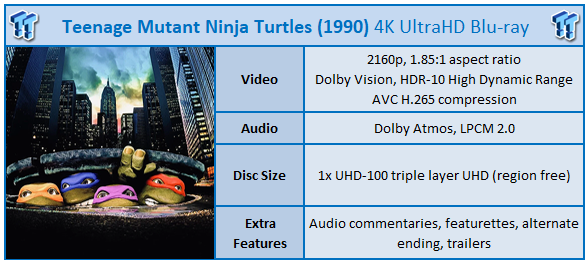
Teenage Mutant Ninja Turtles is presented in its original aspect ratio of 1.85:1 in the Rec. 2020 color space, finished with dynamic Dolby Vision and static HDR-10 high dynamic range formats and encoded with AVC H.265 compression. Notably, it has been approved by director Steve Barron.
Rather than being derived from later generation interpositive elements as the previous Blu-ray was, for the first time ever, the film has been scanned in 4K from the original camera negative at by Fotokem in the United States, with restoration undertaken by R3store Studios in the United Kingdom. Straight up, this means you're seeing Teenage Mutant Ninja Turtles in the highest fidelity possible, with clear effort expended to make it shine as best it can.
Our Latest Blu-ray Movies Review Coverage
- Mars Attacks! (1996) 4K Ultra HD Blu-ray Review
- Mortal Kombat Annihilation (1997) 4K Ultra HD Blu-ray Review
- Mortal Kombat (1995) 4K Ultra HD Blu-ray Review
- The Super Mario Galaxy Movie (2026) 4K Ultra HD Blu-ray Review
- Speed Racer (2008) 4K Ultra HD Blu-ray Review: a stunning remaster of the cult classic
However, I need to stress that this doesn't mean that the film is now a demo-worthy disc. Indeed, in many ways, it's actually a difficult one to review. The challenges posed by the production of the film, much of it shot in low lit interiors, with a bevy of undercranked shots (to make action appear faster), analog composites and a variety of film stocks, including fast 35mm that's inherently more grainy, and even lower resolution 16mm and 8mm formats adds to an experience that was never going to challenge the best looking discs on the format. But fans who are familiar with the specific look of the film will recognise it rightly for what it is.
Straight up, this is - as it always has been - an extremely grainy film, and the studio has wisely chosen not try to manage it in any aggressive way. Some might be disappointed by the varying levels of grain, which vary from barely noticeable in some of the well-lit exterior segments to egregious (most noticeably the flashback sequence shot on 16mm), with the majority of the film somewhere in the middle, playing out in dim shadows. Rightly or wrongly, this is the way the film looks, but going back to the negative helps resolve this as best as possible. Colour is often muted, with Raphael and Michelangelo's masks sometimes being difficult to distinguish.
Despite these technical challenges, overall, this is a really superb remaster which should please most fans.

Audio
Teenage Mutant Ninja Turtles is presented in a new Dolby Atmos object-based mix.
Subtly improving on the 5.1 TrueHD track on the previous Blu-ray, Arrow's new Atmos soundtrack has been mixed and mastered by Deluxe Audio, utilising Warner's archival elements. Arrow has also included the original stereo audio mix in uncompressed PCM 2.0, as well as an alternate audio track for the Korean market in DTS HD-MA 2.0.
This isn't some wholesale re-engineering of the original audio, with the soundfield remaining firmly fixed to the front soundstage and only occasionally springing to life in any meaningful way. Still, there are a few somewhat impressive attempts to engage the rears, but there's little for the height surrounds to do other than support John Du Prez's score, and a few reverb effects throughout. Low frequency is used sparingly, but does provide light support throughout.
Overall, this is a decent attempt to improve the previous 5.1 mix, doing so without any downsides. Arrow should be congratulated for preserving the original theatrical 2.0 mix for purists.

Extras
In typical Arrow style, we have a great collection of new bonus features which have been lovingly created by the boutique studio. Let's jump in.
First up, we have no one but two newly recorded Audio Commentaries, the first with director Steve Barron running solo, and the second with 'comic book expert' Dave Baxter. Fans of the film will no doubt be interested in the different perspectives offered, but if you had to choose one, I'd go with the director's commentary, even though I personally think that Barron's recollections in the commentary recorded for the German Blu-ray release back in 2014 (not offered here) were superior.

The bulk of the extras consists of 90 minutes of new featurettes, including in-depth interviews with cast and crew. Highlights include Rising When We Fall, which interviews director Steve Barron, Turtle Talk which features Turtles voice artists Robbie Rist and Brian Tochi, as well as martial artists Ernie Reyes Jr. and Kenn Scott looking back at their roles and O'Neil on the Beat which features a new interview with actress Judith Hoag looking back at her role and some insight on why she didn't return for the sequels. Wet Behind the Shells features a new interview with producer Simon Fields, while Beneath the Shell has Brian Henson and Rob Tygner look back at the Henson Creature Shop's cutting-edge animatronic work. Finally, Teenage Mutant Ninja Turf is a fun but somewhat amateurish tour of the current status of the film's filming locations in New York and North Carolina.
Finally, we have an Alternate UK Version which preserves the censoring required to release the film in that market, along with an Alternate Ending from a VHS workprint, Alternate Korean Footage and four Theatrical trailers.