


Our Verdict
Pros
- Attractive design
- Good throughput from 2.5Gbe ports
- Supports up to four SSDs for faster caching
- Wide array of add-on apps
Cons
- Shiny appearance attracts dust and fingerprints like crazy
- High priced if you only need a basic NAS
- Installing M.2 SSDs is a little tricky
Should you buy it?
Introduction & Specification Details and Close-up
The ASUSTOR AS5402T 2-Bay NAS - alternatively available as the ASUSTOR AS5404T as a 4-Bay NAS option if needed - is a nicely powerful system that incorporates some premium features, including the ability to load in up to four M.2 SSDs if required.

That question of need is key to whether or not the ASUSTOR AS5402T 2-Bay NAS will make sense for you. It sits just below the absolute Pro-grade NAS tier, but the use of some higher-speed or higher-grade features does push its price up a little. If you only need the NAS basics, it's overkill, but if you want a really flexible NAS system that can grow with your needs, it's an excellent piece of kit.
Specifications & Close Up

| Item | Details |
|---|---|
| Product Name | ASUSTOR AS5402T 2-Bay NAS |
| Drive Bays | 2-Bay (SATA HDD 3.5"/2.5" SATA 2.5" SSD) |
| M.2 Drive Slots | 4 |
| Hot Swap Support | Yes |
| File System Support | Internal Disk: EXT4 ,Btrfs External Disk: FAT32, NTFS, EXT3, EXT4, HFS+, exFAT ,Btrfs |
| CPU | Intel Celeron N5105 |
| RAM | 4GB SO-DIMM DDR4, supports up to 16GB |
| Flash Memory (System Disk) | 8GB eMMC |
| RAID | Single/JBOD/RAID 0/RAID 1 |
| LAN Ports | 2 x 2.5 Gigabit Ethernet |
| USB Ports | 2 x USB 3.2 Gen2, 10Gbps |
| HDMI | 1 x HDMI 2.0b |
| Dimensions | 170 (H) x 114 (W) x 230 (D) mm |
| Weight | 1.71kg |

Design
Most 2-Bay NAS systems opt for very plain designs, but then there's not so much you can do with a box that's going to throw a motherboard at one side or end and then just a couple of drive enclosures.

Best Deals: ASUSTOR AS5402T 2-Bay NAS
Price Trend:
Prices last scanned 2 hours and 23 minutes ago

7 days ago: $406.99 USD30 days ago: $406.99 USD

7 days ago: $406.99 USD30 days ago: $406.99 USD
7 days ago: $555 CAD30 days ago: $595 CAD
7 days ago: £36930 days ago: £369


I'm not sure that too many NAS owners are particularly stressed about what it looks like anyway. If ever there was a tech category where function utterly trumps form, it's got to be NAS, no?

ASUSTOR has at least put a little thought into what the ASUSTOR AS5402T looks like, with a reflective black finish capped off by a removable, magnetically attached front plate that hides the two primary drive bays. To the side of the faceplate sits the ASUSTOR AS5402T's indicator lights above a single USB-A 3.2 Gen 2 port.

The top of the ASUSTOR AS5402T houses patterned vents, while the rear is where you'll find a further pair of USB-A 3.2 Gen 2 ports for external storage devices, dual 2.5Gbe ethernet ports and an HDMI 2.0b port for connecting to an external display.


The ASUSTOR AS5402T ships sans drives - I've used a pair of Seagate 4TB Iron Wolf drives loaned to me for the purposes of review - so you would have to budget for drives on top of the asking price of the NAS.
Our Latest SOHO NAS/DAS Review Coverage
- UGREEN NASync DXP4800 GT Review: powerful 4-bay NAS with AMD Ryzen and dual 10GbE ports
- ASUSTOR Lockerstor 2 Gen2+ AS6702T v2 NAS Review - Fast Performance
- TERRAMASTER D4 SSD 4-Bay NVMe DAS Enclosure Review - Superior Portable DAS
- UGREEN NASync DH2300 Review - Simple NAS at a low price
- Synology DiskStation DS423+ Home NAS Review

In the box outside the enclosure itself, you get a pair of Ethernet cables, mounting screws for smaller 2.5-inch drives, and a couple of slender installation guides that are essentially just there to provide QR code links to ASUSTOR's website.
I'm not a big fan of having only QR code links, if only because if you're trying to set up the ASUSTOR AS5402T in a situation where your online connectivity is sketchy, or ASUSTOR decides to move files around in the future, you could be plumb out of luck, but this is absolutely the way that the support market for documents has gone. The flip side of that argument is that it is a little more environmentally friendly than printing full manuals that few will read in their entirety.
Installation

The first step in physical installation is getting access to the dual drive bays, which is easy enough. The front plate is magnetically attached, and not that strongly. Even just getting the plastic wrap off is enough to have it fall from the front of the ASUSTOR AS5402T.
Installing 3.5-inch HDDs - in my case, I'm using a pair of Seagate Iron Wolf 4TB drives supplied to me for review by Seagate - is a simple enough process, though it is a little noisy.


Unclipping the drives from the bay involves some force, and the separation of the plastic sounds eerily as though it's snapping when you do so. To be clear, this hasn't actually happened during my review period, but it's far from a smooth release motion.
The drive enclosures only fit in one way, though it might have been nice for ASUSTOR to have labelled them for easy installation to avoid having to flip them around to get them to fit. No prizes for guessing what I had to do during the install process.

3.5-inch drives install using simple plastic side clips, though if you were using 2.5-inch HDDs or SSDs, you would need to screw them in place with a screwdriver; ASUSTOR does supply the relevant screws in the box to make that happen.
The ASUSTOR AS5402T also supports up to 4 M.2 SSDs for caching purposes, though the installation here is considerably more complex.

You have to pull both drive bays from the unit, unscrew two holding screws on the back of the ASUSTOR AS5402T (or four on the ASUSTOR AS5404T) and then pull the cover off to reveal the SSD drive bays.
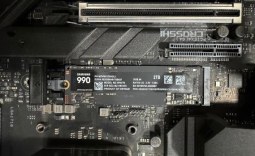
The ASUSTOR AS5402T uses a holding clip to keep each SSD drive in place; for the purposes of testing, I used what I had to hand, which was a single Samsung 990 EVO Plus 2TB Drive.

If you did want to upgrade the internal 4GB memory, either with a secondary stick or by pairing up two 8GB sticks for a maximum of 16GB, it's feasible to do so, but advisable when you're installing SSDs as well, because that's also an upgrade you can only do with the ASUSTOR AS5402T's cover removed. For this review, I left it at the stock 4GB of RAM.
Once the physical install is done, you've got to turn to the software part of the equation. This took me a little while to get up and running from my test PC, mostly because ASUSTOR's Control Center app really didn't like the fact that I was also using a VPN on the same system, even though at this point, the ASUSTOR AS5402T wasn't configured enough to really do anything online.

One quick tip here: If you're having trouble getting an ASUSTOR NAS seen by its own discovery software, try temporarily disabling your VPN; it just might do the trick.
The web-based installation - there's also an app, AiMaster for iOS or Android, if you prefer that route - is simple enough in execution, with options for simpler installation if you're happy with how the unit detects your drives.

ASUSTOR's Data Master Platform should be easy to configure if you've ever set up a NAS before, but if you haven't, it does include a simple walkthrough of basic features to get you started.

The UI itself has a very smartphone OS kind of feel to it, and for my own purposes, I only interacted with it via a web browser.

Setup was not notably quick by NAS standards, though you should expect some time for drive initialization for any setup like this. This wasn't helped by the system detecting that it needed a software update.

Times like this are what coffee was invented for.
While the ASUSTOR AS5402T detected the presence of the single installed SSD that I was using for this review, if you want to use it as a caching helper (as you might), that's a separate initialisation process.

As I only installed a single SSD for the purposes of review, the only caching option open to me was to potentially enhance read performance, but with multiple SSDs, you could conceivably boost both read and write performance this way.
Performance and Productivity
Performance
As a 2-bay NAS, your options when it comes to configuration are limited logically to JBOD, RAID 0 or RAID 1; I prefer a more secure option for my files, so I opted for RAID 1 for the purposes of review.
The ASUSTOR AS5402T is built around an Intel Celeron N5105 with 4GB of onboard RAM, which isn't extensive, but you can upgrade it if you do require a little more performance at that level; I've left it at the stock 4GB for testing purposes.
Outside basic file storage and sharing duties, either within a local network or worldwide - though you will need an ASUSTOR login to enable remote file access - ASUSTOR also makes a very wide array of NAS tools available to install, covering everything from small business tools to video streaming apps such as Plex or Jellyfish.

The HDMI port on the ASUSTOR AS5402T, by default, won't do much until you install the ASUSTOR Portal app onto the NAS, at which time you can access services such as Netflix and YouTube through it, with control either via a remote control (sold separately) or ASUSTOR's AiRemote app for iOS or Android.

I lacked the remote for review, but I can confirm that the AiRemote app quickly found the NAS and allowed very simple control of an external display. It does have the issue that so many touchscreen remotes have in that it's very easy to press the wrong area of a scrolling area, activating files when you meant to scroll past them.
One note of interest here is that ASUSTOR Portal uses Firefox for its streaming access to YouTube; Firefox can (from time to time) be a little quirky in how it handles streaming rights, not that I hit too many problems during my review period.
Ultimately, what you want a NAS to do is provide accessible storage, and your usage of that can vary a lot, with a significant potential impact on overall throughput speeds. To put the ASUSTOR AS5402T through its paces, I ran the same simple large file read/write test over it that I've previously used with devices such as the UGREEN NASync DH2300, comparing read/write speeds.
The use of an SSD in this scenario was unlikely to have a significant impact on a single file copy operation, but the fact that the ASUSTOR AS5402T has 2.5GbE ports most certainly does. It's a somewhat unfair comparison - these are NAS systems that do sit at very different price points - but here's how they compare:

Dropping the ASUSTOR AS5402T onto a lower-spec 1Gbe network did, rather predictably, drop it down the speed rankings that were essentially identical to the UGREEN NAS, which does rather point to the fact that the ASUSTOR would be overkill if you're not already up and running on a 2.5GbE network.
Final Thoughts
The ASUSTOR AS5402T is a nicely configured NAS for those whose use cases extend beyond simple storage, especially if you can make use of SSD caching to improve your overall workflows; I've been using it for storing and rendering video files for my YouTube channel where it's been running rings around an older NAS on the same network for that purpose, and I can totally see it as a wise investment for that level of content creation or file storage.


It does have its limitations; I do wish installing SSDs were as simple as adding new HDDs, and there's an inherent RAID level limitation in any 2-bay NAS solution, though you could overcome that with the 4-bay alternative if you already know your needs point that way.