


Our Verdict
Pros
- Up to 3.35 million RR IOPS
- Highest sequential write
- Best compressible workload performance
Cons
- None
Should you buy it?
Introduction and Drive Details
As we see it, ScaleFlux might just be the best-kept secret in the storage industry. The company specializes in on-device computational storage by leveraging proprietary write reduction and write optimization technologies to deliver superior random IOPS and sequential throughput with reduced latency, making it ideal for data-intensive applications. These technologies enable infrastructure and operations teams to utilize more of the drives' capacity while maintaining maximum performance.
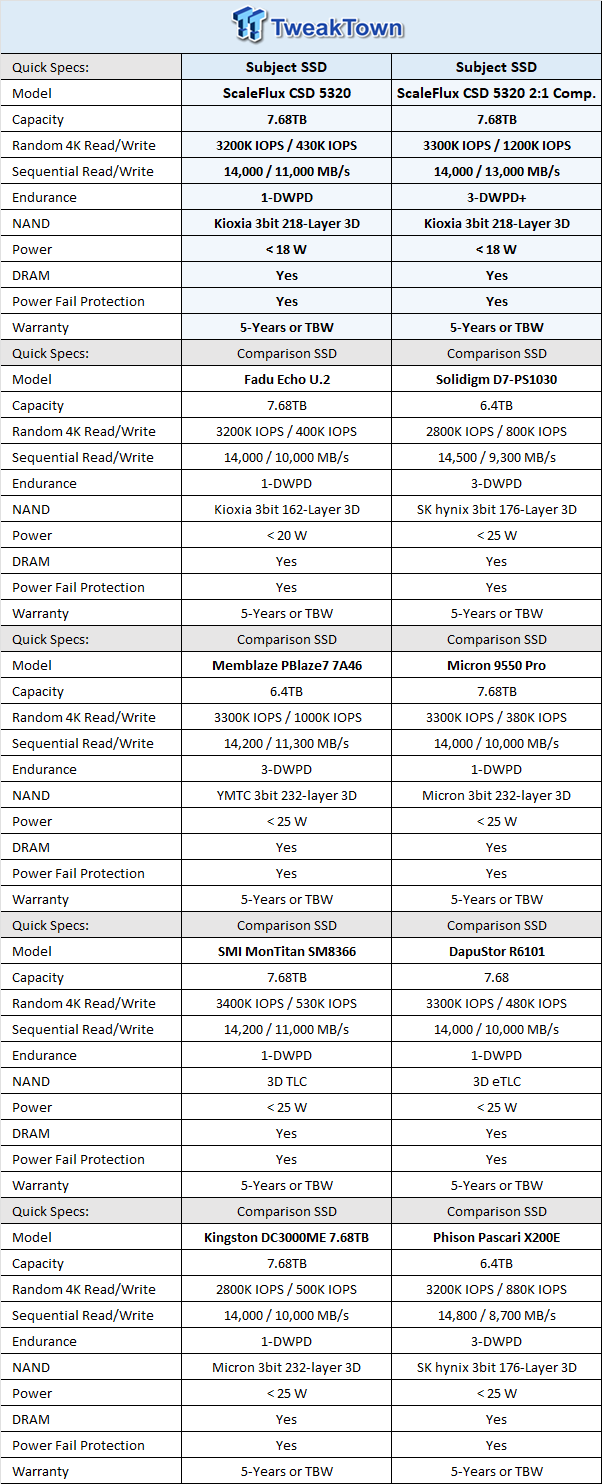
After making huge inroads with its PCIe Gen4 computational SSD, better known as the ScaleFlux CSD 3000 Series, the company is back again to make some more noise, this time at PCIe Gen5 speeds. The CSD 5320 is a PCIe Gen5 x4 SSD with integrated data compression and decompression engines, which the company claims can deliver up to quadruple the capacity and double the performance of traditional solid-state storage.
At the heart of the device is ScaleFlux's custom SFX 5000 storage processor built with ARM processors and dedicated hardware acceleration engines. Mixed workloads consisting of compressible data are what the CSD 5320 is made for. ScaleFlux claims that its 7.68TB CSD-5320 can sustain a 4K 70/30 2:1 compressible data workload at up to a whopping 1.8 million IOPS. That's approaching double the performance of most 1-DWPD Gen5 SSDs, and beyond anything we've ever extracted from any 3-DWPD SSD. Incredible.
Think of it. The capacity advantage of a 1-DWPD SSD with the capability of outperforming a 3-DWPD SSD. And that's just the beginning. If the data you deal in is compressible, and there is a good chance it is, a single CSD 5000 SSD can store the equivalent of up to 4x the capacity of conventional SSDs. Then there is the drive's efficiency advantage. Improving drive-level performance helps with system-level power efficiency; the drives themselves are designed with performance per watt in mind. CSD 5000 Series SSDs can achieve over 1.5x the reads per watt and over 3x the writes per watt of many of the PCIe Gen5 SSDs from leading vendors.
And finally, there is the endurance advantage that computational storage brings to the table. ScaleFlux's proprietary data compression technology can not only deliver performance and efficiency at a higher level, but when dealing with compressible data, can deliver endurance of up to 6X more than similar capacity SSDs.
So, the question becomes singular in nature as we see it; just how compressible are my datasets? Well, ScaleFlux can help you determine this easily with its Online Compression Calculator tool. With it, you can get a visual perspective of what a ScaleFlux SSD can do for your enterprise, relative to performance, endurance, and NAND use.

Best Deals: Samsung 990 EVO Plus 4TB SSD
Price Trend:
Prices last scanned 2 hours and 48 minutes ago

7 days ago: $579 USD30 days ago: $589.99 USD
7 days ago: $1098.76 CAD30 days ago: $961.43 CAD
7 days ago: £54930 days ago: £549

7 days ago: $129930 days ago: $1449

Specs/Comparison Products
| Item | Details |
|---|---|
| Model | ScaleFlux CSD 5320 7.68TB |
| MSRP | NA |
| Model Number | CSDF1UDG76 |
| Interface | PCIe Gen5 x4 |
| Form Factor | E3.S |
| Sequential BW | Up to 14,000 MB/s |
| Random IOPS | Up to 3300K IOPS |
| Warranty | 5-Years Limited |
ScaleFlux CSD 5320 7.68TB PCIe Gen5 x4 E3.S SSD


The CSD 5000 drives will be available in U.2, E3.S, E1.S, and E1.L form factors with capacities ranging from 4TB to 128TB of physical NAND. Users can leverage the capacity expansion feature and NVMe commands to store up to 4x the physical capacity of data (capped at 256TB of effective capacity) per drive.
Our Latest SSD Review Coverage
- KIOXIA CM9-R 15.36TB E3.S Enterprise SSD Review - Performance King at 1-DWPD
- Micron 6600 ION 245.76TB Enterprise SSD Review - Best in Class Programming Speeds
- Memblaze PBlaze 7 7A40 Ocean 61.44TB Enterprise SSD Review - Oceans of QLC at 3.3 million IOPS
- KIOXIA CD9P-R 7.68TB E3.S Review - The Best-In-Class Data Center SSD
- DapuStor Roealsen6 R6060 E1.L 245.76TB SSD Review - Massive Capacity with Fast Retrieval
Feature sets include: NVMe 2.0b, OCP 2.0, OCP Telemetry logging, Latency Monitoring, Flexible Data Placement (FDP - 1000 reclaim units), Zoned Namespaces (ZNS), Dual-port, TCG Opal, Self-encrypting drives (SED), AES-256 encryption, Key Per IO, Transparent data compression/decompression, NVMe Thin Provisioned Namespaces, Capacity expansion, Endurance multiplier, and other standard data center SSD features.
The drive we have in hand is a 1-DWPD design, E3.S form factor, 7.68TB in capacity, Kioxia BiCS8 TLC arrayed, and 16-channel controlled. This configuration is rated for up to 3.3 million IOPS and up to 14 GB/s sequential throughput. ScaleFlux SSDs are compatible with major operating systems such as RHEL, SLES, CentOS, Ubuntu, Windows Server, and VMware ESXi.
Test System Specs & Enterprise Testing Methodology
Enterprise SSD Test System
| Item | Details |
|---|---|
| Motherboard | ASUS Pro WS W790E-SAGE SE (Buy at Amazon) |
| CPU | Intel Xeon w7-2495X (Buy at Amazon) |
| GPU | GIGABYTE GeForce GTX 1650 (Buy at Amazon) |
| Cooler | Alphacool Eissturm Hurricane Copper 45 (Buy at Amazon) |
| RAM | Micron DDR5-4800 RDIMM (Buy at Amazon) |
| Power Supply | be quiet! Dark Power Pro 12 1200W (Buy at Amazon) |
| Case | PrimoChill's Praxis Wetbench (Buy at Amazon) |
| OS | Ubuntu 24.04.1 LTS |
A special thank you goes to Allyn Malventano, without whose help, we wouldn't be where we are with our Linux-based Enterprise SSD testing platform.
Testing Methodology
TweakTown strictly adheres to industry-accepted Enterprise Solid State Storage testing procedures. Each test we perform repeats the same sequence of the following steps:
- Secure Erase SSD
- Write the entire capacity of SSD 2x (2 loops) with 128KB sequential write data, seamlessly transition to the next step (sequential testing skips step 3)
- Precondition SSD by filling the drive twice with 4K or 8K random writes
- Run test-specific workload with a 30-second ramp up for 5 minutes at each measured Queue Depth, and record average result
Benchmarks - Sequential
128K Sequential Write/Read

We precondition the drive with 100 percent sequential 128K writes at QD256 using 1-thread for 2-drive fills, receiving performance data every second. We plot this data to observe the test subject's descent into steady-state and to verify steady-state is in effect as we seamlessly transition into testing at queue depth. A steady-state is achieved after 1-drive fill. Average steady-state 128K sequential write performance at QD256 is approximately 9,300 MB/s.


The CSD 5320 Series is factory spec'd for up to 11,000 MB/s when being programmed with 128K non-compressible sequential data. We don't know what capacity point this up to figure is derived from, but we are pretty certain it's not the 7.68TB model. We are hitting 9,300 MB/s with our configuration, which is plenty good enough for our liking.
Now, when we swap to compressible data, the computational storage device switches gears and delivers a jaw-dropping 13.1 GB/s. This is by far the highest sustained sequential write throughput we've ever seen from any enterprise SSD. Incredible.


Here, the drive is factory spec'd for up to 14,000 MB/s 128K sequential read throughput. We are hitting up to 14,741 MB/s. Excellent. Here again, compression delivers an advantage. When the data being served to the host is being decompressed on-the-fly, performance gets significantly better. Additionally, we note that full throughput is achieved at QD16, which is a first for any TLC arrayed SSD we've encountered to date.
Benchmarks - Random
4K Random Write/Read

We precondition the drive using 100 percent random 4K writes at QD256 for 2-drive fills, receiving performance data every second. We plot this data to observe the test subject's descent into steady-state and to verify steady-state is in effect as we seamlessly transition into testing at queue depth. A steady-state is achieved after 1-drive fill. Average steady-state 4K random write performance at QD256 is exactly 375K IOPS. Consistency here is the best we've ever seen from any SSD at any time. Amazing.


The CSD 5000 Series is spec'd at up to 430K IOPS with non-compressible data. Again, we don't know which capacity point will deliver this, but we are pretty certain it's not our 7.68TB model, where we are getting a rock steady 375K IOPS. We love what the drive is giving us at QD1, where it is cranking out the second most we've encountered to date.
And now for the good stuff. When we swap over to compressible data, our test subject again switches into high gear, leaving not only every 1-DWPD SSD in the dust, but it also bests all the most powerful 3-DWPD SSDs currently in circulation. Over 1-million steady-state IOPS coming from a 7% overprovisioned SSD is hard to believe, but there it is right in front of our eyes. Unprecedented.


Factory spec here for non-compressible data here is up to 3,200K IOPS at QD512, which is exactly what we are getting. However, much more impressive is how the drive gets there. It is the best performing of its kind at queue depths of up to 128 that we've ever encountered. And it doesn't matter if it's non-compressible or compressible data, the CSD 5320 outperforms them all and does so where arguably performance matters most - low queue depths.
4K 7030


Mixed workloads are where our test subject is most at home, especially when the workload consists of compressible data. If the data is compressible, then nothing else is even close to our CSD 5320 7.68TB computational storage device. It even demolished all 3-DWPD SSDs currently in circulation. Astounding.
Additionally, we again note that even with non-compressible data, our test subject is still delivering better performance than anything appearing on this chart at queue depths of up to 8.
4K 5050


As we add more programming into the mix, our test subject responds with an even better performance curve if the data being digested is compressible. If that data is instead non-compressible, our 7.68TB contender still beats them all at QD1-2, and all but one of the competition up to QD8, which is again in many cases where performance matters most. The compression advantage is becoming crystal clear.
8K Random Write/Read

We precondition the drive using 100 percent random 8K writes at QD256 for 2-drive fills, receiving performance data every second. We plot this data to observe the test subject's descent into steady-state and to verify steady-state is in effect as we seamlessly transition into testing at queue depth. A steady-state is achieved after 1-drive fill. Average steady-state 8K random write performance at QD256 is exactly 187K IOPS. Again, consistency here is the best we've ever seen from any SSD at any time.


We expect 8K random to track pretty much the same as 4K random here, just at a lower IOPS rate because it's moving twice the amount of data. Our test subject delivers exactly half of what we saw at 4K. When the data is non-compressible, the drive delivers extremely well at QD1, which is again a very important performance metric.
Switching over to compressible data, we see exactly what we saw at 4K with our test subject delivering more than any flash-based SSD we've ever encountered. Hard to believe a 1-DWPD SSD can do this, but again, our chart delivers the proof. Impressive.


Here, its performance with pure 8K random reads is about average, which is plenty good enough for our liking.
8K 7030


8K 7030 is representative of a common database workload. Database workloads typically consist of data that is compressible. If this is the case with your database workload, then as you can see, a CSD 5000 series SSD can deliver more than anything else we've encountered to date. This is a demonstration of efficiency at a higher level. More performance per watt, more data per gigabyte equals what is likely the best TCO proposition we've ever seen.
8K 5050


Again, as we add more programming into the mix, our test subject responds with an even better performance curve if the data being digested is compressible. 900K IOPS here is insanely good.
Final Thoughts

Is computational storage the new frontier? If your datasets are compressible, there is no question that your enterprise will massively benefit from ScaleFlux's proprietary technology. In certain use case scenarios, we are of the opinion that you'd be crazy not to employ ScaleFlux storage. Efficiency translates directly to profitability, does it not? A 7% OP SSD that can deliver up to 6-DWPD endurance, along with the highest mixed workload performance of any PCIe Gen5 TLC arrayed SSD, higher even than that of every 27% OP SSD, is like nothing else we've ever seen. Again, if your data is compressible.
ScaleFlux computational storage is like nothing else out there and, as such, has earned our highest award. Editor's Choice.