
Our Verdict
Pros
- Bargain pricing
- Single-sided design
- Power efficient
- Real-world performance
Cons
- None
Should you buy it?
Introduction & Drive Details
Currently, Sandisk BiCS 8 flash is the top-performing flash on the market. BiCS 8 - specifically Sandisk BiCS 8 - powers the two top spots on our user experience ranking chart:
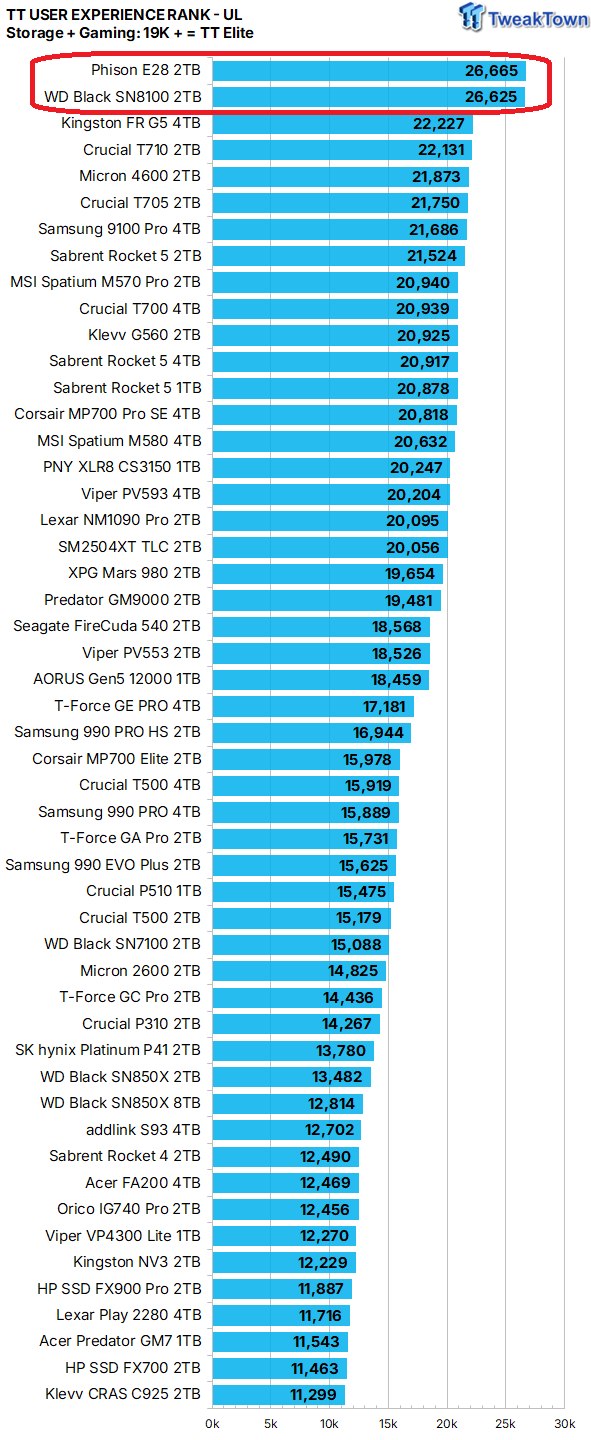
To prove our assertion, we can compare the T710 and the WD_BLACK SN8100. Both are powered by the very same SM2508 controller. The difference between the two comes down to the flash, with the T710 being arrayed with Micron G9 flash and the SN8100 being arrayed with Sandisk BiCS 8 flash. With the flash being isolated as the only significant difference between those two flagship performers, BiCS 8 is yielding a whopping 20% more real-world performance. Amazing.
And to break it down even a step further, the BiCS 8 arrayed Fury Renegade G5 that's currently sitting in third place as shown on the above chart; that drive is also powered by the same SM2508 controller as the SN8100, however, there is yet another difference, one that seemingly should not make a difference, but it absolutely does. The difference? Kioxia BiCS 8 vs. Sandisk BiCS 8, with Sandisk being the better-performing BiCS 8.
We say all that to back up our assertion that currently, BiCS 8, specifically Sandisk BiCS 8, is the highest performing flash in circulation, bar none. Why does this matter for the subject of today's review? The Sandisk WD Blue SN5100 is the first SSD we've encountered to be arrayed with 4-bit (QLC) BiCS 8 flash. This flash is intriguing; will it prove to be the best-performing flash in a 4-bit configuration just as it is in a 3-bit configuration? How will it compare against 4-bit Micron G9? How will it compare with Sandisk's own BiCS 8 TLC? Well, let's dive in and see firsthand what Sandisk's newest BiCS 8 arrayed value SSD can deliver.
Drive Details
| Item | Details |
|---|---|
| Model | Sandisk WD Blue SN5100 2TB |
| MSRP | $150 |
| Model Number | WDS200T5B0E-00CPE0 |
| Interface | PCIe Gen4 x4 |
| Form Factor | M.2 2280 |
| Performance | Up to 7,100 MB/s |
| Warranty | 5-Years |


Best Deals: WD Blue SN5100 2TB NVMe SSD
Price Trend:
Prices last scanned 11 hours and 29 minutes ago

7 days ago: $279.89 USD30 days ago: $279.95 USD

7 days ago: $279.99 USD30 days ago: $279.99 USD
7 days ago: $399.99 CAD30 days ago: $359.99 CAD
7 days ago: $459.25 CAD30 days ago: $392.59 CAD
7 days ago: £21930 days ago: £224.99
7 days ago: $423.09 AUD30 days ago: $423.09 AUD

Performance and endurance are both excellent, as is its 5-year limited warranty.

We will note the extremely efficient power draw here as it's the best we've seen for a QLC arrayed SSD.


When you buy a Sandisk SSD, you get the value-added bonus of free Acronis True Image software, making system migration over to your new Sandisk SSD simple and free. Additionally, Sandisk offers for free with its SSDs the Sandisk Dashboard SSD toolbox. The software helps maintain peak performance and optimization for Sandisk SSDs in Windows. Tools for checking health, firmware versions, and updates are included. Click HERE to download both.
Our Latest SSD Review Coverage
- Biwin M560 2TB SSD Review - Best Overall Retail-Ready DRAMless SSD
- Samsung 990 2TB SSD Review - Ninth Gen QLC at PCIe Gen4 Speeds
- Phison E37T SSD Controller Exclusive Preview - The Fastest DRAMless SSD Platform Yet
- Seagate FireCuda X1070 4TB SSD Review - A New Mainstream Contender
- Micron 3610 2TB SSD Review - DRAMless QLC at 11,000 MB/s
Jon's Test System Specifications
Intel Test System
| Item | Details |
|---|---|
| Motherboard | ASUS Z890 Apex (Buy at Amazon) |
| CPU | Intel Core Ultra 9 285K (Buy at Amazon) |
| GPU | MSI SUPRIM X RTX 3080 12GB (Buy at Amazon) |
| Cooler | Alphacool Eissturm Hurricane Copper 45 (Buy at Amazon) |
| RAM | Patriot Viper Xtreme 5 8000 48GB (Buy at Amazon) |
| Power Supply | be quiet! Dark Power Pro 12 1200W (Buy at Amazon) |
| Case | PrimoChill's Praxis Wetbench (Buy at Amazon) |
| OS | Microsoft Windows 11 Pro (Buy at Amazon) |
AMD Test System
| Item | Details |
|---|---|
| Motherboard | ASUS ROG Crosshair X870E APEX(Buy at Amazon) |
| CPU | AMD Ryzen 9 9950X (Buy at Amazon) |
| GPU | MSI SUPRIM X RTX 3080 12GB (Buy at Amazon) |
| Cooler | Alphacool Eissturm Hurricane Copper 45 (Buy at Amazon) |
| RAM | Sabrent Rocket DDR5 32GB (Buy at Amazon) |
| Power Supply | be quiet! Dark Power Pro 12 1200W (Buy at Amazon) |
| Case | PrimoChill's Praxis Wetbench (Buy at Amazon) |
| OS | Microsoft Windows 11 Pro (Buy at Amazon) |
Please note: We employ an M.2 AIC for testing on our Intel Core Ultra 9 285K platform.
Sony PlayStation 5 - M.2 Storage Expansion
PS5 Read Performance
With Sony's wildly popular PlayStation 5 console now enabled for M.2 NVMe SSDs to be used as fast storage expansion, we are including results for PS5-compatible SSDs we test as a part of our reviews going forward.


For SSDs that don't have an adequately sized PS5-compatible heatsink or other SSDs where the heatsink provided doesn't fit right and can be removed, we both use and recommend Sabrent's unparalleled PS5 heatsink available HERE.


We only chart SSDs that can deliver a minimum of 5,500 MB/s read, which is Sony's original recommendation.
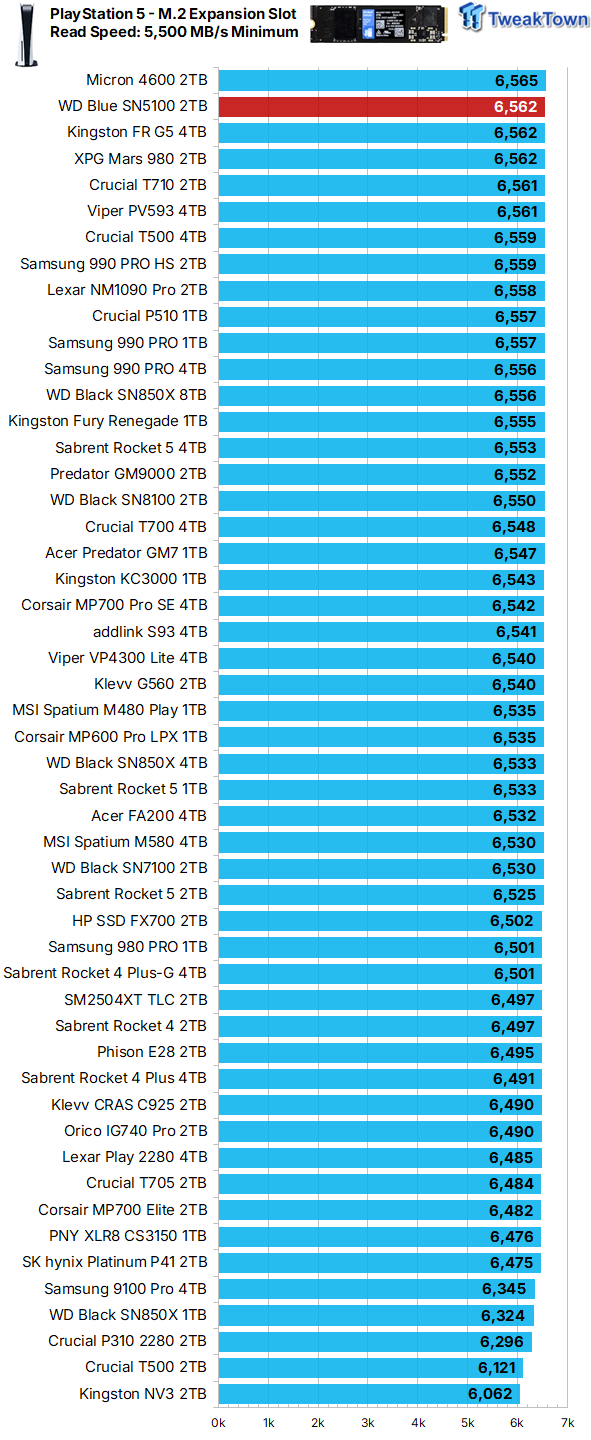
A QLC SSD delivering the second-best result here? Totally unexpected, and because the SN5100 is such a bargain, runs so cool, and delivers so well, it becomes our highest recommended SSD for PS5 storage expansion. Impressive.
Synthetic Benchmarks: CDM, Max IOPS, ATTO
CrystalDiskMark
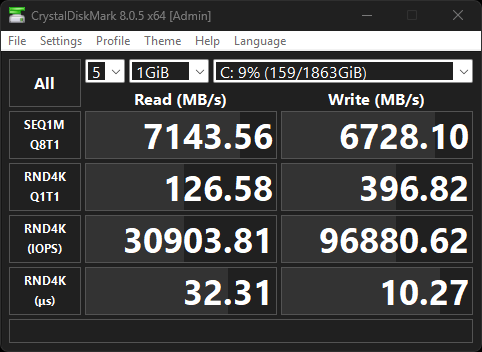
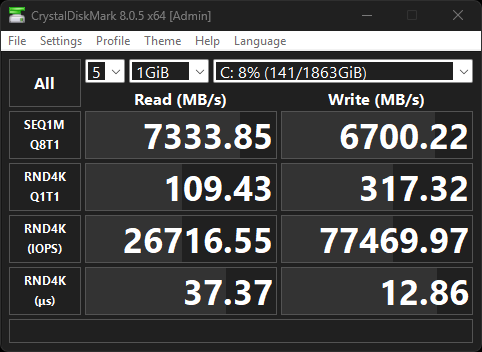
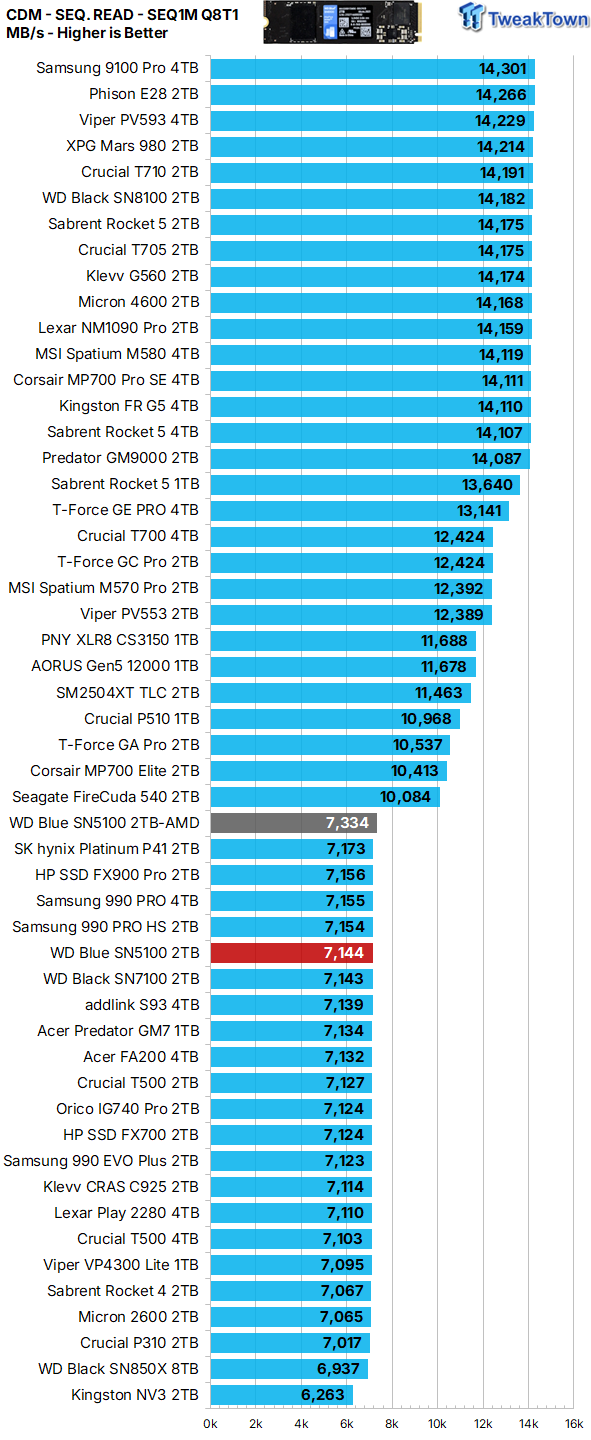
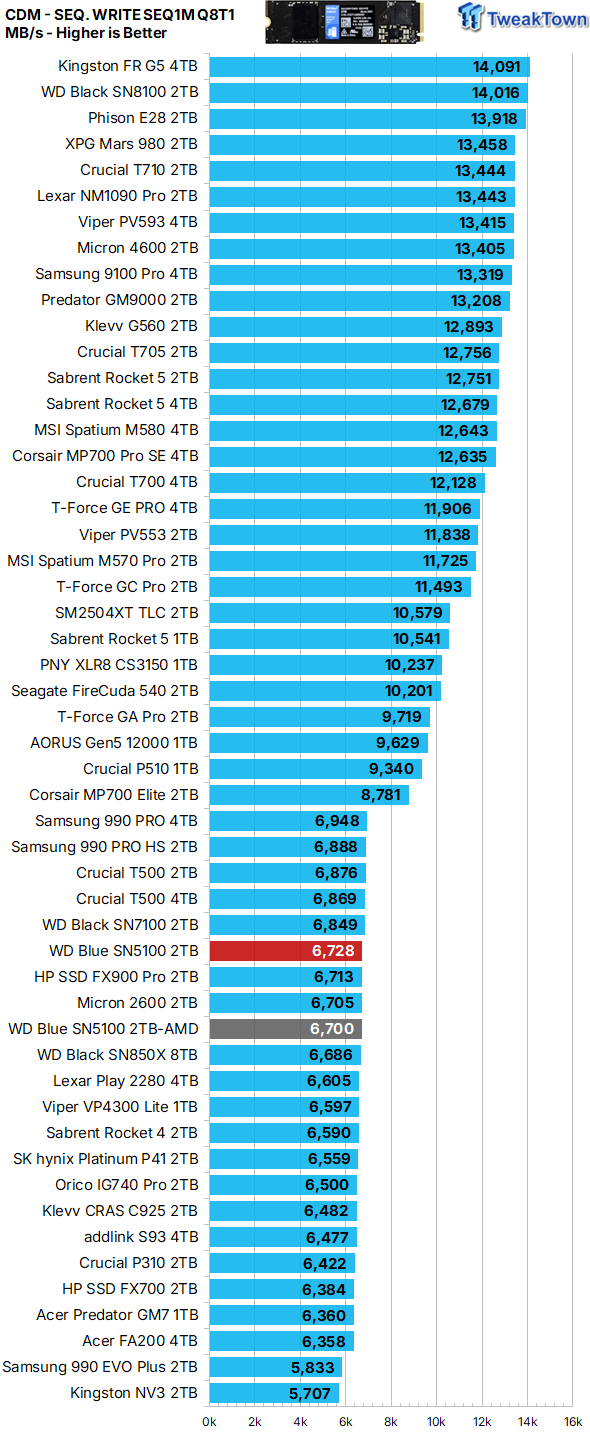
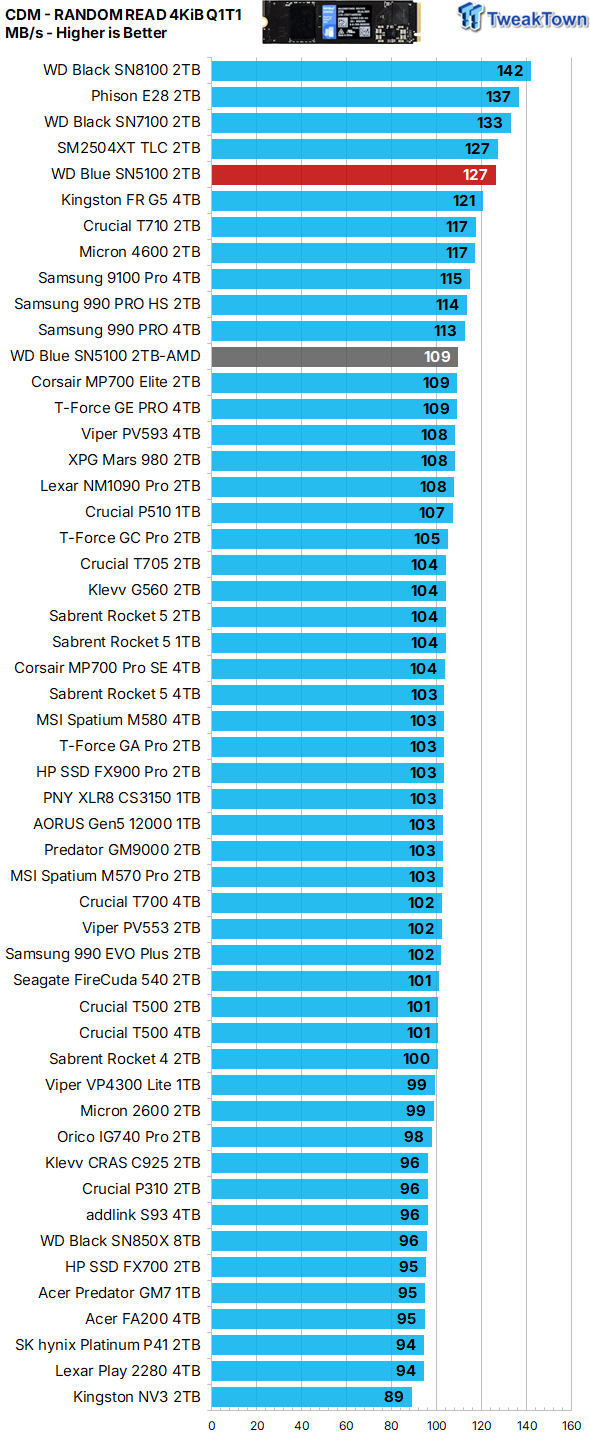
We employ CDM as our standard measurement for both sequential throughput and Q1T1 random read. We want to pay close attention to how well the SN5100 compares with the BiCS 8 TLC arrayed SN7100 and the Micron G9 QLC arrayed Micron 2600, as this will give us an excellent feel for how potent BiCS 8 QLC flash really is. In terms of sequential throughput, the SN5100 2TB delivers exactly as advertised and then some - even in our more demanding user state. Excellent.
Comparing our test subject against the SN7100 and the Micron 2600, we find the SN7100 delivering better sequential read throughput and comparable sequential write throughput. Keep in mind that controllers do play a part when directly comparing the SN5100 to the Micron 2600, but not when comparing against the SN7100, which appears to be using the same Sandisk-made Polaris 3 controller.
Moving our focus over to Q1T1 random read speed, our 4-bit BiCS arrayed contender is delivering as we've only seen coming from Sandisk BiCS 8 flash. The top 5 here, including our test subject, are ALL arrayed with Sandisk BiCS 8 flash. This is important as this performance metric is the best synthetic indicator of real-world performance, or as we call it, performance that matters.
Max IOPS
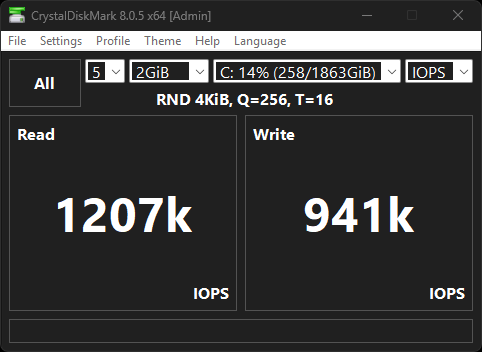
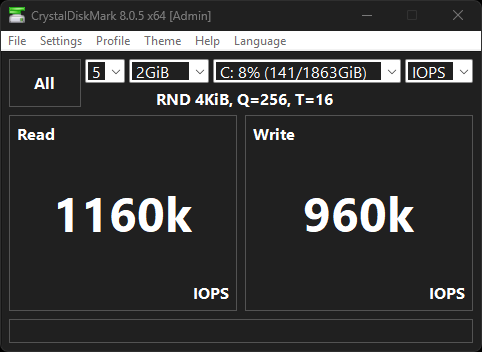
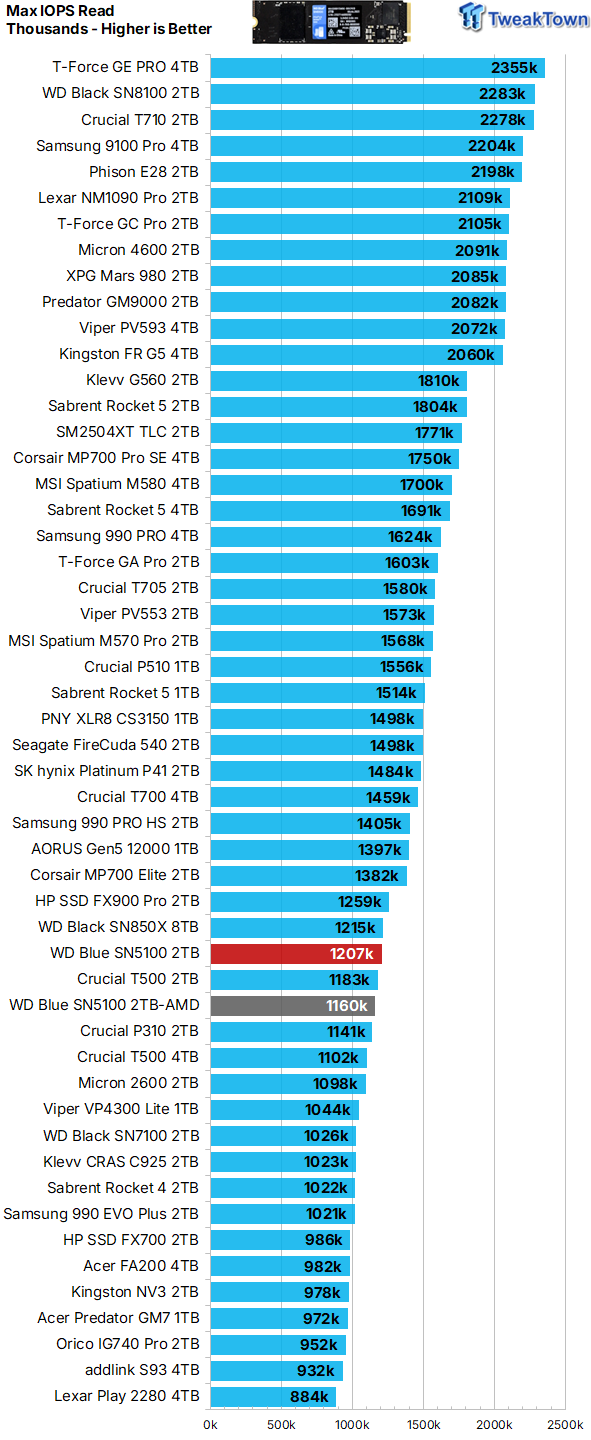
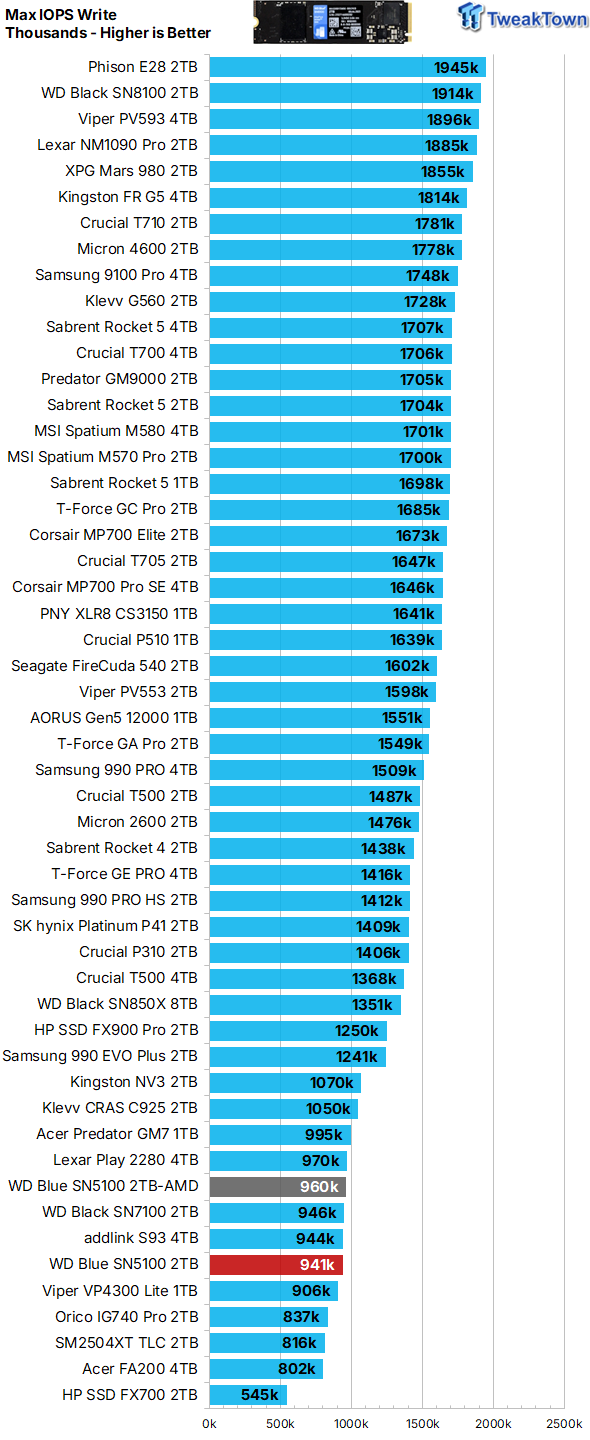
We have no issues meeting and exceeding the quoted factory max 4K random read performance specifications, even under our more demanding user state. Impressive. We can't get there on the random write side due to our user state, but we don't care about write performance, much if at all, in the consumer space. Plenty good enough for our liking here. Comparing results here with the SN7100, we find our test subject delivering a bit more than its predecessor. Compared to Micron's 2600, we find our test subject generating more on the read side, but less on the write side of the equation. Overall, a win for the SN5100.
ATTO
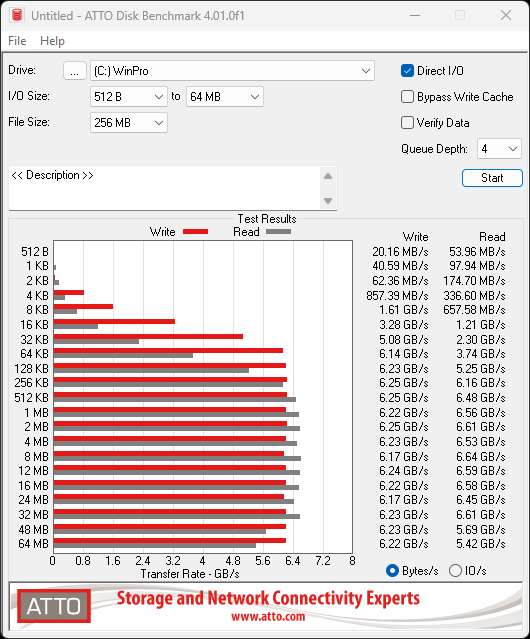
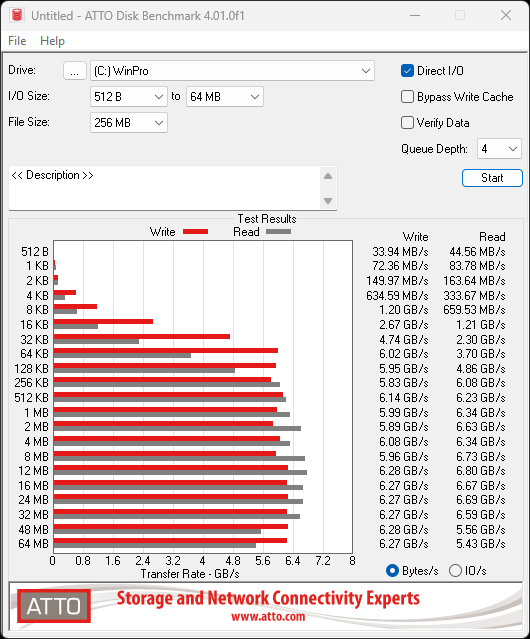
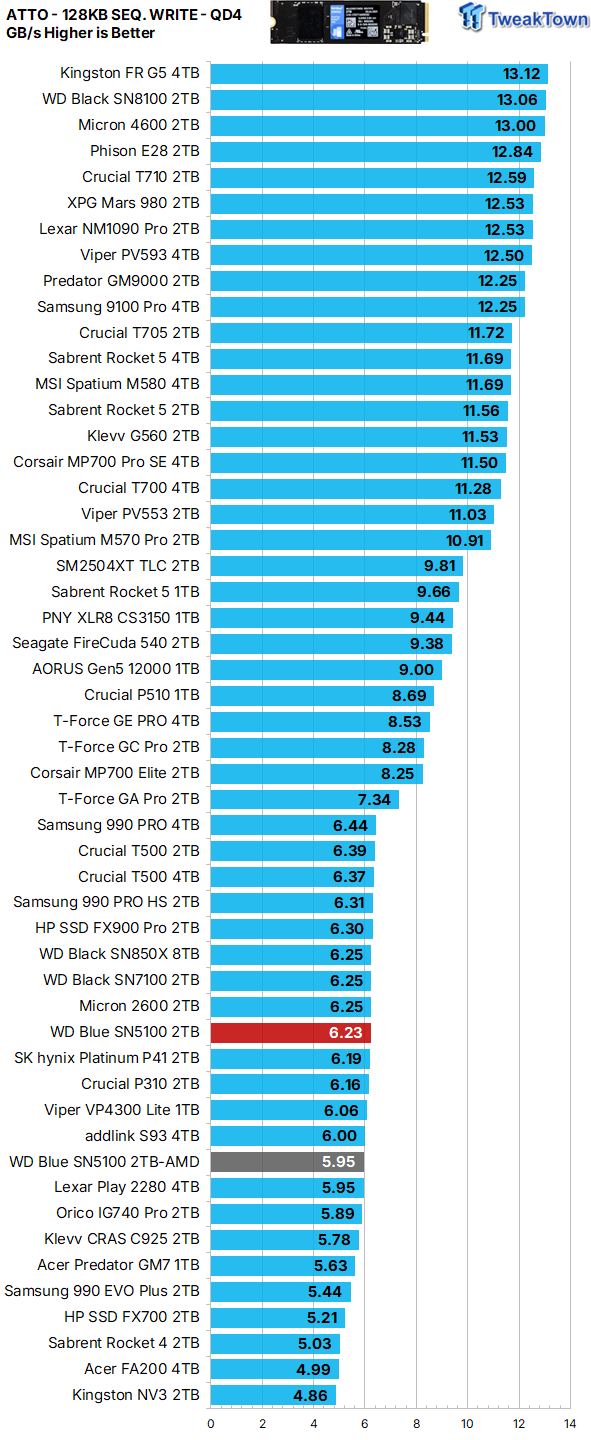
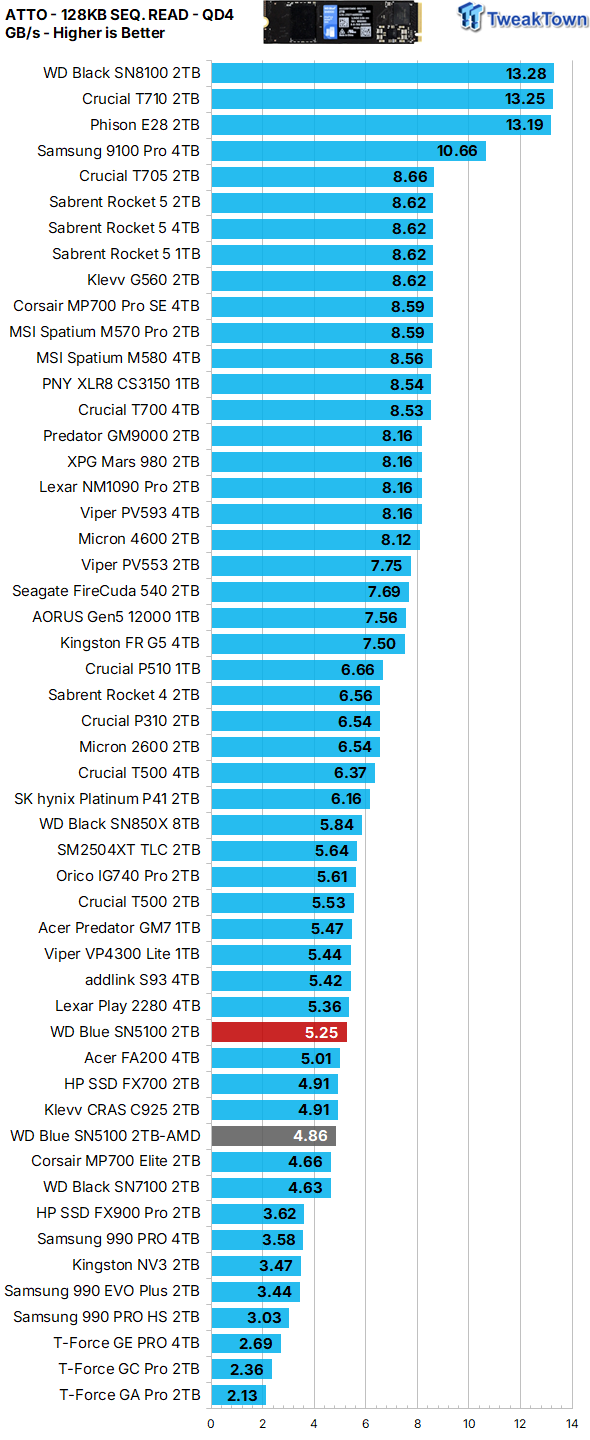
ATTO gives us a clear picture of what transfer sizes a particular SSD favors in terms of QD4 sequential throughput. We chart 128K transfers. At a queue depth of four, the SN5100 2TB favors sequential transfers of 256KB or larger when serving data to the host (reading) and 64KB or larger when programming (writing) data. Excellent small-file performance.
Real-World Testing: Transfers, 3DMark SSD Gaming Test, PCM10 Storage
Transfer Rates
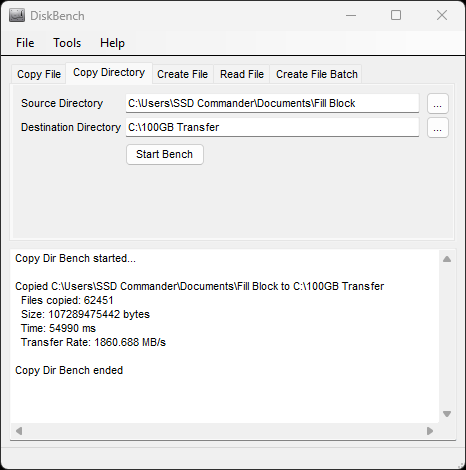
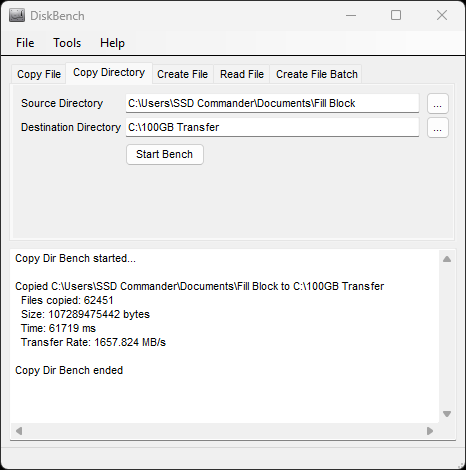
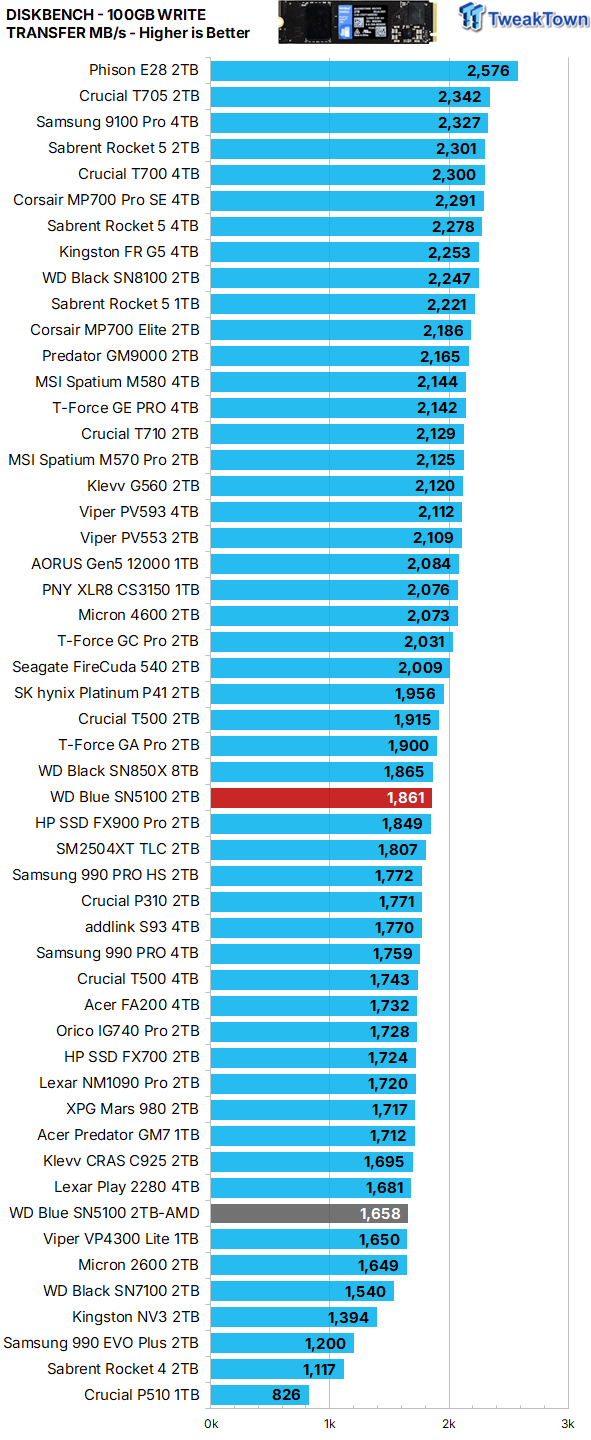
Our 100GB data transfer test is not your ordinary 100GB of data; ours is a crushing mix composed of more than 62K files. Write performance, random or sequential, is an infrequent operation, and as such, we do not consider it to be an important performance metric in the consumer space. An example is how many times a game is installed vs. how many times it's played. This is an unexpected result. Here we find the WD Blue SN5100 significantly outperforming both the WD_BLACK SN7100 and Micron 2600. Impressive.
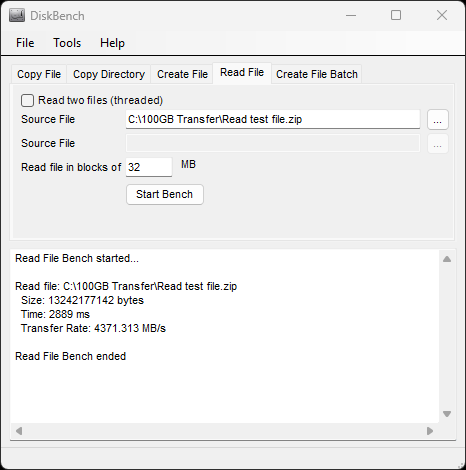
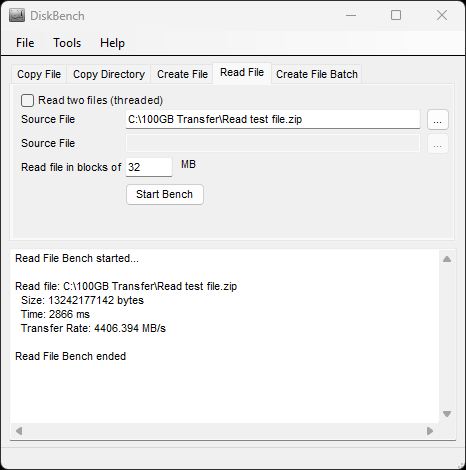
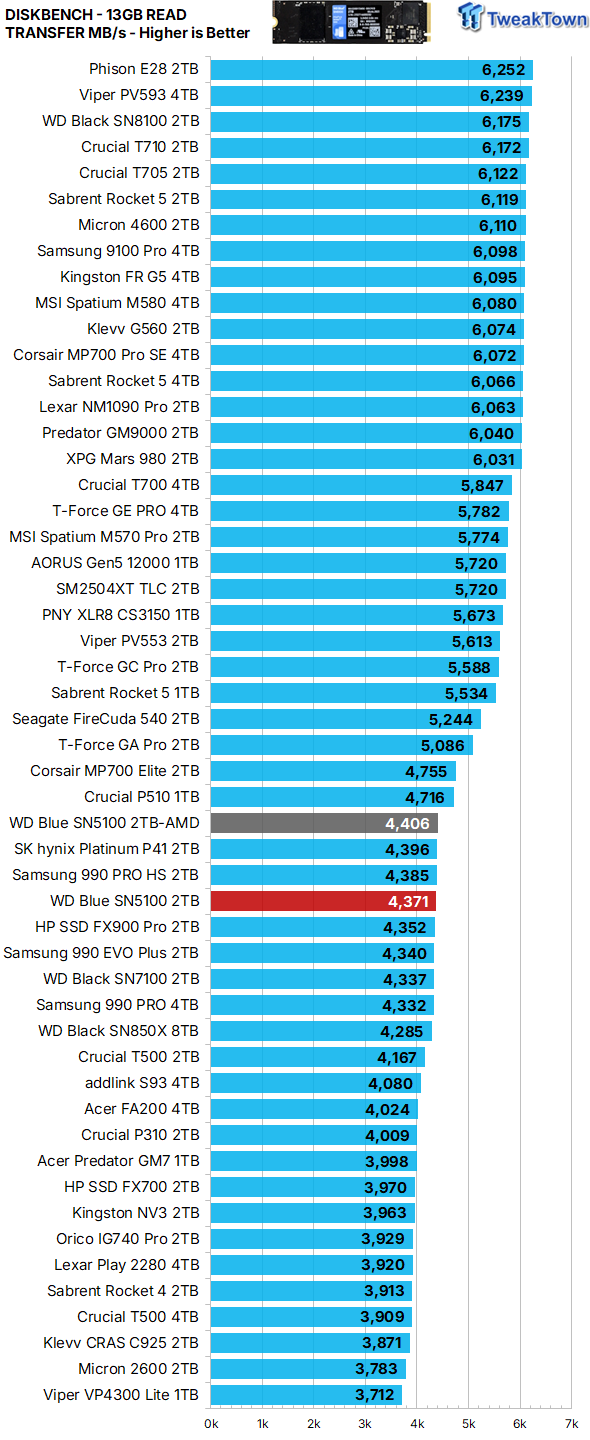
Unlike programming (writing) data, serving data to the host (reading) is typically an important performance metric as it relates to the consumer space. This is where transfer rates matter most, and we love what we see from our test subject. This is the best we've ever extracted from any QLC arrayed SSD. This is slightly better than the SN7100 and much better than the Micron 2600. Impressive. In fact, there are only two other PCIe Gen4 SSDs appearing on this chart that can deliver slightly more. Incredible.
3DMark SSD Gaming Test
UL's newest 3DMark SSD Gaming Test is the most comprehensive SSD gaming test ever devised. We consider it superior to testing against games themselves because, as a trace, it is much more consistent than variations that will occur between runs on the actual game itself. This test is the same as running the actual game, just without the inconsistencies inherent to application testing. In short, we believe that this is the world's best way to test an SSDs gaming prowess and accurately compare it against competing SSDs. The 3DMark SSD Gaming Test measures and scores the following:
- Loading Battlefield V from launch to the main menu.
- Loading Call of Duty Black Ops 4 from launch to the main menu.
- Loading Overwatch from launch to the main menu.
- Recording a 1080p gameplay video at 60 FPS with OBS (Open Broadcaster Software) while playing Overwatch.
- Installing The Outer Worlds from the Epic Games Launcher.
- Saving game progress in The Outer Worlds.
- Copying the Steam folder for Counter-Strike Global Offensive from an external SSD to the system drive.


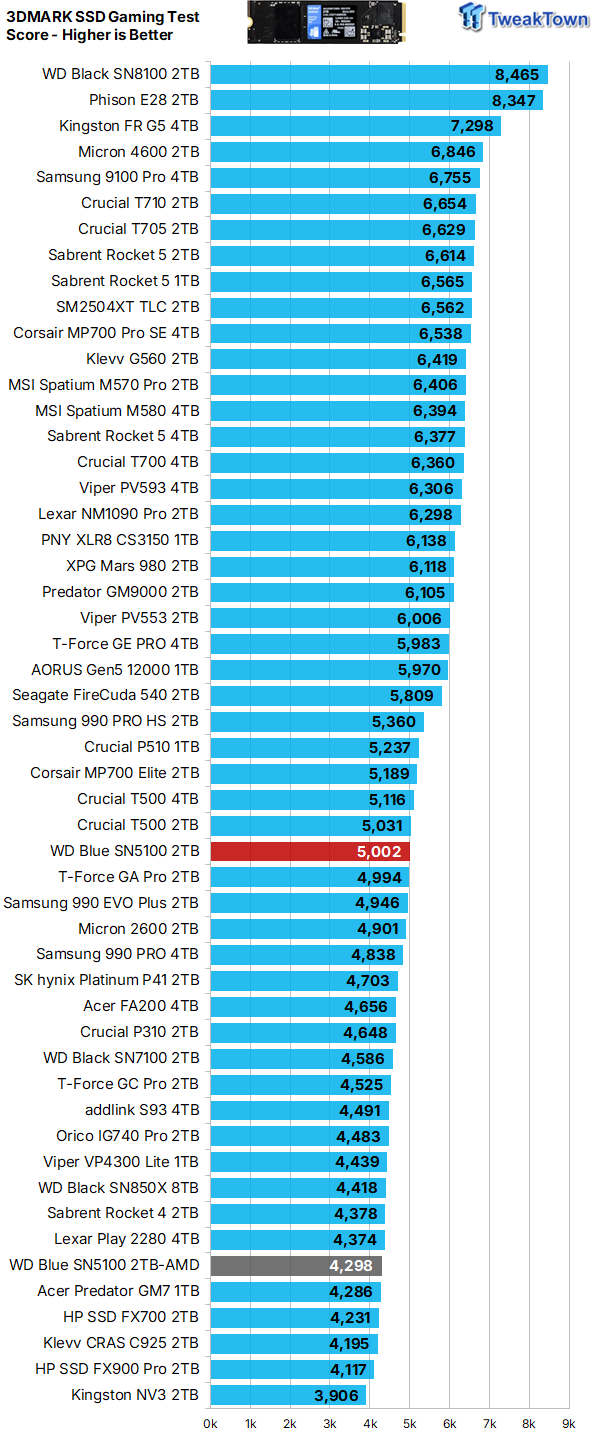
Gaming is a performance metric that matters to most DIY consumers, especially for the enthusiast crowd that TweakTown caters to. Now we've reached the point where results start to matter as they are a direct reflection of user experience.
We consider a score of 5,000 here to be somewhat of a milestone achievement for any PCIe Gen4 SSD. Incredibly, our QLC arrayed test subject delivers that milestone. This again is the best result we've ever attained with a QLC arrayed SSD. And once again, the SN5100 delivers more than both the SN7100 and the Micron 2600.
Even more impressively, the WD Blue SN5100 shows itself to be the third-best PCIe Gen4 gaming SSD we've ever encountered. This is performance that matters.
PCM10 Storage Tests
PCMark 10 Storage Test is the most advanced and most accurate real-world consumer storage test ever made. There are four different tests you can choose from; we run two of them. The Full System Drive Benchmark and the Quick System Drive Benchmark. The Full System Drive Benchmark writes 204 GB of data over the duration of the test. These tests directly correlate with mainstream user experience.
PCMark 10 Full System Drive Benchmark
This test writes 204GB of data and covers a broad range of common consumer tasks, including booting Windows 10, file transfers, Adobe and Office applications, and startup times for games such as Battlefield V, COD Black Ops 4, and Overwatch. Unlike synthetic numbers, this is comprehensive real-world data, which is why we use it to rank SSDs in terms of user experience.


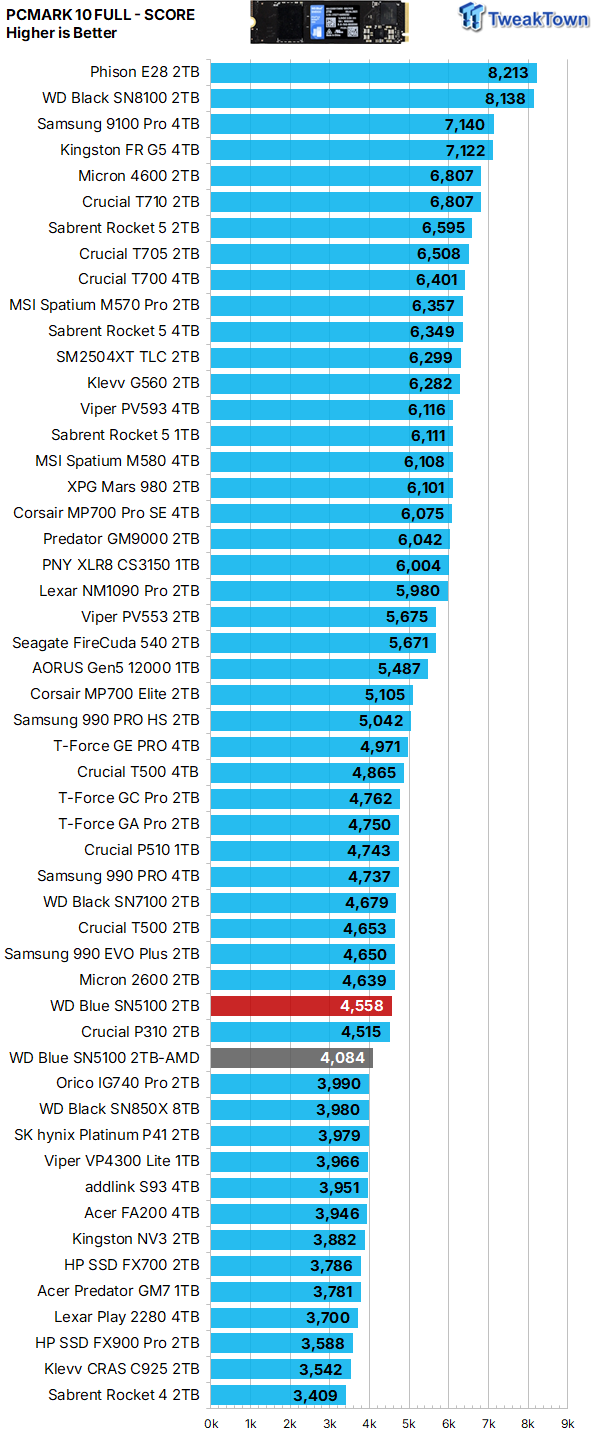
This time, our test subject is nipping at the heels of both the SN7100 and Micron 2600. Nevertheless, the WD Blue SN7100, once again, finds itself clustered in with the best PCIe Gen4 has to offer. Impressive.
PCMark 10 Quick System Drive Benchmark
The Quick System Drive Benchmark writes 23 GB of data over the duration of the test.


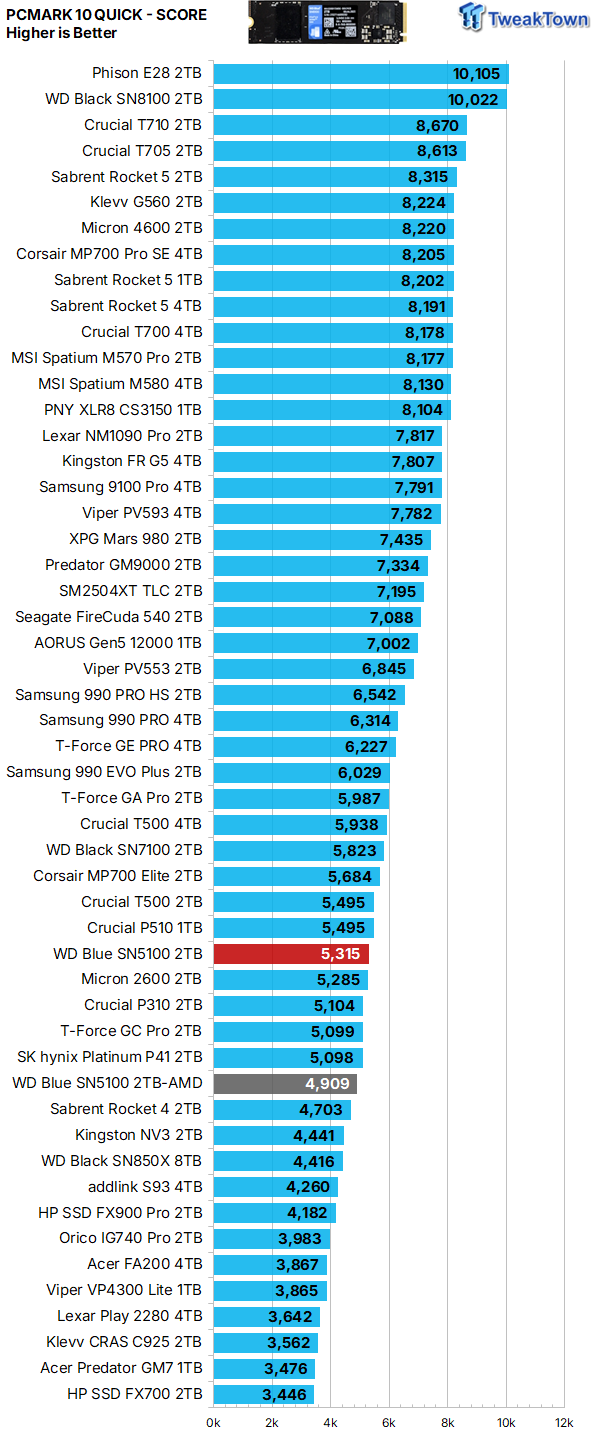
Of all the benchmarks we run, it can be argued that this one offers the best reflection of a typical consumer use case scenario. By edging out Micron's 2600 for the best ever showing for a QLC arrayed SSD, we are of the opinion that we can reasonably confirm that Sandisk BiCS 8 QLC is indeed the 4-bit flash to beat.
Final Thoughts
Sandisk's newest WD Blue is indeed the fastest and most powerful QLC arrayed SSD we've ever encountered. This BiCS 8 QLC arrayed SSD is so powerful that we consider it to be the 6th-best performing PCIe Gen4 SSD ever made. Like its predecessor, the BiCS 8 TLC arrayed WD_BLACK SN7100, it can even outperform some PCIe Gen5 SSDs using half the channels and without onboard DRAM.
Additionally, and worth noting, we are of the opinion that the Sandisk WD Blue SN5100 2TB is overall the best choice for PlayStation 5 M.2 storage expansion.
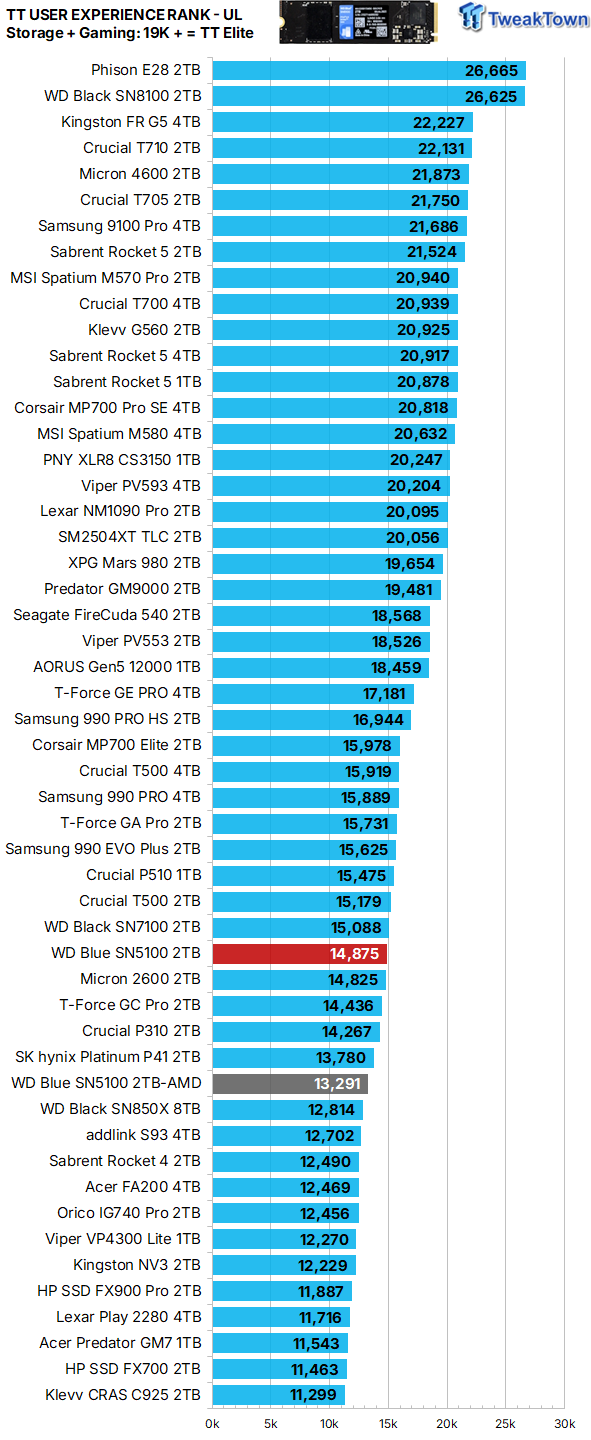
We rank SSDs in terms of overall user experience (performance where it matters most) as expressed by PCMark 10 storage and 3DMark gaming storage tests. Currently, we consider a user experience score of 19K or more to verify an SSD as a TweakTown Elite performer. We no longer consider any flash-based PCIe Gen4 SSD to be a TT Elite performer.
With a user experience score of 14,875, we can legitimately crown the Sandisk WD Blue SN5100 2TB as the best-performing QLC arrayed SSD on the planet.

This is when Blue runs like Black, earning Sandisk's WD Blue SN5100 2TB SSD our highest recommendation.