


Our Verdict
Pros
- Up to 3.4 million RR IOPS
- QOS
- Power efficiency
Cons
- None
Should you buy it?
Introduction and Drive Details
We've encountered it for several years now at various trade shows, and finally, we get to take Silicon Motion's MonTitan TLC SSD for a spin. So, what exactly is the MonTitan Platform? "Silicon Motion's MonTitan is a high-performance, user-programmable PCIe Gen5 development platform targeting the most challenging Datacenter and Enterprise SSD solutions. It is available with the production-ready SM8366 Flash controller ASIC, Turnkey and Layered Enterprise firmware, and SSD Reference Design Kits to enable customers' rapid time-to-market design, providing the best total cost of ownership (TCO)."
MonTitan Reference Design Kits (RDKs) are available in conventional NVMe and the market's first QLC-based PCle Gen5, Zoned Namespaces, FDP and Multi-Dimensional SSDs for AI Support. Each RDK is purpose-built to support Turnkey Firmware that is power and performance-optimized per application with < 25W SSD average power and < 5W Idle SSD power.
Popular Now: PS6 could be faster than the RTX 5080, claims analysis, but 80 TFLOPS math doesn't add upCurrently, the MonTitan platform is exclusively powered by SMI's SM8366 PCIe Gen5 x4 controller. Silicon Motion's flagship enterprise controller is optimized for both TLC and QLC flash, spanning across Micron, Kioxia, and YMTC dies. It's one controller to rule them all, so to speak. The SM8366 controller is enhanced with several key technologies, including "PerformaShape". Configured in FW, PerformaShape is a multi-stage shaping algorithm to optimize SSD performance on a per user-defined QoS set bases. Combined with using true HW isolation technology, the SM8366 ensures maximum bandwidth performance while maximizing user-defined individual performance elements (QOS, Latency, RR/RW, power).
Silicon Motion contends its MonTitan PCIe Gen5 platform can deliver best-in-class performance, power, and high-capacity support and that SM8366-controlled SSDs are ideal for today's datacenter challenges and emerging HPC, Edge Computing, and AI applications. The new storage platform supports NVM Express 2.0b and OCP Data Center NVMe SSD 2.5 specifications with firmware optimized for power and performance in standard form factors, including E1.S (9.5/15/25 mm), E3.x, and U.2/3.
Specs/Comparison Products
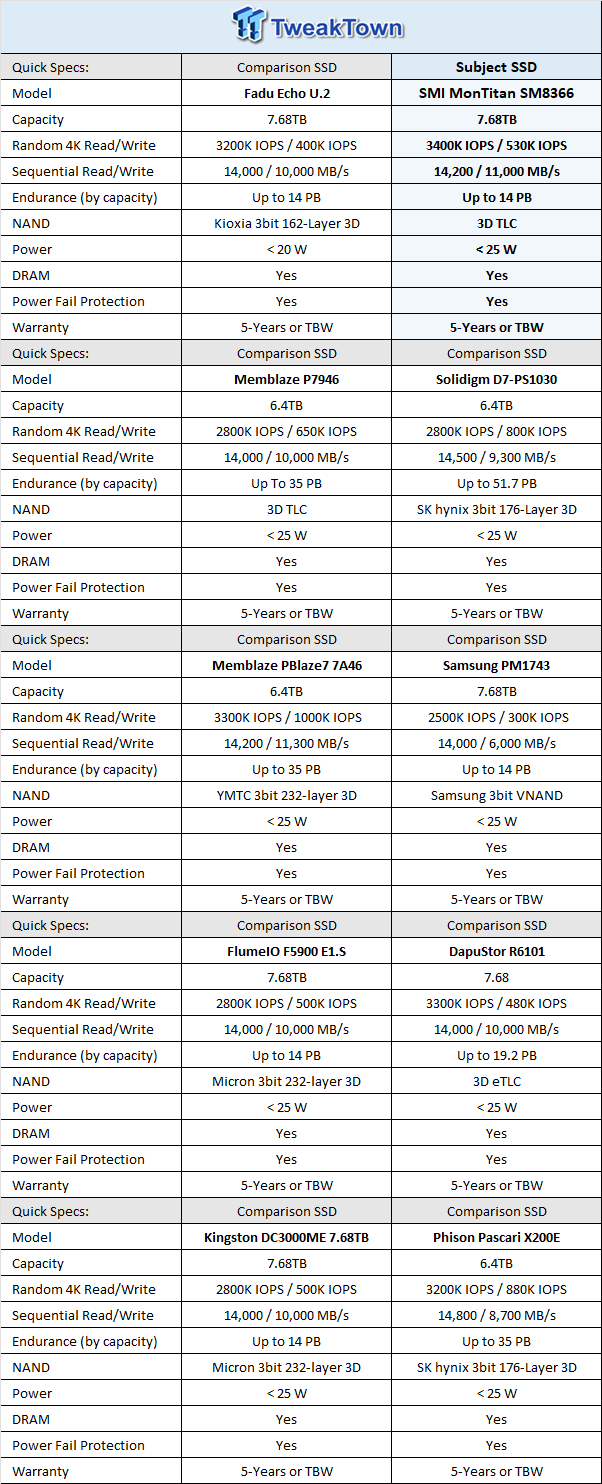
| Item | Details |
|---|---|
| Model | Silicon Motion MonTitan 7.68TB |
| MSRP | NA |
| Model Number | SMI SM8366CA |
| Interface | PCIe Gen5 x4 |
| Form Factor | U.2 |
| Sequential BW | Up to 14,500 MB/s |
| Random IOPS | Up to 3400K IOPS |
| Warranty | 5-Years Limited |
Silicon Motion SM8366 7.68TB TLC PCIe Gen5 x4 U.2 SSD


Best Deals: Samsung PM9A3 SSD
Price Trend:
Prices last scanned 3 hours and 24 minutes ago


The preconfigured drive we have in hand is a 1-DWPD design, U.2 form factor. 7.68TB in capacity, TLC arrayed, and SM8366 16-channel controlled. This particular configuration is rated for up to 3.4 million IOPS and up to 14.2GB/s sequential throughput. MonTitan SSDs are compatible with major operating systems such as RHEL, SLES, CentOS, Ubuntu, Windows Server, and VMware ESXi.
Test System Specs & Enterprise Testing Methodology
Enterprise SSD Test System
| Item | Details |
|---|---|
| Motherboard | ASUS Pro WS W790E-SAGE SE (Buy at Amazon) |
| CPU | Intel Xeon w7-2495X (Buy at Amazon) |
| GPU | GIGABYTE GeForce GTX 1650 (Buy at Amazon) |
| Cooler | Alphacool Eissturm Hurricane Copper 45 (Buy at Amazon) |
| RAM | Micron DDR5-4800 RDIMM (Buy at Amazon) |
| Power Supply | be quiet! Dark Power Pro 12 1200W (Buy at Amazon) |
| Case | PrimoChill's Praxis Wetbench (Buy at Amazon) |
| OS | Ubuntu 24.04.1 LTS |
Prior to the AI revolution, datacenter SSDs' normal operating range would typically never exceed QD32. With AI data pipeline storage being directed by GPU, high queue depth performance has become paramount. Queue depths in the thousands are now commonplace, which is why we've changed our test platform, methodology, and operating system. Our charted upper queue depth range has been revised from QD256 to QD4096 for random data and up to QD1024 for sequential testing.
Testing Methodology
TweakTown strictly adheres to industry-accepted Enterprise Solid State Storage testing procedures. Each test we perform repeats the same sequence of the following steps:
Our Latest SSD Review Coverage
- KIOXIA CM9-R 15.36TB E3.S Enterprise SSD Review - Performance King at 1-DWPD
- Micron 6600 ION 245.76TB Enterprise SSD Review - Best in Class Programming Speeds
- Memblaze PBlaze 7 7A40 Ocean 61.44TB Enterprise SSD Review - Oceans of QLC at 3.3 million IOPS
- KIOXIA CD9P-R 7.68TB E3.S Review - The Best-In-Class Data Center SSD
- DapuStor Roealsen6 R6060 E1.L 245.76TB SSD Review - Massive Capacity with Fast Retrieval
- Secure Erase SSD
- Write the entire capacity of SSD 2x (2 loops) with 128KB sequential write data, seamlessly transition to the next step (sequential testing skips step 3)
- Precondition SSD by filling the drive twice with 4K or 8K random writes
- Run test-specific workload with a 30-second ramp up for 5 minutes at each measured Queue Depth, and record average result
Benchmarks - Sequential
128K Sequential Write/Read

We precondition the drive using 100 percent sequential 128K writes at QD256 using 1-thread for 2-drive fills, receiving performance data every second. We plot this data to observe the test subject's descent into steady-state and to verify steady-state is in effect as we seamlessly transition into testing at queue depth. A steady-state is achieved after 1-drive fill. Average steady-state 128K sequential write performance at QD256 is approximately 10,800 MB/s. We note that our precon chart shows some of the best QOS we've ever seen. Impressive.


SMI specs TLC arrayed SM8366 controlled SSDs as capable of delivering up to 11,000 MB/s 128K sequential write throughput. We are getting 11,100 MB/s, so the factory spec is spot on. This is the second-highest 128K sequential write throughput we've ever extracted from any enterprise SSD. Impressive.


Here the drive is factory spec'd for up to 14,200 MB/s 128K sequential read throughput. We are hitting up to 14,692 MB/s. Impressive.
Benchmarks - Random
4K Random Write/Read

We precondition the drive using 100 percent random 4K writes at QD256 for 2-drive fills, receiving performance data every second. We plot this data to observe the test subject's descent into steady-state and to verify steady-state is in effect as we seamlessly transition into testing at queue depth. A steady-state is achieved after 1-drive fill. Average steady-state 4K random write performance at QD256 is approximately 530K IOPS. Again, its tight pattern with no outliers attests to its high QOS design.


Our TLC arrayed 7.68TB model is rated at up to 530K for 4K random write IOPS. We are getting up to 545K, so again, it's pretty much spot on. As the chart demonstrates, our test subject delivers incredibly well for a 1-DWPD SSD - among the best we've encountered to date. Impressive.


Performance here is exactly where the drive is designed to deliver. Factory spec here is up to 3,400K IOPS at QD512. We are getting exactly that at QD512 with our configuration. This the second highest for any SSD we've encountered to date with only the R6101 able to best it on the top end. However, looking at its performance curve at queue depths of up to 256, it could be argued is actually the best of the bunch.
4K 7030


Here our 7.68TB contender is delivering better at queue depths up to 32 than any 1-DWPD SSD appearing on our chart. In fact, our test subject is beating all but one of the 3-DWPD SSDs appearing on our chart. Outstanding.
4K 5050


As we add more programming into the mix, naturally 1-DWPD SSDs take a performance hit. However, our test subject is still holding its own, again delivering more than any other in its class at queue depths up to 16.
8K Random Write/Read

We precondition the drive using 100 percent random 8K writes at QD256 for 2-drive fills, receiving performance data every second. We plot this data to observe the test subject's descent into steady-state and to verify steady-state is in effect as we seamlessly transition into testing at queue depth. A steady-state is achieved after 1-drive fill. Average steady-state 8K random write performance at QD256 is approximately 270K IOPS. Again, its tight pattern with no outliers attests to its high QOS design.


We expect 8K random to track pretty much the same as 4K random here, just at a lower IOPS rate because it's moving twice the amount of data. Exactly half of what we saw at 4K. Overall, this is the second-best performance curve for any 1-DWPD for appearing on our chart. Excellent.


Again, it could be argued that our test subject has the best overall performance curve of any SSD appearing on this chart. Looking at QD128 specifically, we find our SM8366 powered contender is beating everything by 140K IOPS. Impressive.
8K 7030


8K 7030 is representative of a common database workload. No 1-DWPD SSD we've encountered can deliver more at queue depths of up to 64, which is ideal for a database, considering this workload hovers around QD32 max. Additionally, none of the 3-DWPD SSDs can deliver much more at queue depths of up to 16. This SSD is a dream come true for database applications.
8K 5050


Again, no 1-DWPD SSD can deliver more at queue depths of up to 32. Impressive.
Final Thoughts
We like what Silicon Motion has developed in its SM8366 controller as delivered by its MonTitan platform. Our test subject demonstrated clearly that it can deliver more than most of its competitors. We especially appreciate its tight, consistent and predictable IO delivery along with its ability to dominate most, if not all, of those in its class or even above at low queue depths.

As we see it, SMI's TLC arrayed 1-DWPD MonTitan SSD is an elite storage solution without a single drawback. Editor's Choice.