



Arm has announced details on its new Arm Accuracy Super Resolution, or Arm ASR, upscaling for mobile devices. Described as a 'best-in-class open-source solution,' Arm ASR is based on AMD's open-source FidelityFX Super Resolution 2 or FSR 2. Yes, Arm took AMD's FSR 2 and used the open license to create its upscaler for mobile - a significant win for AMD's focus on developing open-source tools.

In its announcement, Arm specifically mentions PC and console games as the inspiration for creating its upscaling tool for mobile devices and mobile games. With Arm ASR, it aims to address the "disparities that exist between PC and consoles" when it comes to rendering and gaming.
However, Arm has tailored the core tech for mobile to deliver more significant performance increases than standard FSR 2 while reducing the overall GPU load by up to half. Rendering on a mobile device with limited power is very different from rendering on a PC or console plugged into a wall socket.
Yes, Arm ASR runs faster and is more power efficient than standard FSR 2, as seen in the following charts.
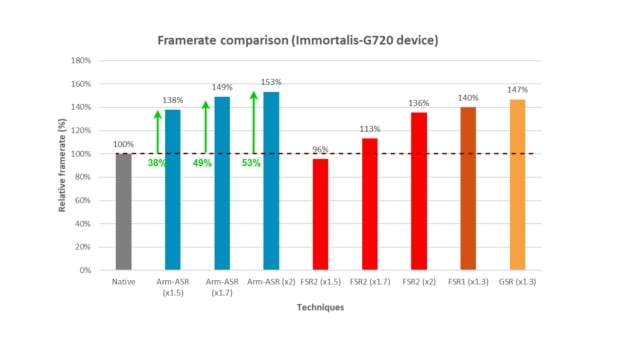
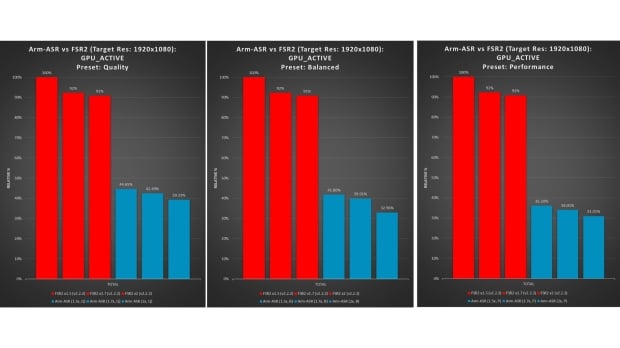
"Our starting point was AMD's FSR 2 upscaler, which produces fine results but with an implementation that is only affordable on PC and high-end consoles," Arm writes. "The excellent performance of Arm ASR is a combination of highly efficient shader code which reduced both GPU load and bandwidth requirements."
Arm ASR works much like FSR in that it takes a lower-resolution image to generate a higher-resolution one to improve a game's performance. Like FSR, ASR uses temporal data from the game to improve image fidelity and runs before post-processing and user interface rendering to maintain a clean and consistent look. ASR's temporal upscaling offers a significant improvement in image quality compared to traditional spatial upscaling methods.
It features three modes: Quality, Balanced, and Performance, and it focuses on upscaling from 540p to 1080p.