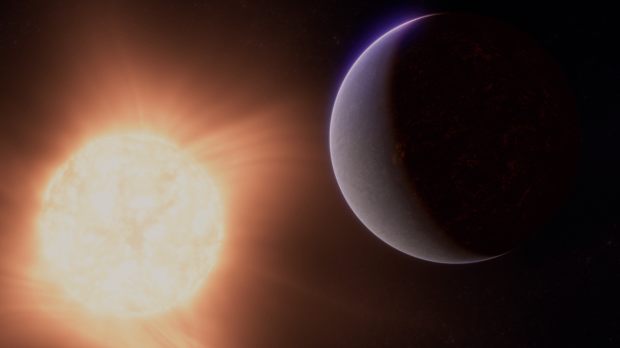




NASA has taken to its website to highlight a "rocky" planet approximately 41 light-years from Earth within the constellation Cancer.

That planet is called 55 Cancri e, and is referred to as a super-hot super-Earth exoplanet by researchers as it has a diameter twice that of Earth and has a composition similar to our planet's. As for super-hot, 55 Cancri e orbits its host star at approximately 1.4 million miles, or about one-twenty-fifth the distance between Mercury and the Sun. Due to its extremely close proximity, 55 Cancri e is believed to be tidally locked to its star, meaning only one side of the planet is facing the host star - exactly how from Earth we can only see one side of the Moon.
NASA's James Webb Space Telescope (JWST) pointed its sensitive infrared images at the planet and measured the light coming off it. By measuring the light researchers are able to determine what elements are present in the atmosphere, and the first indication 55 Cancri e could have a substantial atmosphere came from temperature measurements, or the heat energy given off in the form of infrared light.
The space agency writes that if 55 Cancri e is 1.4 million miles away from its host star its day-facing side should be covered in molten rock, have zero atmosphere and be around 4,000 degrees Fahrenheit (~2,200 degrees Celsius). However, Webb's results didn't confirm this as the space telescope's data showed reading of about "2,800 degrees Fahrenheit [~1540 degrees Celsius]".
"This is a very strong indication that energy is being distributed from the dayside to the nightside, most likely by a volatile-rich atmosphere," said Renyu Hu from NASA's Jet Propulsion Laboratory (JPL) in Pasadena, California, and lead author on the paper recently published in Nature
"We see evidence of a dip in the spectrum between 4 and 5 microns - less of this light is reaching the telescope," explained co-author Aaron Bello-Arufe, also from NASA JPL. "This suggests the presence of an atmosphere containing carbon monoxide or carbon dioxide, which absorb these wavelengths of light."
"The primary atmosphere would be long gone because of the high temperature and intense radiation from the star," said Bello-Arufe. "This would be a secondary atmosphere that is continuously replenished by the magma ocean. Magma is not just crystals and liquid rock; there's a lot of dissolved gas in it, too."
![Photo of the $10 -PlayStation Store Gift Card [Digital Code]](https://m.media-amazon.com/images/I/41MT2s0Gm2L._SL160_.jpg)