



NASA's James Webb Space Telescope may have discovered alien life on a planet located 120 million light years away from Earth, according to rumors circulating in astronomy and astrobiology groups.
A new article by Ars Technica has explained what basis the rumors are founded on and how they started to get into the public eye. According to the publication, the rumors were at least exacerbated by British news magazine The Spectator, which featured the article "Have we just discovered aliens?" The short answer to this news piece is no, but it isn't a hard no, according to scientists quoted in the article.
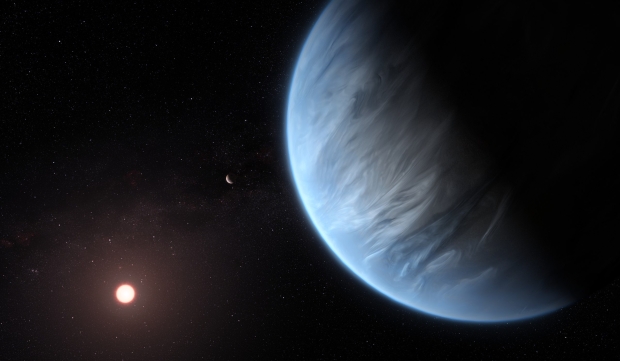
The planet that many scientists have their eyes on is K2-18 b, an exoplanet 8.6 times as massive as Earth, and is believed to be a "hycean" exoplanet, which means its rich in water having oceans as its surface and a hydrogen-rich atmosphere. This exoplanet was first studied by NASA's Hubble Space Telescope, but further analysis by Webb revealed a biosignature that many scientists are placing their bets for alien life on.
That biosignature is the discovery of a molecule called dimethyl sulfide. On Earth, this molecule is only produced by living organisms, and while Webb's instruments, capable of analyzing the atmosphere of exoplanets and determining their molecular make-up, doesn't necessarily prove that life exists outside of Earth, or at least not with definitive proof.
Ars Technica reached out to NASA to discuss these rumors, and the space agency replied as you would probably expect - asserting that no "definitive evidence" of life on an exoplanet has been found so far, but "It is anticipated that JWST observations may lead to the initial identification of potential biosignatures that could make habitability more or less likely for a given exoplanet. Future missions will be needed to conclusively establish the habitability of an exoplanet," said Knicole Colón, the telescope's deputy project scientist for exoplanet science.
Despite the rumors being shut down by NASA, some scientists remain very optimistic about the discovery of the biosignature molecule.
"I think we are going to get a paper that has strong evidence for a biosignature on an exoplanet very, very soon," said Rebecca Smethurst, an astrophysicist at the University of Oxford, as quoted by The Spectator
"Potentially, the James Webb telescope may have already found [alien life]," Peake said, as quoted by The Spectator. "It's just that they don't want to release or confirm those results until they can be entirely sure, but we found a planet that seems to be giving off strong signals of biological life."
![Photo of the $25 PlayStation Store Gift Card [Digital Code]](https://m.media-amazon.com/images/I/41cEZpeUA1L._SL160_.jpg)