









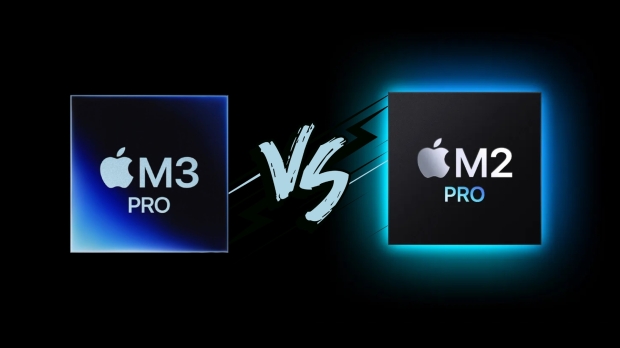




At the company's recent Scary Fast event, Apple announced new 14-inch and 16-inch MacBook Pro models that would use the brand-new M3, M3 Pro, and M3 Max chips - the first chips to hit the home PC market using the cutting-edge 3nm or N3 process node from TSMC. However, based on leaked benchmark results, the jump from M2 Pro to M3 Pro might not be worth it.
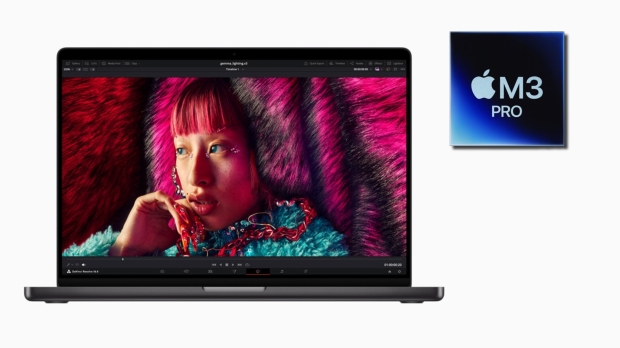
It's worth highlighting that we're only looking at a single Geekbench 6 result (spotted by the YouTube channel Max Tech), but it shows that the M3 Pro is only 6% faster than the M2 Pro regarding multi-core performance. In single-core performance, the M3 Pro is up to 14% faster than the M2 Pro - more impressive though still underwhelming results.
Is there a reason why moving to TSMC's cutting-edge 3nm process hasn't yielded more impressive results for the M3 Pro? Yes, it probably has more to do with the M3's architecture than the process itself.
- Read more: Apple's future-gen M6, M7, M8 chips in development: up to 256-core CPU, 640-core GPU teased
- Read more: Apple's new M5 MacBook Pro can't stay cool with single fan: M5 chip hits crazy 99C under load
- Read more: Samsung's next-gen Exynos 2600: 59% more efficient than Apple A19 Pro thanks to 2nm GAA process
Multi-core performance is super important in 2023, as more apps and intensive programs use multi-core processors. Both the Apple M2 Pro and the M3 Pro features feature a 12-core CPU, but the newer M3 Pro features six high-performance cores and six efficiency cores, while the older M2 Pro features eight high-performance cores and four efficiency cores. Fewer high-performance cores could be why going from 5nm to 3nm sees diminishing returns. The M3 Pro also has 25% less memory bandwidth.
That said, the M3 Max looks to be a far more impressive flagship; it doubles the high-performance core count to 12 and, according to earlier Geekbench 6 results, is up to 45% faster than the M2 Max. And when you throw in the vanilla M3 being up 20% faster than the standard MN2 chip, the M3 Pro is the least exciting chip in Apple's new M3 lineup.


 Apple's future-gen M6, M7, M8 chips in development: up to 256-core CPU, 640-core GPU teased
 Apple's flagship M4 Max processor teased, will power next-gen MacBook Pro laptops
 M4 MacBook Pro unboxed weeks before Apple's official announcement
 Cyberpunk 2077 runs at 1600p, 61FPS on MacBook Pro 16 with Apple M4 Max chip and ray tracing
 Apple M4 Pro chip has 'world's fastest CPU core': up to 14 CPU cores, 20 GPU cores, 64GB of RAM
 Microsoft warns travelers of Russian hackers hijacking hotel Wi-Fi networks to steal account credentials
 Microsoft plans to make Xbox 360 games playable on PC through the Xbox app, leaked document reveals
 GIGABYTE, ASUS, and MSI plan to raise motherboard prices by at least 50% in Q3 2026
 Arc Raiders' developer introduces new Elytra anti-cheat to The Finals for testing
 It's time to dust off GTA 5 - if you want to check out the latest easter egg hint showing what GTA 6's map will look like
 Noctua showcases one of its 'custom-built torture-test rigs' that it uses to test its fans
 More PC gamers are using GPUs with 16GB of VRAM than 8GB, according to the latest Steam data
 GeForce RTX 5070 is now the third most popular desktop gaming GPU among PC gamers
 Original Game Boy versions of Pokémon Red and Blue ported to PC with 3D voxel graphics
 TSMC is ramping up 2nm production, 100K monthly wafers by the end of 2026
 Thinkware U3000 Pro Review - Smart Dashcam with Wi-Fi quirks
 Montech TG3 Mid-Tower Chassis Review
 ASUS ROG Strix X870E-A Gaming WiFI7 Neo Review - A New Enticing Option
 Noctua NL-LC1-36 Liquid CPU Cooler Review
 Logitech G316 X 98 Wired Gaming Keyboard Review - Retro-Inspired Board that Falls a Little Short
 Biwin M560 2TB SSD Review - Best Overall Retail-Ready DRAMless SSD
 Logitech G512 X 98 Analog Mechanical Gaming Keyboard Review - An Innovative Two-in-One
 Thrustmaster T.Flight HOTAS 5 MSFS Edition Review
 SteelSeries Arctis Nova Pro Omni Wireless Headset Review - One Headset to Rule Them All
 SteelSeries Arctis Nova 7 Wireless Gen 2 Headset Review - New and Improved, But Is It Enough?
 I swapped File Explorer for this free file manager and finally got the layout I wanted
 How to tell if someone has been using your Windows PC without your permission
 6 Task Manager tips for troubleshooting Windows performance problems
 ASUS ROG's 20th Anniversary Line-up of Premium PC Gaming Gear has Arrived - Here's Everything You Need to Know
 Six File Explorer tips every Windows user should know
 I switched my PC to encrypted DNS in Windows 11, and browsing felt more private
 Printer Not Working in Windows? How to fix detection, print queues and drivers
 The Ultimate Guide to Personalizing Your Windows 11 Taskbar
 How to Turn Your Windows Laptop Into a Second Monitor with Miracast and Wireless Display in Minutes
 6 Mistakes to Avoid When Buying a Windows Laptop