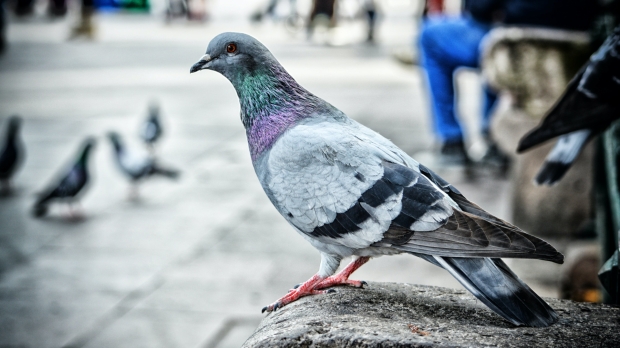





Pigeons are like AI in the way that they solve problems, some new research from The Ohio State University suggests.

How does that work? Well, the researchers previously theorized pigeons used a brute force method of tackling a problem, similar to the way current AI models work, allowing the birds to solve problems humans couldn't cope with. That method is built on associative learning and error correction.
Brandon Turner, a professor of psychology at the university, led a study in which pigeons were shown stimuli - various different lines and rings - and with each one, the bird had to peck the appropriate button to show which category it belonged to, a line or ring.
A correct answer meant food was dispensed, but if the pigeon was wrong, they didn't get any food.
Some tests were harder than others, but using their brute force trial and error method, pigeons ended up getting 95% of choices correct in the easier tests (when they started at 55% - so that was quite a leap and demonstration of learning).
In more difficult experiments, the improvement was less marked, but still clearly there, going up from 55% to 68%.
Building an AI around the two central pillars of how the pigeon's decision making worked - associative learning and error correction - gave the same results, with an AI that got significantly better over time.
Turner observed:
"We found really strong evidence that the mechanisms guiding pigeon learning are remarkably similar to the same principles that guide modern machine learning and AI techniques."
"We celebrate how smart we are that we designed artificial intelligence, at the same time we disparage pigeons as dim-witted animals. But the learning principles that guide the behaviors of these AI machines are pretty similar to what pigeons use."