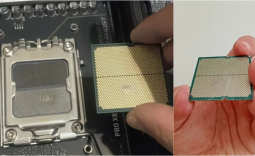
Earlier this year, we began hearing about an alarming number of AMD AM5 X3D CPUs burning out and failing - namely, the current PC gaming champ, the Ryzen 7 9800X3D. And although the failures have covered a wide range of motherboard manufacturers, it does seem that a large number of cases are tied to ASRock's motherboard line-up.

There have been several investigations into the issue, from AMD, ASRock, and independent media like Gamers Nexus, to determine the cause of the problem. The "9800X3D Failures/Deaths Megathread" on Reddit has been tracking this problem for around six months now, with the fix or preventative measure for those using a 9800X3D CPU being to ensure that they update their motherboard to the latest BIOS.
In fact, some of the CPU damage that we've been seeing has been linked to overly aggressive Precision Boost Overdrive settings. In a new interview with Quasar Zone, AMD's David McAfee and Travis Kirsch have provided an updated statement on this issue, with the company seemingly blaming motherboard manufacturers for being too lax or taking advantage of its openness to overclocking and custom Precision Boost Overdrive settings.
The following quote has been machine-translated from Korean.
At AMD, quality is very important. To this end, we work very closely with our board partners during the product and BIOS development process to ensure that the product works within specification limits, etc.
The issue is caused by some BIOSes not following the values provided by AMD. AMD's position is fundamentally that it offers the highest quality products after thorough testing.
We recommend that everyone always update their motherboard BIOS to the latest version. This is because not only additional features, but also performance improvements and solutions to problems are reflected in the BIOS.
One thing to add is that it's also one of the drawbacks of the flexibility that AMD offers. If you look at competing platforms, there is a limited number of motherboard and CPU combinations that can be used for one platform.
AMD, on the other hand, has an extensive range of combinations and supports PBO and overclocking. That is why the number of cases is very large. It is a very complex problem, but we are working closely with our partners to solve the problem and develop the platform.
It seems that AMD's recommended settings weren't being adhered to, and the complexity of the AM5 platform supporting so many CPUs exponentially increases the number of possible scenarios that could lead to failure. It'll be interesting to see if AMD implements tighter controls on overclocking for future CPUs.