






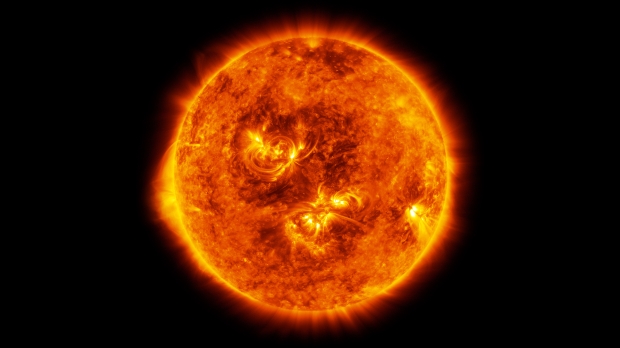




The US National Science Foundation (NSF) is celebrating the first year of the Operations Commissioning Phase (OCP) of its new Daniel K. Inouye Solar Telescope, which they describe as the world's most powerful solar telescope.
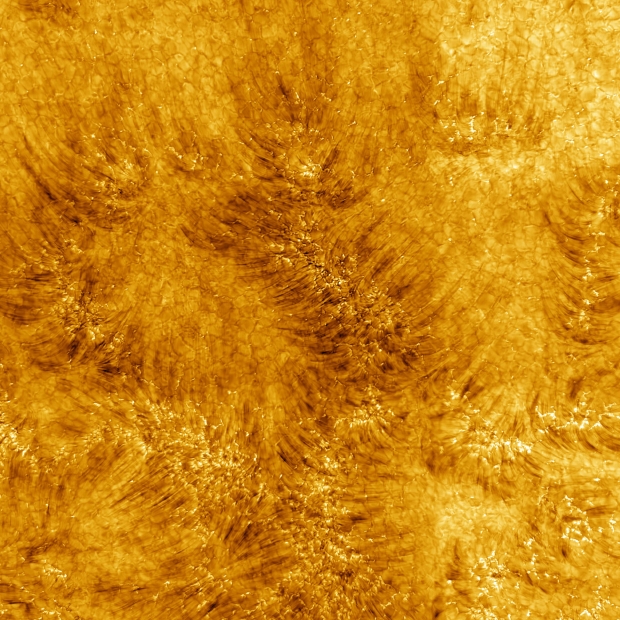
The Inouye Solar Telescope is the largest solar telescope in the world, located on culturally and spiritually significant land in Hawaii. The has released two new images to commemorate the telescope's inauguration, which represents the final stages of an investment by the NSF starting over 25 years ago to create a cutting-edge, ground-based solar observatory.
The telescope's OCP began in February 2022, and it has since worked alongside NASA's Parker Solar Probe and ESA/NASA's Solar Orbiter to make coordinated observations of the Sun. It has already gathered data for over 20 scientific proposals and is primed to continue studying the Sun for an expected 50 years at least.
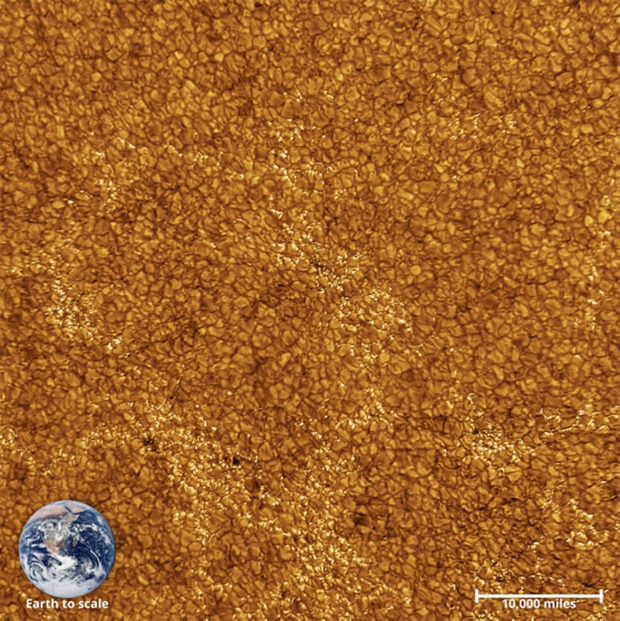
The first images to be released show the Sun's chromosphere, a region of its atmosphere just above its surface. Both photos capture a region 82,500 kilometers (51,263 miles) wide, with a resolution of 18 kilometers. Both images are available in full-size with and without the Earth for scale on the NSF's National Solar Observatory (NSO) website.
"NSF's Inouye Solar Telescope is the world's most powerful solar telescope that will forever change the way we explore and understand our sun. Its insights will transform how our nation, and the planet, predict and prepare for events like solar storms," said NSF Director Sethuraman Panchanathan.
"With the world's largest solar telescope now in science operations, we are grateful for all who make this remarkable facility possible. In particular we thank the people of Hawai'i for the privilege of operating from this remarkable site, to the National Science Foundation and the US Congress for their consistent support, and to our Inouye Solar Telescope Team, many of whom have tirelessly devoted over a decade to this transformational project. A new era of Solar Physics is beginning!" said Matt Mountain, President of the Association of Universities for Research in Astronomy (AURA).


 World's largest digital camera turns on, can spot a golf ball on the surface of the Moon
 NASA telescope photographs planet-transforming grains in deep space
 NASA confirms detection of carbon, oxygen, and iron within nearby planet atmospheres
 Cyberpunk 2077 sells over 40 million copies, 10 million more than The Witcher 3 in the same time
 PlayStation games out before 2028 can still get disc reprints
 Nintendo may raise Switch 2 prices a second time, company plotting Fiscal Year 2028 with assumption that costs will rise
 Sony limiting PS5 disc drives to 1 per person following decision to kill PlayStation physical media
 Intel confirms new price hike for Core Ultra 200S Plus CPUs, blames rising supply chain costs
 Microsoft fires shots at Sony over PlayStation disc phase out by offering free CDs through GitHub
 Sony stock up 7% following decision to terminate game disc production
 Elon Musk's SpaceX showcases Grok-powered smartphone built to reshape AI interaction
 Sony confirms PlayStation Plus price hikes aren't off the table
 Philips unveils a world's first triple-mode gaming monitor designed to be a Swiss Army knife
 KTC H49S66 5K2K (5120x1440) 49-inch 180Hz Gaming Monitor Review
 HighPoint Rocket 1604L Gen5 x16 NVMe SoftRAID AIC Review: half the price with full 59 GB/s speed
 Next Level Racing ERS3 Haptic Seat Review: immersive sim racing comfort with integrated haptics
 ASUS TUF Gaming X870-Pro WiFi7 W NEO Review - Tuffed up
 GIGABYTE GO27Q24G Gaming Monitor Review: Glossy OLED Gaming at 240Hz
 Lian Li B4-mATX Review: a compact mATX SFF case with excellent airflow and premium features
 MSI MPG 322UR QD-OLED X24 Review: A Brighter, Tougher 4K 240Hz QD-OLED for $1099
 UGREEN NASync DXP4800 GT Review: powerful 4-bay NAS with AMD Ryzen and dual 10GbE ports
 Dell XPS 14 (2026) Laptop Review - Premium Quality, Impressive Performance
 Ocypus Sigma F36 BK ARGB Cooling Fan Review: high airflow and unified design in one frame
 7 tips to organize your Windows files for faster, easier access
 Intel Arc G3 Extreme first impressions with MSI's Claw 8 EX AI+ - Incredible power for an extreme price
 How to fix Wi-Fi Adapter Not Working on Windows laptops: troubleshooting tips
 Hisense U7SG 4K TV: Modern Entertainment for the New Age
 6 underrated Microsoft Word features worth using to boost your productivity
 Level Up Your PC Gaming with these Fantastic ASUS Prime Day Deals on GPUs, Motherboards, and More
 GIGABYTE Wants to Kickstart Your New Gaming PC or Upgrade with These Limited-Time Deals
 7 Windows settings to change right after installation for better privacy, security, and performance
 I stopped Windows 11 notifications from interrupting me with Do Not Disturb, Focus, and a priority list
 7 ways to transfer data from Android to Windows PC quickly and easily