


Our Verdict
Pros
- Price point
- Half-length card
- Single-slot design
- Runs cool
- Bus powered
Cons
- High queue depths required for maximum throughput
Should you buy it?
Introduction & Drive Details
About a year ago, we spent some time with HighPoint Technologies 7604A AIC (Add-In-Card) RAID card. This card enabled up to four PCIe Gen5 SSDs over a single PCIe x16 slot, capable of delivering almost 60 GB/s sequential throughput.
HighPoint's Rocket 7604A AIC employs a Broadcom PEX89048A RAID controller along with four PCIe Gen5 x4 M.2 channels, with the RAID controller being the most expensive portion of the $999 card. While the 7604A AIC is still a great value proposition at $999 for what it is, it is still priced out of range for some who would benefit from that 59 GB/s throughput.
Priced at a much more affordable $399, the subject of this review is designed to be capable of delivering up to 59 GB/s but do so with affordability as one of its greatest attributes and additionally do so with perfect signal integrity, which is something that can be a real issue when slotting the card into a slot that is further away from the CPU. The Rocket 1604L is engineered for the 32GT/s era, where signal integrity is the primary barrier to performance. By integrating HighPoint's Active Retimer Architecture, the Rocket 1604L eliminates the physical-layer decay common in high-density PCIe expansion.
The new card provides a "Zero-Distance" data path, effectively resetting the electrical signal to its native state. Whether hosting a cluster of four M.2 AI Accelerators or high-velocity Gen5 NVMe drives, the Rocket 1604L ensures every device operates with the same deterministic latency and bit-perfect reliability as a direct, motherboard-integrated connection.
The retimer ensures 100% data integrity across all four M.2 ports. Unlike standard M.2 cards that utilize motherboard bifurcation, the retimer eliminates noise and re-transmits a clean signal to the SSDs, regardless of where it is installed. Standard cards can suffer from added latency (due to signal degradation) if they are installed into PCIe slots further away from the CPU.
Okay, let's get into this review and see exactly what the HighPoint Rocket 1604L can do for you by the numbers, keeping in mind that it is a highly specialized product not intended to be used as a typical consumer storage device. It is intended for content creation applications where higher sequential throughput equals faster data processing. As such, this will be a standalone review without comparison products or charts.

Best Deals: Rocket 1604L PCIe Gen5 x16 4X M 2 NVMe AIC Storage Expansion Card
Price Trend:
Prices last scanned 0 minutes ago


Drive Details
| Item | Details |
|---|---|
| Model | HighPoint R1604L Software RAID Card |
| MSRP | $399 USD |
| Model Number | R1604L-72C000 |
| Interface | PCIe Gen5 x16 |
| Form Factor | Single Slot Half-Length AIC |
| Performance | Up to 59,000 MB/s |
| Warranty | 5-Years Limited |


While a matching set of SSDs is always preferable, we decided to instead employ a conglomeration of four different SSD brands at 2TB capacity points to see how well we could do with this likely real-world scenario.
Our Latest RAID Review Coverage
Jon's Test System Specifications
Intel Workstation Test System

Review Q&A
Powered by TweakBot
From TweakTown's coverage of this review.
How does installing the Rocket 1604L in a PCIe x16 slot furthest from the CPU affect latency for small random I/O workloads compared with a motherboard-integrated M.2 connection?
Want something else? Ask TweakBot.

| Item | Details |
|---|---|
| Motherboard | ASUS Pro WS W790E-SAGE SE (Buy at Amazon) |
| CPU | Intel Xeon w7-2495X (Buy at Amazon) |
| GPU | GIGABYTE GeForce GTX 1650 (Buy at Amazon) |
| Cooler | Alphacool Eissturm Hurricane Copper 45 (Buy at Amazon) |
| RAM | Micron DDR5-4800 RDIMM (Buy at Amazon) |
| Power Supply | be quiet! Dark Power Pro 12 1200W (Buy at Amazon) |
| Case | PrimoChill's Praxis Wetbench (Buy at Amazon) |
| OS | Ubuntu 24.04.1 LTS |
Benchmarks: CDM, ATTO, Blackmagic, Anvil & DiskBench
CrystalDiskMark
We employ CDM as our standard benchmark for sequential throughput.
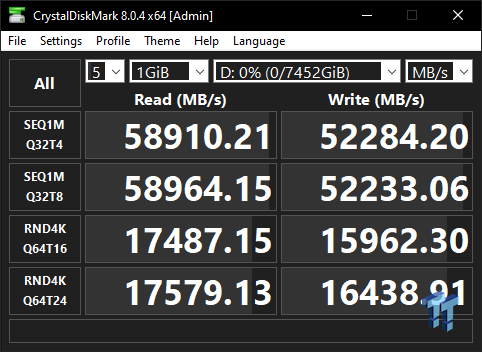
In terms of sequential throughput, we find our test subject fully capable of delivering quoted up to factory throughput specifications. At almost 59 GB/s with only 4x SSDs, the 1604L delivers sequential throughput about as good as any AIC we've ever encountered regardless of price. Impressive.
ATTO
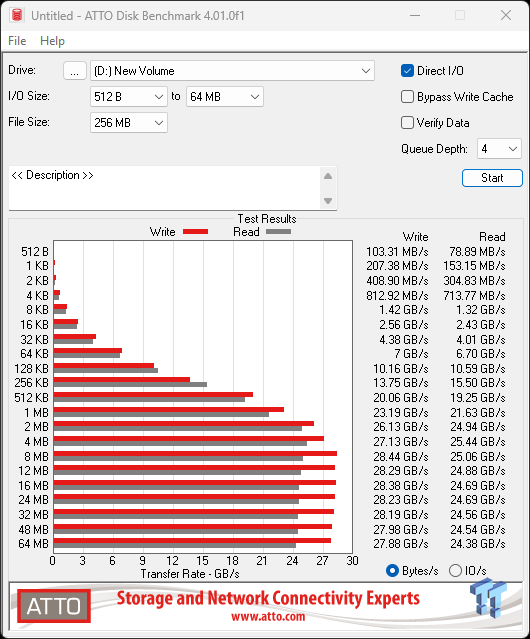
ATTO gives us a clear picture of what transfer sizes a particular SSD favors in terms of sequential throughput. With 4x SSDs, at a queue depth of four, our test subject favors sequential transfers of 4MB or larger when serving data to the host (reading) and 4MB or larger when programming (writing) data.
Blackmagic

When serving data to the host (reading) or programming it (writing), we find our test subject delivering more than 20 GB/s at low queue depths. Excellent.
Anvil's Storage Utilities

Again, further verification of more than 20 GB/s at low queue depths. Additionally, a score of 74K here is the second highest we've attained to date, second only to the RAID chip-enabled 7604A.
DiskBench - Transfer Rates
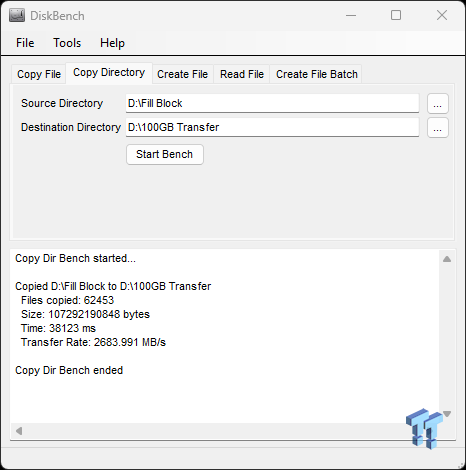
Our 100GB data transfer is composed of more than 62,000 files of random types of data, making it very hard to swallow for any storage device, especially for a sequential specialist like the Rocket 7604A. Not the type of data the Rocket 1604L is targeted at; we just wanted to see how it would handle it. Surprisingly well, all things considered.
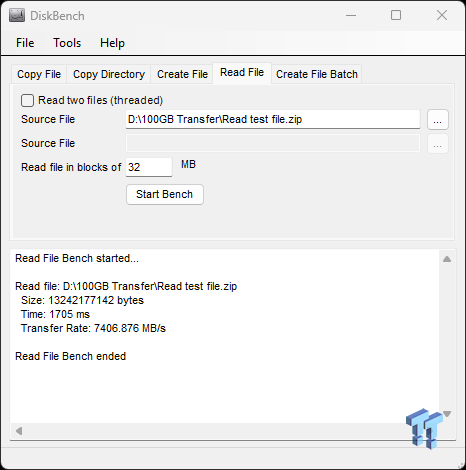
Our read transfer file is more to the Rocket 1604L's liking because it is a single zip file. However, this is a single-threaded benchmark, and that is not to the HighPoint card's liking. Despite its aversion to what we are transferring and the way we are transferring it, the 1604L still delivers very well.
Final Thoughts
HighPoint's newest is another masterpiece of engineering. A server-grade AIC that prioritizes signal integrity and at the same time delivers up to 59 GB/s sequential throughput for a mere $399. This is, to our knowledge, unprecedented across the industry.

HighPoint's Rocket 1604L Gen5 x16 NVMe Software RAID Retimer AIC delivers the full bandwidth on offer from a PCIe Gen5 x16 slot, doing so with perfect signal integrity, and as such has earned our highest award. Editor's choice.