Phison has revealed some juicy new details on the future of SSD controller technology, with future PCIe 5.0, PCIe 6.0, and PCIe 7.0 connectivity on the way.
The next-gen PCIe 5.0, PCIe 6.0, and PCIe 7.0 SSD technology was talked about during MSI's recent Insider Livestream, where Phison CTO Sebastien Jean talked about all things next-gen SSDs and PCIe tech. He said that it takes around 16-18 months to develop a brand new SSD design, while the technology and enabling for a new silicon process node starts 2-3 years earlier.
Phison says that it has begun work on low-level components for PCIe 6.0 SSDs and expects them to be here in 2025-2026, a few years from now. As for what to expect from PCIe 6.0 SSDs we can expect up to 32GB/sec from a PCIe 6.0-based SSD, up from the 14-16GB/sec we're going to see from PCIe 5.0-based SSDs with Intel's new Alder Lake and Z690 platform launching in a few days, and up from the 7-8GB/sec you get from PCIe 4.0-based SSDs.
- Read more: PCIe 6.0 specification teased: ushers in 32GB/sec SSDs of the future
- Read more: Synopsys first with complete IP solution for PCIe 6.0 tech in Q3 2021
- Read more: Phison E26 PCIe 5.0 SSD controller will power next-gen SSDs in 2022
- Read more: Phison's next-gen E26 PCIe 5.0 SSD controller: 16GB/sec read speeds
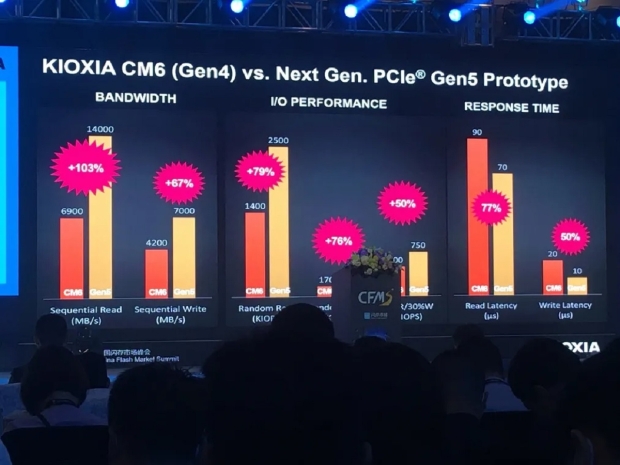
- Read more: KIOXIA teases PCIe 5.0 SSD prototype: 14GB/sec reads, pure insanity
SSDs pushing a huge 14-16GB/sec on PCIe 5.0 is going to be pretty crazy, and those dizzyingly-good speeds will have the NAND flash running very hot underneath. This means that chunky heat sinks and active cooling on PCIe 5.0 SSDs will be the new norm -- while active cooling on future-gen PCIe 6.0 SSDs will be mandatory.
The bigger upgrades for future SSDs will be that you could have a PCIe 6.0 x4 or PCIe 7.0 x4 SSD and it would be insanely fast, blowing away whatever is inside of your PC right now no matter how good (how fast) it is.
As we move towards next-gen SSDs using more power, which also generates more heat (along with the NAND flash going off its tits at huge 16GB/sec+ speeds) then active cooling becomes a thing. PCIe 5.0 SSDs will have a 14W TDP, but PCIe 6.0 SSDs ramp things up to around 28W TDP... this is nothing to a CPU or GPU, but it is a gigantic increase for SSDs and now SSD cooling will become very, very important for SSD makers.
If you didn't know already, around 30% of the heat is dissipated through the M.2 connector while 70% is done through the M.2 screw. New interfaces and slots will be used in the future, while current PCIe 4.0 SSD DRAM and controllers are fine to operate at up to 125C, but the NAND needs extremely good cooling because if it reaches 80C you're going to active the thermal shutdown.
This means that SSDs need to be chilled down to 50C, with higher temperatures resulting in reduced speeds (which would suck on a super-fast PCIe 4.0, PCIe 5.0, or super-next-gen PCIe 6.0 SSD).