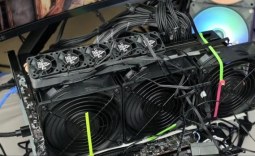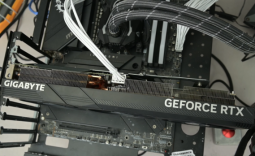


TrashBench on YouTube, known for doing crazy experiments with computer hardware, did his riskiest test yet, benchmarking a GPU cooled by nothing but water touching the GPU die itself. This "direct water cooling" method surprisingly worked and proved to be very effective, producing better temperatures than AIO liquid cooling.
To make this type of cooling solution possible, TrashBench had to create a fully custom cooling solution that wouldn't short-circuit the GPU and wouldn't let water leak onto the PCB. After a few failed tries on a dead RTX 3060, the YouTuber found a working solution featuring a 3D-printed block with adhesive sandwiched between the block and substrate to prevent water from leaking into the main PCB. Nail polish was used to protect the capacitors around the GPU from short-circuiting. After leak testing the makeshift cooling solution on the dead 3060, TrashBench conducted a cooling test on a working GTX 980 to ensure the cooling system can produce cool enough temperatures under a thermal load.
For benchmarking, TrashBench applied his makeshift cooling solution to an RTX 2060 Super hooked up to a Core i5-7600K test rig and tested the cooling solution against AIO cooling and the GPU's stock air-cooling. In Unigine Heaven, stock cooling achieved 70C, AIO cooling achieved 36C, direct water achieved 28C, and direct water with a freezer achieved 13C. Cyberpunk 2077 showed similar results with the RTX 2060 Super running cooler with direct water than on AIO cooling.
The test was so successful that TrashBench also opted to test the same "direct-water" cooling solution on the Core i5-7600K powering his test bench. This time the AIO cooler won, achieving 39C in Cinebench R23, compared to direct water, which "only" achieved 52C. Even though the cooling behavior was the opposite of the GPU results, the direct water cooling solution was more than sufficient to cool the chip.

Frequently Asked Questions
Open a question for an answer from TweakTown's coverage of this news, or ask your own below.
What specific GPUs and CPU did TrashBench test with the direct water-on-die setup?
What materials and modifications did TrashBench use to prevent short circuits and PCB leaks in the DIY block?
How did the direct water-on-die solution perform on the Core i5-7600K versus the AIO in Cinebench R23?
What differences did TrashBench note between GPU and CPU cooling effectiveness with direct fluid contact on the die?
Have a question that isn't listed here? Ask below, and TweakBot will answer it.

The YouTuber's testing shows that using cooling fluid itself to extract heat directly from a GPU die is a highly effective cooling method. Traditional waterblocks use a heatspreader and thermal paste, thermal metal, or a thermal pad to transfer heat from the GPU die to the radiator. It remains unclear if we will ever see this type of cooling solution in a retail product, but TrashBench's experiment proves it works and works best on GPUs.