










Valve has made it pretty clear that, with the success of the original Steam Deck, it was working on a follow-up. However, its position has always been that, for them to release a Steam Deck 2, the handheld would need to deliver a notable generational leap in performance rather than an incremental one. It needs to feel like a new console generation, and not the incremental updates seen in PC hardware and gaming.

With previous word from the company being that it's "hard at work" on creating the Steam Deck 2, and credible leakers stating that the company is targeting a 2028 release window (assuming hardware prices normalize by then), we've now got a small but definitely worthwhile update thanks to the recent launch of the Steam Machine.
Speaking with IGN, Valve has provided a quick update on the Steam Deck 2's development, and it sounds like the hardware is getting pretty close to being locked in.
"I'd say we're closer than we were the last time we talked," Valve Engineer Pierre-Loup Griffais tells IGN. "We're definitely getting there." However, when pressed for details, it does sound like the chips currently out aren't quite at the efficiency level Valve needs. And this is an important note because Valve has been vocal about not wanting the Steam Deck 2 to be more power-hungry than the original. In fact, it wants a generational leap in performance with the same power profile.

"I would say that the new chips that are coming out are still in power envelopes that are not quite the right segment that you'd want for a true handheld experience," Griffais added. "I think a lot of them are more low-end laptop chips or playing in that sort of form factor that are then repurposed for handhelds and maybe not leading to, I guess, the trade-off that we would've chosen in terms of power and battery life and all that."
Here, Valve is referring to chips like the Ryzen Z2 Series from AMD, and the new Arc G3 Series from Intel, which are essentially laptop APUs in PC gaming handheld form. And with that, it sounds like Valve is either developing a new custom APU with AMD that will leverage RDNA 4 or RDNA 5, or it's simply waiting for the next generation of chips that should deliver better performance and efficiency. Either way, "definitely getting there" makes it sound like everything is falling into place.


 Valve paves the way for a Steam Deck 2 gaming handheld with GeForce RTX graphics
 AMD will power Valve's unannounced Steam Deck refresh with Ryzen Z2 APU
 Valve confirms it's working on the Steam Deck 2, but it's waiting for two things
 Leaker reiterates 2028 window for Steam Deck 2, but the date is still iffy
 Valve confirms that it's 'hard at work' on the Steam Deck 2
 Diablo 4 Season 14 changes how the best items in the game work
 AMD updates FSR SDK with FSR 4.1.1 support for RDNA 3 and improved FSR Ray Regeneration 1.2.0
 Creative's new compact XF1 desktop PC speakers support Hi-Res audio
 8BitDo unveils new Nintendo 64-inspired Retro 87 Keyboard
 OLED buyer becomes victim of Amazon scam, receives broken 240Hz OLED screen instead of 540Hz OLED they initially ordered
 Google taps MediaTek to build its next Triggerfish TPU chip launching in 2027
 Samsung announces world's first UFS 5.0 chip with 10.8 GB/s read and 9.5 GB/s write speeds
 GTA 6 will feature a story chapter system like Red Dead Redemption 2
 AMD confirms Adrenalin 26.6.2 driver fails to launch on Windows 10, recommends rolling back
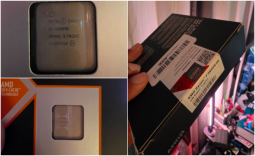 User receives Intel Core i9-10900K in sealed AMD Ryzen 7 9800X3D box from Amazon in CPU swap scam
 Dell XPS 14 (2026) Laptop Review - Premium Quality, Impressive Performance
 Ocypus Sigma F36 BK ARGB Cooling Fan Review: high airflow and unified design in one frame
 PCCooler CPS RZ820 Display Review: a flagship-level CPU air cooler with an LCD screen
 UGREEN FineTrack Mini 2 Air Tracker Tag Review - Long battery life, lesser performance
 Speed Racer (2008) 4K Ultra HD Blu-ray Review: a stunning remaster of the cult classic
 MOAIPLAY ORA PRO G1 850W ATX 3.1 PSU Review: high efficiency and 10-year warranty for $119.99
 Navman MiVue Smart True 4K Surround Dashcam Review - Seeing In All Directions At Once
 IQUNIX Magi96 Pro Aluminum Low Profile Mechanical Keyboard Review - Premium Build, Satisfying Sound
 Asetek Forte S-Series Racing Simulator Bundle Review
 Razer Pro Type Ergo Wireless Split Ergonomic Keyboard Review - Built for Comfort and Support
 Level Up Your PC Gaming with these Fantastic ASUS Prime Day Deals on GPUs, Motherboards, and More
 GIGABYTE Wants to Kickstart Your New Gaming PC or Upgrade with These Limited-Time Deals
 7 Windows settings to change right after installation for better privacy, security, and performance
 I stopped Windows 11 notifications from interrupting me with Do Not Disturb, Focus, and a priority list
 7 ways to transfer data from Android to Windows PC quickly and easily
 I read the Windows Backup app screen carefully, and it does not back up what most people think
 Low Sound Volume on Windows 11? How to fix audio issues and restore normal volume
 8 Critical Warning Signs You Should Never Ignore in Windows 11
 This Windows security feature protects Documents from ransomware, but it is off by default
 Windows 11 already has a voice typing tool, and it is the one most people are not using