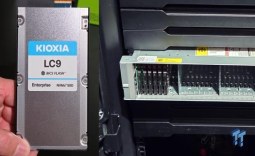
245.76 Terabytes of storage is an impressive number, but it's what's called for in the age of generative AI and the insatiable demand for flash memory and storage. KIOXIA's new LC9 Series is the industry's first high-capacity 245.76 TB NVMe SSD built for the enterprise data center market, available in 2.5-inch and Enterprise and Datacenter Standard Form Factors (EDSFF).

It's a game changer not only because of the capacity, but because KIOXIA's new LC9 Series is built using the company's latest flash memory technology. Powered by KIOXIA's new 8th Gen BiCS FLASH with CBA (CMOS directly Bonded to Array) technology, you're getting 32 2-Terabit (Tb) dies to be stacked together to deliver industry-leading density.
And yes, this also means PCIe 5.0 speeds, with sequential read speeds of up to 12,000 MB/sec and sequential write speeds of up to 3,000 MB/sec. On an SSD offering nearly 250TB of storage capacity, it's impressive, alongside meeting the demands of cutting-edge generative AI setups.
When it comes to generative AI with large LLM vector databases that utilize retrieval augmented generation (RAG), capacity, speed, and power efficiency are crucial, which is precisely what the KIOXIA LC9 Series brings to the table. When paired with GPUs, KIOXIA's new LC9 Series also reduces the total cost of ownership (TCO) with a fast and compact storage solution.
"KIOXIA has a long history of advancing flash storage, and the KIOXIA LC9 Series continues that legacy by setting a new benchmark for capacity and innovation in the SSD space," said Neville Ichhaporia, senior vice president and general manager of the SSD business unit at KIOXIA America, Inc. "As generative AI reshapes data center architecture, we're delivering the kind of breakthrough technology that enables our customers to optimize their IT infrastructure investments - pushing boundaries in performance, efficiency, and scale."
KIOXIA LC9 Series SSDs are also available in 122.88 TB capacity variants in 2.5-inch and E3.S form factors, with all models featuring advanced security features (SIE, SED, FIPS SED), NVMe 2.0, and NVMe MI 1.2c certification, as well as support for the Open Compute Project (OCP).