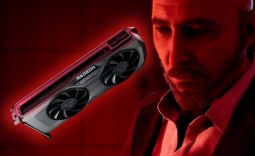


GDDR7 is known to have very high overclocking headroom, with artificial limits set in GPU overclocking tools often preventing higher GDDR7 memory clocks from being achieved. Sad-Victory-8319 on the Overclocking subreddit discovered that their GDDR7 memory on a GIGABYTE RTX 5070 Ti achieved a whopping +5500MHz offset, reaching 39Gbps or 1,248GB/s of memory bandwidth. For perspective, that's over 200GB/s more memory bandwidth than what an RTX 4090 achieves stock.
The utility the user used to reach these exorbitantly high memory speeds was mvolt+ extreme, a third-party overclocking utility purpose-built to unlock overclocking headroom beyond NVIDIA's official limitations. For GDDR7 memory, the maximum offset limit for most tools, including MSI Afterburner, is +3000MHz.
The Reddit poster noted that performance scaling was linear, gaining "about +1 FPS for every +1000[MHz] on the memory", confirming that the offset was providing noticeable performance gains. Other RTX 5070 Ti owners in the same thread shared similar findings with mvolt, with some reporting memory clock speeds working with a +5000MHz or +5500MHz offset. However, there was one exception, where one user with an ASUS Prime RTX 5070 Ti noted their card topped out at around +4500MHz.
Regardless, the results show that GDDR7 has significantly more performance headroom beyond the artificial +3000MHz limit that we are accustomed to seeing on mainstream GPU overclocking software. Even at the aforementioned limit, GDDR7 was already known for having high overclocking headroom, and now this new overclocking data shows just how much more headroom GDDR7 really has. For perspective, RTX 40 series GPUs with older GDDR6X memory typically topped out at around +1500MHz.

Story Q&A
Powered by TweakBot
From TweakTown's coverage of this story.
What gaming benchmarks show the performance gains from a +5000MHz or +5500MHz GDDR7 overclock on the RTX 5070 Ti?
Can mvolt+ extreme run alongside MSI Afterburner on the GIGABYTE RTX 5070 Ti, and which tool controls the memory offset?
What risks come with using mvolt+ extreme to bypass NVIDIA's memory-overclocking limits on an RTX 5070 Ti?
How does RTX 5070 Ti GDDR7 overclocking compare with GDDR6X overclocking on RTX 40 series GPUs in performance and stability?
Want something else? Ask TweakBot.

Not all GDDR7 modules have the same overclocking headroom, so don't expect the same results if you are planning to overclock your own GPU. It is also worth mentioning that mvolt is designed to bypass NVIDIA's limits, so use it at your own risk if you plan to use it to overclock an NVIDIA GPU.