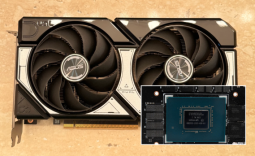
Intel used Hot Chips 2026 to lay out full specs for Crescent Island, its inference-focused GPU built on the new Xe3P architecture.
The chip has 32 Xe3P cores split across four compute slices, working out to 256 Vector Engines and 256 XMX matrix engines. It's paired with 32MB of unified L2 cache and up to 480GB of LPDDR5X memory, though the reference Intel card ships with 160GB. Partners building their own ODM versions can push that number higher.

Crescent Island skips HBM entirely, which is the interesting part. NVIDIA's Rubin and AMD's MI450X both lean on HBM4 for their next AI accelerators, but that memory has gotten harder to source and pricier as demand climbs. Intel is betting LPDDR5X gets it close enough on capacity (480GB beats MI450X's 432GB and Rubin's 288GB on paper) while running at a fraction of the power. The card is rated for 350W and is air-cooled, so it fits into standard PCIe Gen5 x16 servers without needing liquid cooling.
The Xe3P core looks different from Xe2 under the hood. XMX units moved from a 4-deep systolic array to 16-deep, the general register file doubled to 1MB per core, and L1/SLM cache is now 512KB per core. Intel also stripped out the 3D and ray-tracing hardware you'd find on a gaming GPU, freeing up die space for AI compute instead. Support spans FP4 up through FP64.

On the software side, Intel is leaning on an open stack: vLLM, SGLang, llm-d, and even NVIDIA's own Dynamo framework are supported, alongside KV-cache-aware routing for long-context agentic workloads.

It should be clear that this isn't a preview of a future Arc gaming card. Xe3P was originally slated for the canceled Celestial GPUs before Intel folded the architecture into Crescent Island, so gamers shouldn't expect much from today's reveal, even if Xe3P eventually reaches the Arc C-series.

Frequently Asked Questions
Open a question for an answer from TweakTown's coverage of this news, or ask your own below.
What are the core and engine counts of Intel's Crescent Island GPU (Xe3P) and how are they organized?
What memory types and capacities does Crescent Island support, and what does the reference card ship with?
What software frameworks and tooling does Intel support for Crescent Island (inference stack and routing)?
Have a question about this content not listed here? Ask below and TweakBot will answer it.

What it does show is that Intel now has a real answer to NVIDIA and AMD in the inference accelerator market, at a lower price and power point than either. Customer sampling is expected in the second half of 2026, with a full launch in 2027.