













Our Verdict
Pros
- Wonderful new 4K restoration, paired with an improved 5.1 mix
- Some nice new bonus features provide some nice retrospective insights
Cons
- The improved resolution reveals the seams of the mid-90s, low-budget CGI
- Would have been nice to have a full Dolby Atmos sound mix
Should you buy it?
With the video game industry booming in the early 1990's, it was only natural that it would come to the attention of movie studios keen to tap into the zeitgeist of the time. Unfortunately, the financial bomb of 1993's Super Mario Bros. and the critical drubbing of 1994's Street Fighter did little to prove the merits of this curious new sub-genre. But Warner Bros. offshoot label New Line Cinema persevered, turning the controversial series into a bonafine success that grossed six times its modest production budget, propelling the game franchise to new heights - and spurring one of the most memorable soundtracks of the decade.
When the malevolent sorcerer Shang Tsung (Cary-Hiroyuki Tagawa) challenges Earth's protectors Lord Rayden (Christopher Lambert) and Liu Kang (Robin Shou) to the ancient battle of Mortal Kombat, Rayden must assemble a new team of human defenders to protect it. Transported to a mysterious island, the group must learn to work together and master their inner strength as they face round after round of brutal fights against Outworld's stable of finest fighters. Their success means mankind's continuation - or doom.
Rather than just serving as a cynical and derivative video game adaptation, the ultimate success of Mortal Kombat actually worked to improve the video game franchise's credibility and pop cultural cachet, proving that not only could they be both financially successful and crowd pleasing, but also ushered in a new era of franchise convergence which the studios continue to hone to this day. Unfortunately, the film's rushed sequel immediately dashed all the goodwill, but with the distance of time, the film stands alone as one of the most satisfying video-game to feature film adaptations ever made.

Video

Best Deals: Casino
Prices last scanned 30 minutes ago


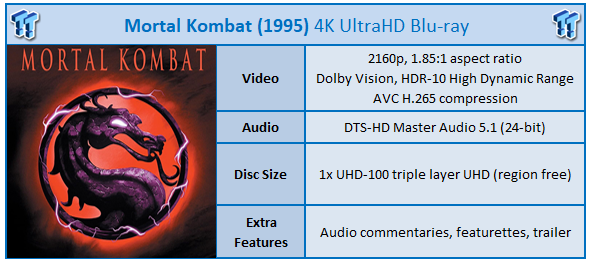
Mortal Kombat is presented in its original aspect ratio of 1.85:1 in the Rec. 2020 color space, finished with dynamic Dolby Vision and static HDR-10 high dynamic range formats and encoded with AVC H.265 compression. Notably, it has been approved by director Paul W.S. Anderson.
Derived from a brand new scan of the original camera and interpositive elements from Warner, Arrow's restoration makes for a stunning improvement over all previous releases, including the 2013 Blu-ray release. First-generation camera elements look truly superb, with a gentle amount of film grain reminding us that this was lensed on 35mm, now graded with wonderfully saturated colors.
As you might expect, the increased resolution does draw attention to the film's handful of (very early) CG effects, although the grade does help to smooth them out a tad. The HDR assists in providing a bit more pop, whilst respecting the original image intent.
Our Latest Blu-ray Movies Review Coverage
- The Super Mario Galaxy Movie (2026) 4K Ultra HD Blu-ray Review
- Speed Racer (2008) 4K Ultra HD Blu-ray Review: a stunning remaster of the cult classic
- Teenage Mutant Ninja Turtles III (1993) 4K Ultra HD Blu-ray Review
- TRON: Ares (2025) 4K Ultra HD Blu-ray Review
- Teenage Mutant Ninja Turtles II: The Secret of the Ooze (1991) 4K Ultra HD Blu-ray Review
Overall, this is a really pleasant remaster which optimizes the image for today's tech, but remains true to the film's aesthetic.

Frequently Asked Questions
TweakBot answers common questions about this review using TweakTown's own coverage from this page and related content from our archive. All answers are generated from TweakTown content and not outside sources. Tap a question to reveal the answer, or type your own below related to this content.
What video formats and HDR options are included on Arrow's Mortal Kombat 4K Ultra HD Blu-ray?
Was the 4K transfer approved by the film's director and what source materials were used for the restoration?
How does the new 4K remaster compare visually to the 2013 Blu-ray release in terms of grain and color grading?
Which new bonus features and audio commentaries are exclusive to this Arrow 4K set?
Have a question about this content not listed here? Ask below and TweakBot will answer it.


Audio
Mortal Kombat is presented in DTS-HD Master Audio 5.1.
Rather than simply repurposing the decent 5.1 DTS-HD track from the previous Blu-ray, Arrow's 4K disc offers a newly re-engineered 5.1 mix which represents a very solid improvement to channel balancing and general responsiveness that impresses - even if it doesn't take it all the way to a new height surround mix. Whilst the soundfield is still rather front-focused, there are now more impactful directional effects and punchier low-frequency effects. Once Techno Syndrome kicks in, you'll want to push the volume just that little bit harder!
Overall, this is a quality effort, and Arrow should be congratulated for putting in additional effort to optimize the track as they have here.
Extras
In typical Arrow style, we have a great collection of new bonus features which have been lovingly created by the boutique studio, in addition to preserving the previous bonus features. Let's jump in.

First up, we have not one, but two newly recorded Audio Commentaries, the first with director Paul W.S Anderson running solo and the second with 'comic book expert' Dave Baxter. Die-hard fans will no doubt be interested in the different perspectives offered, but I always prefer the director's recollections first and foremost. Mortal Kombat is perhaps his most regarded film (and his first directing credit), and it's clear that he retains rather a soft spot for it.
The bulk of the extras consist of roughly 60 minutes of newly filmed interview featurettes with members of the cast and crew. First up is Cage Match, which profiles Johnny Cage actor Linden Ashby. Special attention is given to the filming of the Goro fight scene (spoiler: it's not him doing the splits). Leveling Up interviews cinematographer John R. Leonetti (who would next take on directing duties for the lamentable sequel) and his battles to hide the film's low budget, while Quarters to Millions has producer Lawrence Kasanoff recounting the fascinating story of landing the film rights. Finally, The Heavyweight features Goro stunt performer (and Hollywood monster legend) Tom Woodruff recalling the logistical nightmare of filming the memorable sequence in the days before CG would just do it all.
Finally, we have some vintage EPK making-of featurettes with A Journey Behind the Scenes and the less imaginatively titled Behind the Scenes alongside On Set Soundbites, TV Spots and an Image gallery.


 The Super Mario Galaxy Movie (2026) 4K Ultra HD Blu-ray Review
 Speed Racer (2008) 4K Ultra HD Blu-ray Review: a stunning remaster of the cult classic
 The Super Mario Galaxy Movie Cinema Review
 Teenage Mutant Ninja Turtles III (1993) 4K Ultra HD Blu-ray Review
 TRON: Ares (2025) 4K Ultra HD Blu-ray Review
 ZOTAC replaces RTX 4090 with RTX 5090 after fourth RMA, but the warranty is only 30 days
 SK hynix approves $38.1 billion investment in two new fabs for AI memory supply
 Benchmarks show direct water on die cooling with no heat spreader outperforms AIO liquid cooling on a GPU
 OpenAI's next hardware is a doughnut-shaped smart speaker with moving parts that wants to be your new phone
 Noctua measured over 100 PC cases and found Corsair, NZXT, and Lian Li cooler clearance spec sheets are often wrong
 Leaked Xbox controller for Gears of War E-Day features a cracked volcanic rock design and blood-red Crimson Omen
 Doom co-creator John Romero reveals id Software turned to Taiwanese pirates to help distribute the game to more people
 GTA Online will continue after GTA 6's release, Take-Two reiterates
 YouTuber benchmarks RTX 4060 on Snapdragon X2 Elite laptop using RTX Spark developer driver
 Dev builds a unique 3D operating system for multitasking, gets terrible performance
 CPS PCCooler YS1200 ATX 3.1 80 PLUS Gold PSU Review
 ASRock X870E Taichi White Review: a premium AM5 motherboard with 10G LAN and WiFi 7
 Asetek Initium Pedal Modular Upgrades Review
 Thinkware U3000 Pro Review - Smart Dashcam with Wi-Fi quirks
 Montech TG3 Mid-Tower Chassis Review
 ASUS ROG Strix X870E-A Gaming WiFI7 Neo Review - A New Enticing Option
 Noctua NL-LC1-36 Liquid CPU Cooler Review
 Logitech G316 X 98 Wired Gaming Keyboard Review - Retro-Inspired Board that Falls a Little Short
 Biwin M560 2TB SSD Review - Best Overall Retail-Ready DRAMless SSD
 Logitech G512 X 98 Analog Mechanical Gaming Keyboard Review - An Innovative Two-in-One
 Windows 11 may be encrypting your drive already, and I checked where my recovery key went
 GIGABYTE's 40 Days of INFINITY celebrates 40 Years of Innovation with stunning GeForce RTX graphics cards and rewards
 I swapped File Explorer for this free file manager and finally got the layout I wanted
 How to tell if someone has been using your Windows PC without your permission
 6 Task Manager tips for troubleshooting Windows performance problems
 ASUS ROG's 20th Anniversary Line-up of Premium PC Gaming Gear has Arrived - Here's Everything You Need to Know
 Six File Explorer tips every Windows user should know
 I switched my PC to encrypted DNS in Windows 11, and browsing felt more private
 Printer Not Working in Windows? How to fix detection, print queues and drivers
 The Ultimate Guide to Personalizing Your Windows 11 Taskbar