

Introduction and Drive Details
The E1.S form factor is quickly becoming the standard for read-intensive AI storage compute. This compact form factor is ideally suited for perfect placement in the AI server rack and, as such, has indeed become the standard going forward for this application.
The compact nature of the E1.S form factor has not been without some negatives as it has evolved over the past couple of years. At its early inception, the new form factor, with its limited footprint and cooling surfaces, presented a challenge for most purveyors of the form factor. The typical response to this challenge was a compromise to limit performance, which in turn keeps temperatures in check.
Enter Solidigm, who are not known for compromising where others are willing to do so. Solidigm's newest E1.S SSD - the D7-PS1010 in E1.S form factor is an SSD that we are familiar with in its two other form factors, being E3.S and U.2. Solidigm's newest read-intensive 1-DWPD offering compromises on nothing. It delivers the very same class-leading performance available from its other form factors and, more importantly, can maintain moderate temperatures while doing so.
The storage company describes its D7-PS1010 E1.S as follows: "From HPC to cloud, AI to databases, to general purpose servers, the D7-PS1010 improves performance, reduces latency, and boosts quality of service, including double the throughput, compared to the previous generation SSDs. Experience up to 70% better energy efficiency compared to similar drives, allowing for more efficient operation. Five flexible power states ranging from 5W to 25W let you control your power consumption to meet workload needs."
Solidigm further states: "Solidigm is expanding the high-performance D7-PS1010 family with the powerful first-to-market single-sided cold plate liquid-cooling SSD. Now you can choose between air-cooled or liquid-cooled E1.S SSDs delivering targeted, efficient cooling directly to critical server components. The E1.S enables the design, development, and deployment of the next generation of fanless and thermally optimized AI server architectures. It addresses the challenges of thermal management and cost reduction in modern data centers."


Best Deals: Solidigm D7-PS1010 E1.S 7.68TB Enterprise SSD
Price Trend:
Prices last scanned 20 hours and 26 minutes ago


Solidigm has informed us that the cooling innovations baked into its E1.S design are meant not only to separate its offering from its competition but also to establish a new standard that all SSDs of its kind can follow and benefit from.
Solidigm states that it is not in the cold plate business, so they won't be suppliers of the innovative liquid cooling system shown above, but rather are establishing this new cooling standard designed in collaboration with NVIDIA for the benefit of the industry as a whole. Effective and serviceable single-sided cold plate cooling is on the leading edge of advancing AI storage compute efficiency. Impressive.
Our Latest SSD Review Coverage
- Micron 6600 ION 245.76TB Enterprise SSD Review - Best in Class Programming Speeds
- Memblaze PBlaze 7 7A40 Ocean 61.44TB Enterprise SSD Review - Oceans of QLC at 3.3 million IOPS
- KIOXIA CD9P-R 7.68TB E3.S Review - The Best-In-Class Data Center SSD
- DapuStor Roealsen6 R6060 E1.L 245.76TB SSD Review - Massive Capacity with Fast Retrieval
- Phison Pascari X200P 7.68TB Enterprise SSD Review - Sequential Read Champion
For our review purposes, we could not test the cooling efficiency of our test subjects with liquid cooling, as we are limited to standard air cooling. Even so, we could easily see that based on temperature monitoring, this E1.S SSD is indeed special when it comes to thermal mitigation. We tested both the 9.5mm slim design and the 15mm integrated heatsink models, and both delivered spectacular thermal results:

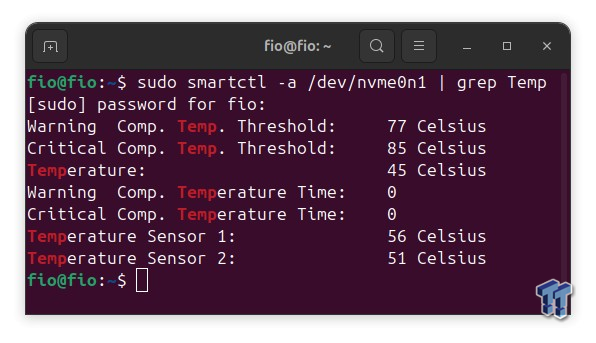
Pictured above are temperatures taken nearing the end of 2 loops of 128K sequential write preconditioning, where we feel temperatures are likely their highest. Typically, we would see temperatures near 70 °C here with standard air cooling, but not with our test subjects. Here we find the 9.5mm model running at a cool 54 °C and the 15mm heatsink model running at an even cooler temperature of 45 °C. Amazing.
Okay, now that we are familiar with what Solidigm's E1.S can do for your enterprise on the thermal front, let's see what kind of performance it can deliver.
Specs/Comparison Products
| Item | Details |
|---|---|
| Model | Solidigm D7-PS1010 E1.S 7.68TB |
| MSRP | NA |
| Model Number | SB5PHU7X076TOP |
| Interface | PCIe Gen5 x4 |
| Form Factor | E1.S |
| Sequential BW | Up to 12,000 MB/s |
| Random IOPS | Up to 2100K IOPS |
| Warranty | 5-Years Limited |
Solidigm D7-PS1010 7.68TB PCIe Gen5 x4 E1.S SSD


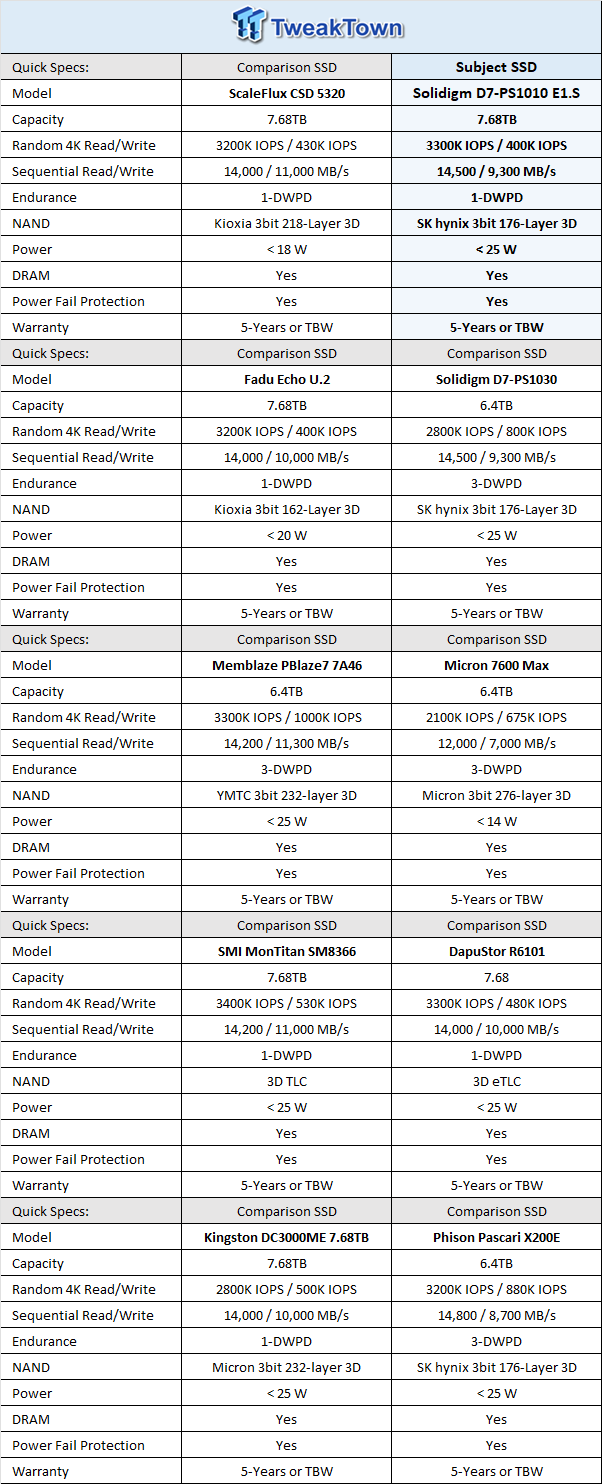
The drive we have in hand is a 1-DWPD design, E1.S form factor, 7.68TB in capacity, SK hynix V7 176L TLC arrayed, and 16-channel controlled. This configuration is rated for up to 3.3 million IOPS and up to 14.5 GB/s sequential throughput. Solidigm D7-PS1010 SSDs are compatible with major operating systems such as RHEL, SLES, CentOS, Ubuntu, Windows Server, and VMware ESXi.
On the Security front, Solidigm's D7-S1010 E1.S SSD is optimized to deploy with support for the latest security protocols like device attestation and key revocation in motion and at rest. Enhanced PLI testing and SDC testing with zero errors.
Test System Specs & Enterprise Testing Methodology
Enterprise SSD Test System
| Item | Details |
|---|---|
| Motherboard | ASUS Pro WS W790E-SAGE SE (Buy at Amazon) |
| CPU | Intel Xeon w7-2495X (Buy at Amazon) |
| GPU | GIGABYTE GeForce GTX 1650 (Buy at Amazon) |
| Cooler | Alphacool Eissturm Hurricane Copper 45 (Buy at Amazon) |
| RAM | Micron DDR5-4800 RDIMM (Buy at Amazon) |
| Power Supply | be quiet! Dark Power Pro 12 1200W (Buy at Amazon) |
| Case | PrimoChill's Praxis Wetbench (Buy at Amazon) |
| OS | Ubuntu 24.04.1 LTS |
A special thank you goes to Allyn Malventano, without whose help we wouldn't be where we are with our Linux-based Enterprise SSD testing platform.
Testing Methodology
TweakTown strictly adheres to industry-accepted Enterprise Solid State Storage testing procedures. Each test we perform repeats the same sequence of the following steps:
- Secure Erase SSD
- Write the entire capacity of SSD 2x (2 loops) with 128KB sequential write data, seamlessly transition to the next step (sequential testing skips step 3)
- Precondition SSD by filling the drive twice with 4K or 8K random writes
- Run test-specific workload with a 30-second ramp up for 5 minutes at each measured Queue Depth, and record average result
Benchmarks - Sequential
128K Sequential Write/Read

We precondition the drive with 100 percent sequential 128K writes at QD256 using 1-thread for 2-drive fills, receiving performance data every second. We plot this data to observe the test subject's descent into steady-state and to verify that steady-state is in effect as we seamlessly transition into testing at queue depth. A steady-state is achieved after a 1-drive fill. Average steady-state 128K sequential write performance at QD256 is approximately 9,000 MB/s.


Solidigm specs its D7-PS1010 Series SSDs as capable of delivering up to 10,500 MB/s 128K sequential write throughput. We are getting up to 9,300 MB/s, so a bit short of factory spec here. However, this is a place where performance matters least for a 1-DWPD SSD, so no worries whatsoever. Note this is a virtually identical performance curve to its U.2 3-DWPD D7-PS1030 sibling. Exactly what we would expect from our particular hardware configuration.


Here, the drive is factory spec'd for up to 14,500 MB/s 128K sequential read throughput. We are hitting up to 14,848 MB/s, so better than advertised and at a place where throughput matters most. Again, virtually identical to its 3-DWPD variant. Impressive.
Benchmarks - Random
4K Random Write/Read

We precondition the drive using 100 percent random 4K writes at QD256 for 2-drive fills, receiving performance data every second. We plot this data to observe the test subject's descent into steady-state and to verify that steady-state is in effect as we seamlessly transition into testing at queue depth. A steady-state is achieved after a 1-drive fill. Average steady-state 4K random write performance at QD256 is approximately 400K IOPS.


Our 7.68TB model is rated at up to 400K 4K random write IOPS. We are getting up to 420K, so we are a bit better than advertised. Excellent.


Factory spec here is up to 3.300K IOPS. We are getting 3,400K with our configuration. We find this to be astounding for its form factor, and even better than its 3-DWPD variant can deliver, indicating to us that firmware improvements are employed here.
4K 7030


The performance curve here is impressive for a 1-DWPD SSD with our test subject capable of delivering over a million IOPS on the top end and a massive 26K IOPS at QD1.
4K 5050


As we add more programming into the mix, our test subject responds well for a 1-DWPD SSD. Again, among the best for its type.
8K Random Write/Read

We precondition the drive using 100 percent random 8K writes at QD256 for 2-drive fills, receiving performance data every second. We plot this data to observe the test subject's descent into steady-state and to verify that steady-state is in effect as we seamlessly transition into testing at queue depth. A steady-state is achieved after a 1-drive fill. Average steady-state 8K random write performance at QD256 is approximately 200K IOPS.


We expect 8K random to track pretty much the same as 4K random here, just at a lower IOPS rate because it's moving twice the amount of data. Our test subject delivers exactly half of what we saw at 4K. Of note is the fact that our 1-DWPD test subject is delivering more at QD1 than we have seen from any 1-DWPD SSD we've encountered to date.


Outstanding performance curve here. At QD1, it again delivers the most we've ever seen from a 1-DWPD SSD. At the top end, it delivers even more than its 3-DWPD variant. Impressive.
8K 7030


8K 7030 is representative of a common database workload. At QD1-2, we find our test subject delivering the goods about as well as it gets from a 1-DWPD SSD. This is where performance matters most, most of the time, so we don't mind that at queue depths above 2, it is lagging behind the rest of the SSDs appearing on this chart.
8K 5050


Again, at QD1-2, we find our test subject delivering the goods about as well as it gets from a 1-DWPD SSD. This is where performance matters most, most of the time, so we don't mind that at queue depths above 2, it is lagging behind the rest of the SSDs appearing on this chart.
Final Thoughts
As we see it, Solidigm's innovation here is a game changer, not only for its own offering but for the industry as a whole. Effective single-sided and most importantly easily serviceable cold plate cooling is the new frontier, especially as it relates to read-intensive AI storage compute. What Solidigm, in collaboration with NVIDIA, has done here is again, in our opinion, revolutionary and paves the path forward for thermal mitigation at PCIe Gen6 speeds.

In our opinion, it's the best of its kind currently available. Editor's Choice.