


Our Verdict
Pros
- 14 watts maximum
- Low queue depths
- Performance curve
Cons
- None
Should you buy it?
Introduction and Drive Details
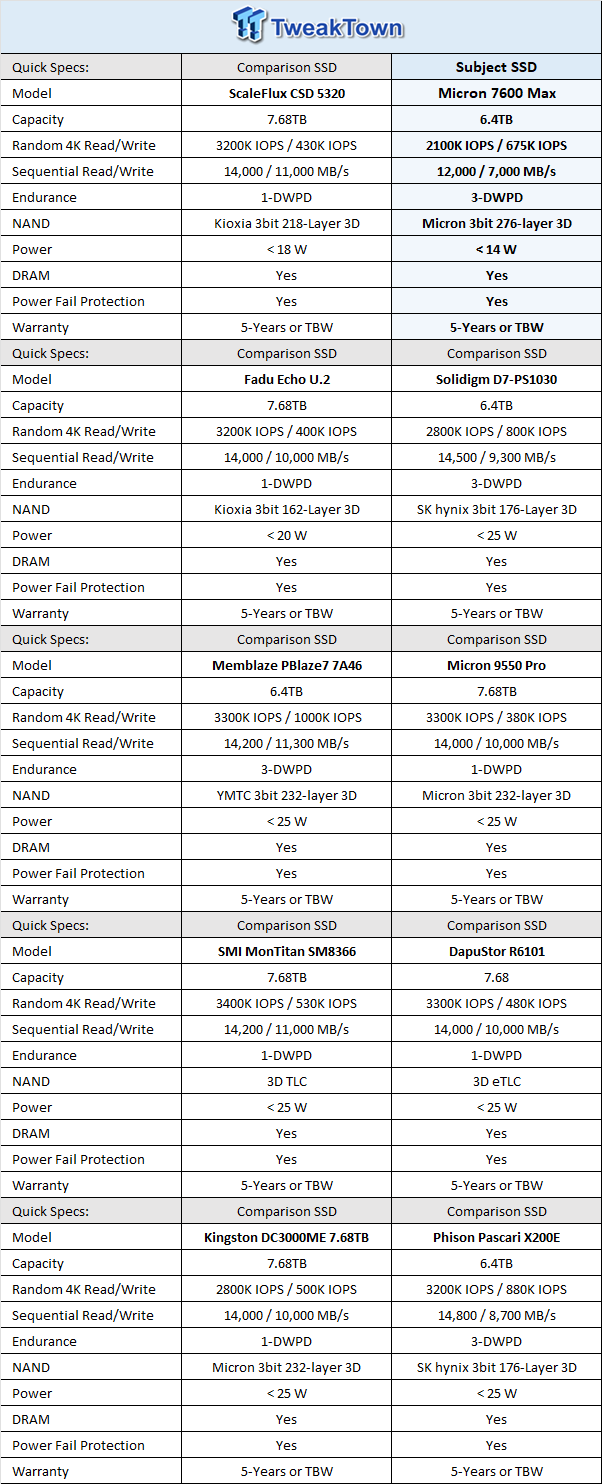
Micron's newly minted 7600 Series is the world's first mainstream data center SSD to employ Micron's super-efficient G9 NAND, with an industry-leading NAND transfer speed of 3.6 GB/s. Efficiency here is the keyword, because Micron's newest Gen5 datacenter SSD is focused on delivering the industry's best, most consistent low queue depth performance while at the same time delivering unrivaled power efficiency.
Micron G9 276-Layer flash is the key ingredient here due to its spectacular power efficiency. Arrayed with Micron G9, the 7600 Series can, in many scenarios, outperform anything we've encountered to date while consuming just 14 watts of power vs. the typical 25 watts. Think of it - equivalent or even better performance at queue depths of up to 256 than most other vendors are offering, while at the same time consuming just 14 watts. Amazing.
Efficiency is the new datacenter frontier for obvious reasons. Lower power consumption per IOP directly translates into less overhead costs, including cooling. Additionally, and this again speaks directly to efficiency, the Micron 7600 SSD is the leader in low, consistent latency. Latency-sensitive applications show up to 59% better latency consistency when reading data, and up to 76% better with mixed workloads. Additionally, Micron asserts that its 7600 SSD is the Gen5 SSD with leading quality of service for AI and mainstream data center workloads.
The Micron 7600 SSD incorporates leading security features like hardware root of trust, securely signed firmware, and SPDM 1.2 (attestation) for identity authentication & firmware verification. It offers options for FIPS 140-3 Level 2 and TAA compliance. The self-encrypting drive (SED) option helps keep your data safe by adding AES-256 encryption for hardware-based data encryption, with no loss of SSD performance. The 7600 Series can be had in all standard form factors, including E1.S (9.5/15/25 mm), E3.x, and U.2/3. The drive is available in both Pro (1-DWPD) and Max (3-DWPD) variants.
Specs/Comparison Products
| Item | Details |
|---|---|
| Model | Micron 7600 Max 6.4TB |
| MSRP | N/A |
| Model Number | MTFDLBQ6T4THS |
| Interface | PCIe Gen5 x4 |
| Form Factor | E3.S |
| Sequential BW | Up to 12,000 MB/s |
| Random IOPS | Up to 2100K IOPS |
| Warranty | 5-Years Limited |
Micron 7600 Max 6.4TB PCIe Gen5 x4 E3.S SSD


Best Deals: Micron 7450 MAX Solid State Drive


The drive we have in hand is a 3-DWPD design, E3.S form factor, 6.4TB in capacity, Micron G9 TLC arrayed, and 16-channel controlled. This configuration is rated for up to 2.1 million IOPS and up to 12 GB/s sequential throughput. Micron 7600 SSDs are compatible with major operating systems such as RHEL, SLES, CentOS, Ubuntu, Windows Server, and VMware ESXi.
Test System Specs & Enterprise Testing Methodology
Enterprise SSD Test System
| Item | Details |
|---|---|
| Motherboard | ASUS Pro WS W790E-SAGE SE (Buy at Amazon) |
| CPU | Intel Xeon w7-2495X (Buy at Amazon) |
| GPU | GIGABYTE GeForce GTX 1650 (Buy at Amazon) |
| Cooler | Alphacool Eissturm Hurricane Copper 45 (Buy at Amazon) |
| RAM | Micron DDR5-4800 RDIMM (Buy at Amazon) |
| Power Supply | be quiet! Dark Power Pro 12 1200W (Buy at Amazon) |
| Case | PrimoChill's Praxis Wetbench (Buy at Amazon) |
| OS | Ubuntu 24.04.1 LTS |
Testing Methodology
TweakTown strictly adheres to industry-accepted Enterprise Solid State Storage testing procedures. Each test we perform repeats the same sequence of the following steps:
- Secure Erase SSD
- Write the entire capacity of SSD 2x (2 loops) with 128KB sequential write data, seamlessly transition to the next step (sequential testing skips step 3)
- Precondition SSD by filling the drive twice with 4K or 8K random writes
- Run test-specific workload with a 30-second ramp up for 5 minutes at each measured Queue Depth, and record average result
Benchmarks - Sequential
128K Sequential Write/Read

We precondition the drive with 100 percent sequential 128K writes at QD256 using 1-thread for 2-drive fills, receiving performance data every second. We plot this data to observe the test subject's descent into steady-state and to verify steady-state is in effect as we seamlessly transition into testing at queue depth. A steady-state is achieved after 1-drive fill. Average steady-state 128K sequential write performance at QD256 is approximately 7,300 MB/s.
Our Latest SSD Review Coverage
- KIOXIA CM9-R 15.36TB E3.S Enterprise SSD Review - Performance King at 1-DWPD
- Micron 6600 ION 245.76TB Enterprise SSD Review - Best in Class Programming Speeds
- Memblaze PBlaze 7 7A40 Ocean 61.44TB Enterprise SSD Review - Oceans of QLC at 3.3 million IOPS
- KIOXIA CD9P-R 7.68TB E3.S Review - The Best-In-Class Data Center SSD
- DapuStor Roealsen6 R6060 E1.L 245.76TB SSD Review - Massive Capacity with Fast Retrieval


Micron specs its 7600 Series SSDs as capable of delivering up to 7,000 MB/s 128K sequential write throughput. We are getting up to 7,300 MB/s, so the factory spec here is on the conservative side.


Here, the drive is factory spec'd for up to 12,000 MB/s 128K sequential read throughput. We are hitting up to 11,787 MB/s, so it's good enough. This is excellent throughput for a power-sipping 14-watt Enterprise SSD.
Benchmarks - Random
4K Random Write/Read

We precondition the drive using 100 percent random 4K writes at QD256 for 2-drive fills, receiving performance data every second. We plot this data to observe the test subject's descent into steady-state and to verify steady-state is in effect as we seamlessly transition into testing at queue depth. A steady-state is achieved after 1-drive fill. Average steady-state 4K random write performance at QD256 is approximately 725K IOPS.


Our G9 arrayed 6.4TB model is rated at up to 675K 4K random write IOPS. We are getting up to 762K, so again significantly better than advertised.


Factory spec here is up to 2,100K IOPS at QD512. We are getting 2,245K at QD512 with our configuration. This is again remarkable efficiency for a 14-watt SSD. Impressive. Additionally, we like what we see from its performance curve, where the drive is extremely potent at lower queue depths, where performance matters most.
4K 7030


Here, our 6.4TB contender delivers what we consider one of the best performance curves we've ever seen. In fact, our test subject bests them all at queue depths of 16 through 64. Outstanding. Overall, its performance at queue depths of 64 and below is stellar. This is performance where it matters most, most of the time.
4K 5050


As we add more programming into the mix, our test subject responds with another superior low queue depth performance curve, being especially potent at QD32, where it's delivering better than anything appearing on this chart. Outstanding.
8K Random Write/Read

We precondition the drive using 100 percent random 8K writes at QD256 for 2-drive fills, receiving performance data every second. We plot this data to observe the test subject's descent into steady-state and to verify steady-state is in effect as we seamlessly transition into testing at queue depth. A steady-state is achieved after 1-drive fill. Average steady-state 8K random write performance at QD256 is approximately 400K IOPS.


We expect 8K random to track pretty much the same as 4K random here, just at a lower IOPS rate because it's moving twice the amount of data. Our test subject delivers a bit more than half of what we saw at 4K. Excellent.


This is a crazy good performance curve. At practical queue depths, it is the best overall we've ever seen. Notably, it's the first of its kind to deliver more than 1 million IOPS at QD64, and the first of its kind to deliver full throughput at QD128. Impressive.
8K 7030


8K 7030 is representative of a common database workload. No TLC arrayed SSD we've encountered can deliver a better performance curve here at practical queue depths than the 7600 6.4TB. This is database workload performance on a higher level. Incredible.
8K 5050


Again, no TLC arrayed SSD we've encountered can deliver a better 8K mixed performance curve and do so where it matters most.
Final Thoughts
Micron's 7600 Max SSD is indeed a master of efficiency. Our power-sipping 14-watt test subject roasted the competition when digesting mixed workloads at lower queue depths, where arguably performance matters most. 4K mixed workloads were masterfully delivered, but 8K is where our contender really separates itself from the rest. Its database performance is easily the best we've encountered to date; it's even better than our previous champion, the G8 arrayed 9550 Max. Much of the world's digital data is 8K mixed in nature, so the importance of its superior performance here cannot be overstated.

Micron's 7600 Max 6.4TB E3.S SSD is a masterpiece of efficiency and an 8K juggernaut. Editor's Choice.