














Our Verdict
Pros
- Sequential throughput performance
- Real-world performance
- Power efficient
Cons
- Double-sided design
Should you buy it?
AvoidConsiderShortlistBuyIntroduction & Drive Details
Another big name has climbed aboard the SM2508 bullet train. Patriot's Viper PV953 is yet another Silicon Motion SM2508-controlled SSD arrayed with Micron B58R or G8 flash. To date, in retail form, this will be the fourth such configuration we've had come across our test benches. This exact hardware configuration is proving to be the most prolific of this year's PCIe Gen5 flagship offerings, with almost all the usual suspects offering it as their 2025 flagship performer.


What makes this hardware configuration so desirable isn't so much its performance as its efficiency. On the performance front, this hardware configuration is generally a bit less powerful than its Phison E26-controlled competition, but close enough that its overwhelming efficiency advantage makes it a much more desirable offering - even for storage enthusiasts.
With its advanced 6nm architecture node, Silicon Motion's SM2508 controller can deliver more than 14,000 MB/s throughput while consuming around 7 watts of power. Contrast that with Phison's 2-year-old E26 controller built on older 12nm architecture requiring more than 11 watts to deliver that same 14,000 MB/s throughput.
Four watts may not sound like a big difference, and certainly, as compared with 500-watt GPUs, it seems utterly insignificant; however, when we are talking PCIe Gen5 storage and what it takes to keep thermals in check, it makes all the difference in the world. Phison E26-controlled SSDs require either active cooling or half-pound chunks of solid aluminum to run throttle-free. SM2508-controlled SSDs need nothing of the sort, as they don't run any hotter than a typical PCIe Gen4 SSD. A standard motherboard heatsink, and you are good to go.

Best Deals: Patriot P400 Lite 2TB SSD
Price Trend:
Prices last scanned 9 hours and 23 minutes ago

7 days ago: $249.99 USD30 days ago: $284.99 USD
7 days ago: $359.99 CAD30 days ago: $369.99 CAD
7 days ago: £296.0330 days ago: £214.99


As with all previous Micron G8 arrayed SM2508 controlled SSDs we've tested, Patriot's Viper PV593 at 2TB and 4TB capacity points comes in a double-sided form factor SSD. A double-sided PCB brings with it inherent advantages and disadvantages. Double-sided SSDs are generally more cost-effective; however, they can be harder to cool and typically don't play well with modern notebooks.
Patriot is touting its new flagship performer as able to deliver blazing load times that are up to 200% faster than its PCIe Gen4 SSDs. The company also states that with its 14,000/13,000 MB/s throughput, its Viper PV593 SSD delivers the horsepower required to accelerate AI model training, as well as delivering stunningly immersive gaming and professional rendering.
Okay, now let's dive in and see what Patriot's Viper PV593 4TB can do for you by the numbers.
Our Latest SSD Review Coverage
- Phison E37T SSD Controller Exclusive Preview - The Fastest DRAMless SSD Platform Yet
- Seagate FireCuda X1070 4TB SSD Review - A New Mainstream Contender
- Micron 3610 2TB SSD Review - DRAMless QLC at 11,000 MB/s
- SK hynix Platinum P51 2TB SSD Review - A Powerful Gen5 Alternative
- Biwin Black Opal X570 Pro 8TB SSD Review - Massive Capacity with Elite Performance
Drive Details
| Item | Details |
|---|---|
| Model | VIPER PV593 4TB |
| MSRP | $360 |
| Model Number | PV593P4TBM28H |
| Interface | PCIe Gen5 x4 |
| Form Factor | M.2 2280 |
| Performance | Up to 14,000 MB/s |
| Warranty | 5-Years |

Performance and endurance are both excellent, as is its 5-year limited warranty.


Jon's Test System Specifications
Intel Test System
| Item | Details |
|---|---|
| Motherboard | ASUS Z890 Apex (Buy at Amazon) |
| CPU | Intel Core Ultra 9 285K (Buy at Amazon) |
| GPU | MSI SUPRIM X RTX 3080 12GB (Buy at Amazon) |
| Cooler | Alphacool Eissturm Hurricane Copper 45 (Buy at Amazon) |
| RAM | Patriot Viper Xtreme 5 8000 48GB (Buy at Amazon) |
| Power Supply | be quiet! Dark Power Pro 12 1200W (Buy at Amazon) |
| Case | PrimoChill's Praxis Wetbench (Buy at Amazon) |
| OS | Microsoft Windows 11 Pro (Buy at Amazon) |
AMD Test System
| Item | Details |
|---|---|
| Motherboard | ASUS ROG Crosshair X870E APEX(Buy at Amazon) |
| CPU | AMD Ryzen 9 9950X (Buy at Amazon) |
| GPU | MSI SUPRIM X RTX 3080 12GB (Buy at Amazon) |
| Cooler | Alphacool Eissturm Hurricane Copper 45 (Buy at Amazon) |
| RAM | Sabrent Rocket DDR5 32GB (Buy at Amazon) |
| Power Supply | be quiet! Dark Power Pro 12 1200W (Buy at Amazon) |
| Case | PrimoChill's Praxis Wetbench (Buy at Amazon) |
| OS | Microsoft Windows 11 Pro (Buy at Amazon) |
Please note: We employ an M.2 AIC for testing on our Intel Core Ultra 9 285K platform.
Sony PlayStation 5 - M.2 Storage Expansion
PS5 Read Performance
With Sony's wildly popular PlayStation 5 console now enabled for M.2 NVMe SSDs to be used as fast storage expansion, we are including results for PS5-compatible SSDs we test as a part of our reviews going forward.


For SSDs that don't have an adequately sized PS5-compatible heatsink or other SSDs where the heatsink provided doesn't fit right and can be removed, we both use and recommend Sabrent's unparalleled PS5 heatsink available HERE.


We only chart SSDs that can deliver a minimum of 5,500 MB/s read, which is Sony's original recommendation.
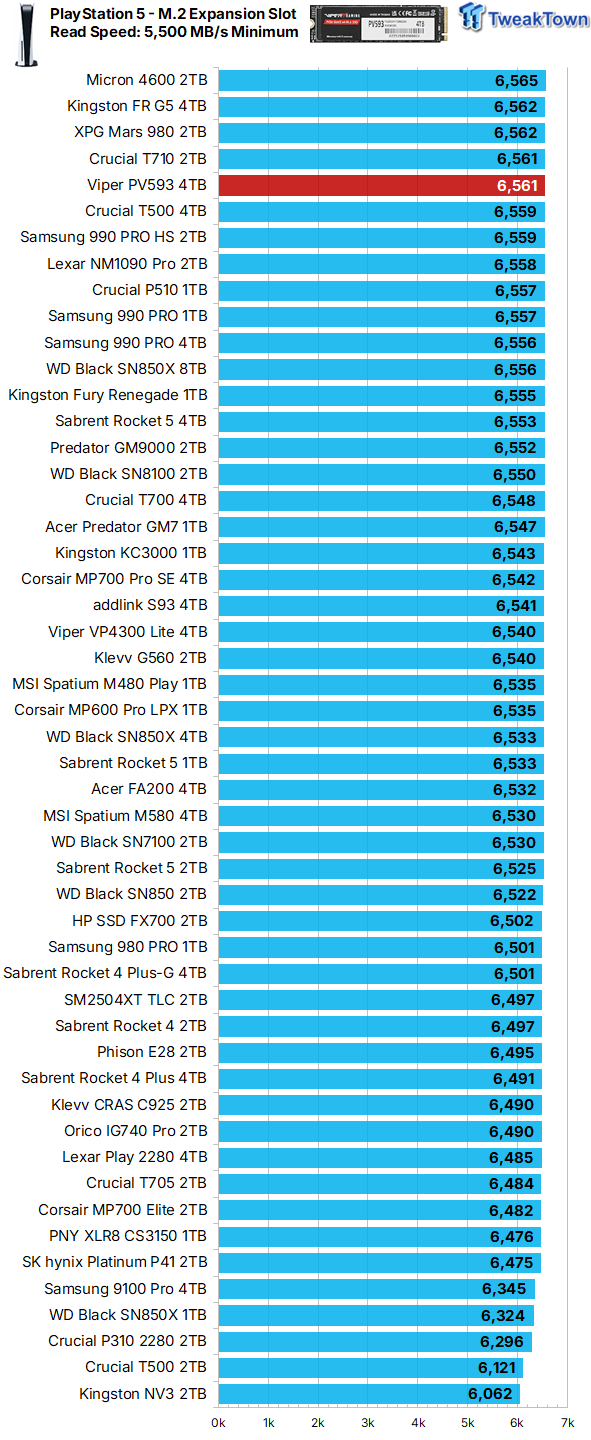
Here we see the Viper PV593 4TB as one of the best options going for PS5 fast storage expansion. Impressive.
Synthetic Benchmarks: CDM, Max IOPS, ATTO
CrystalDiskMark
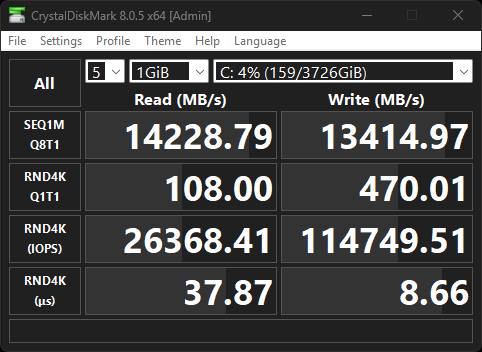
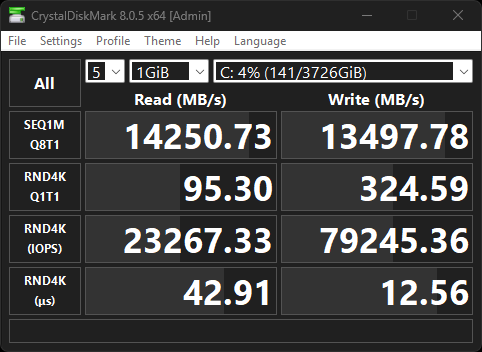
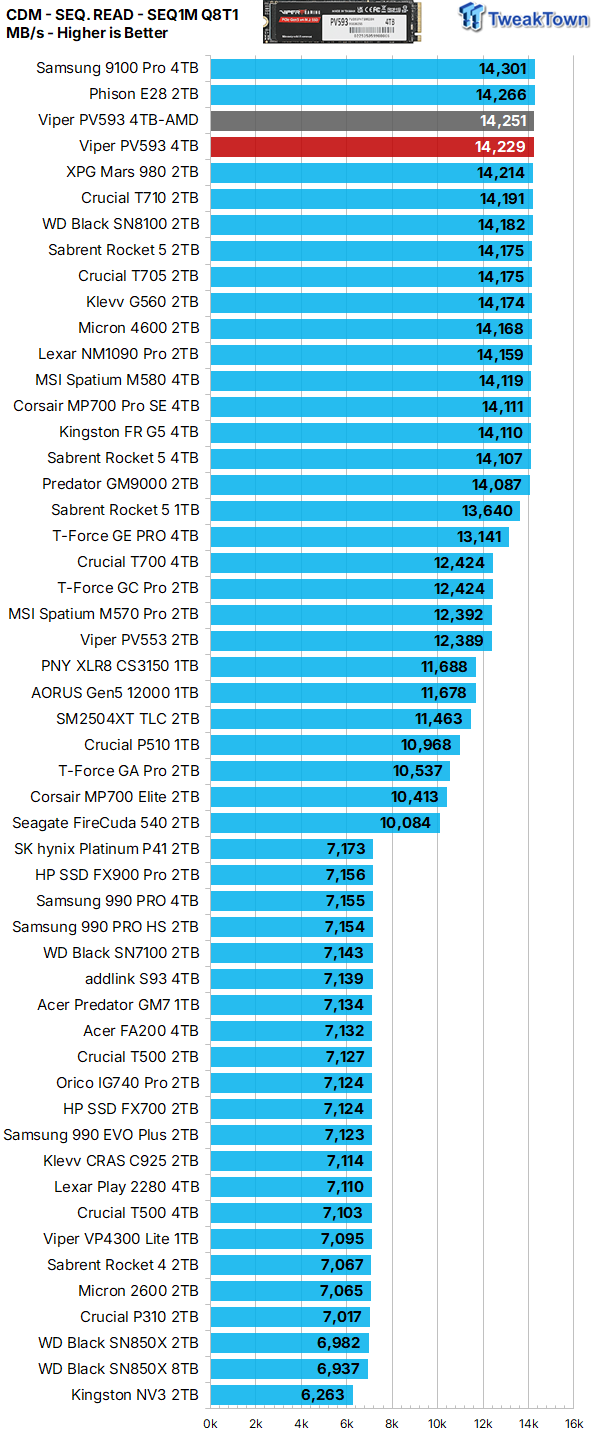
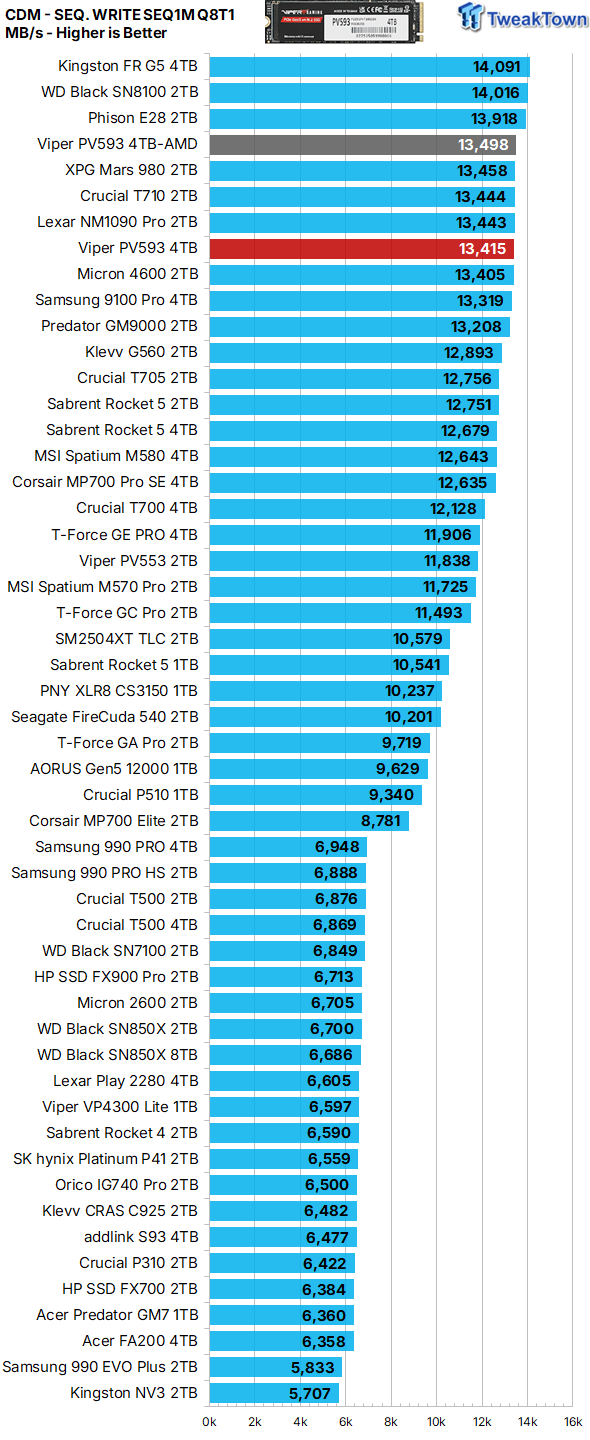
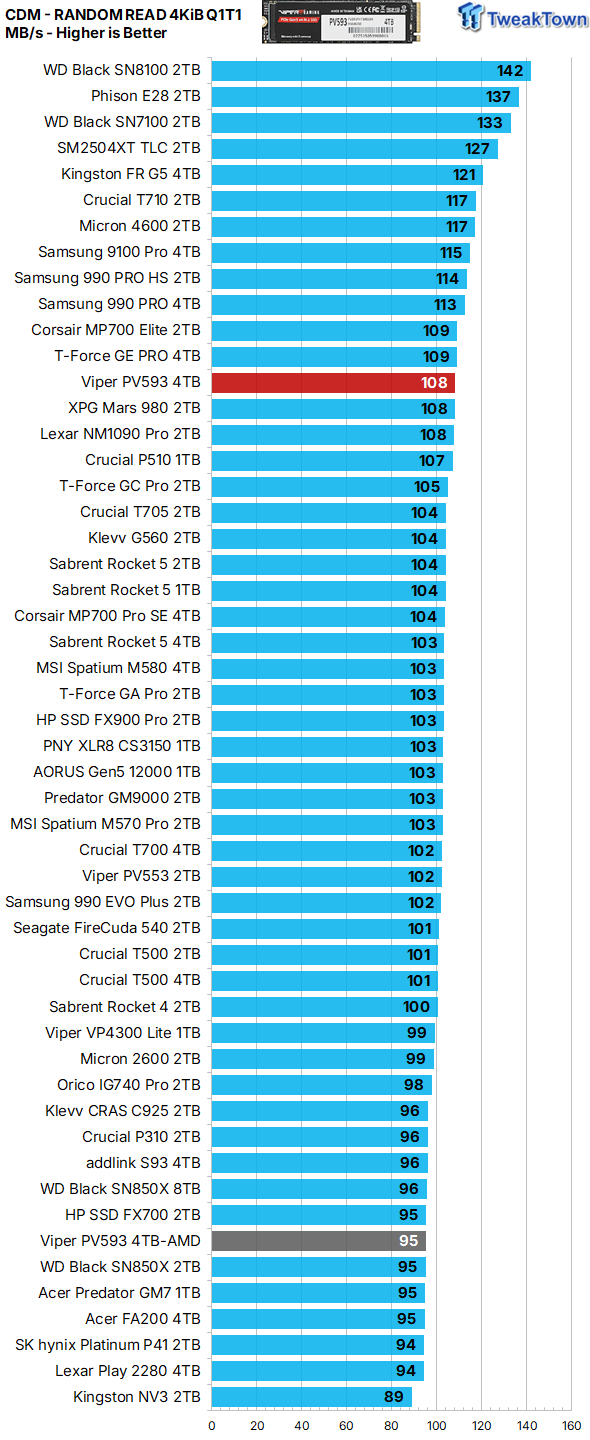
We employ CDM as our standard measurement for both sequential throughput and Q1T1 random read. In terms of sequential throughput, the PV593 4TB delivers exactly as advertised and then some, even in our more demanding user state. Excellent.
Moving our focus over to Q1T1 random read speed, our Micron G8 arrayed contender is delivering as good as we've ever seen for its NAND type. This bodes well for real-world performance.
Max IOPS
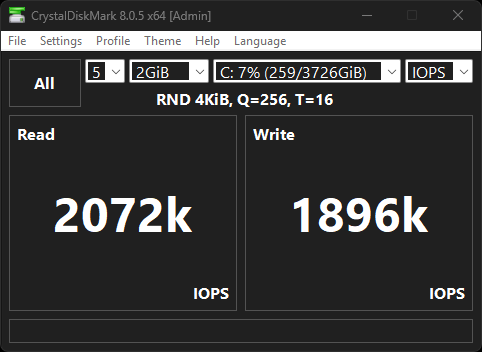
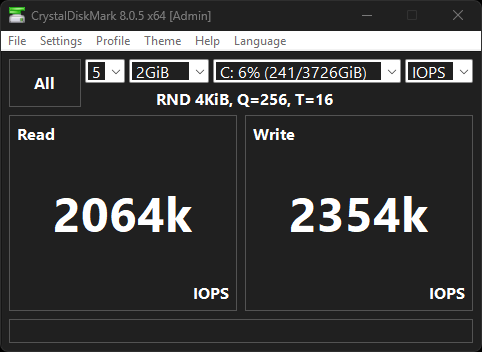
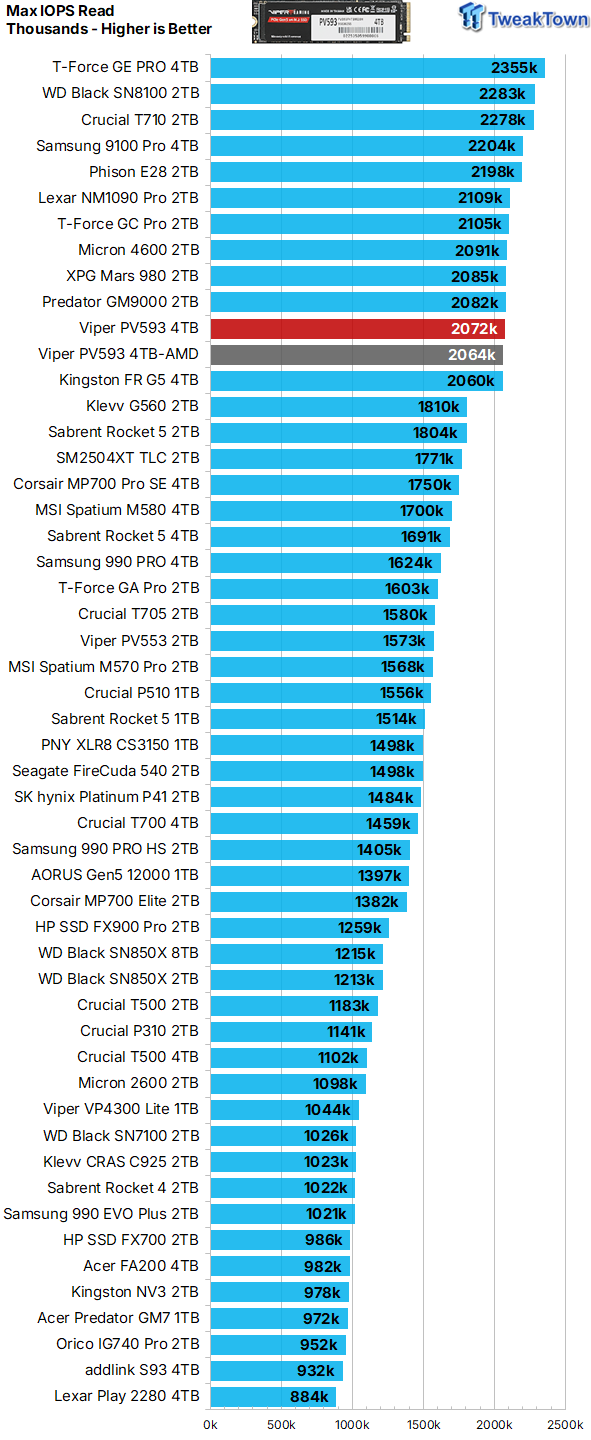
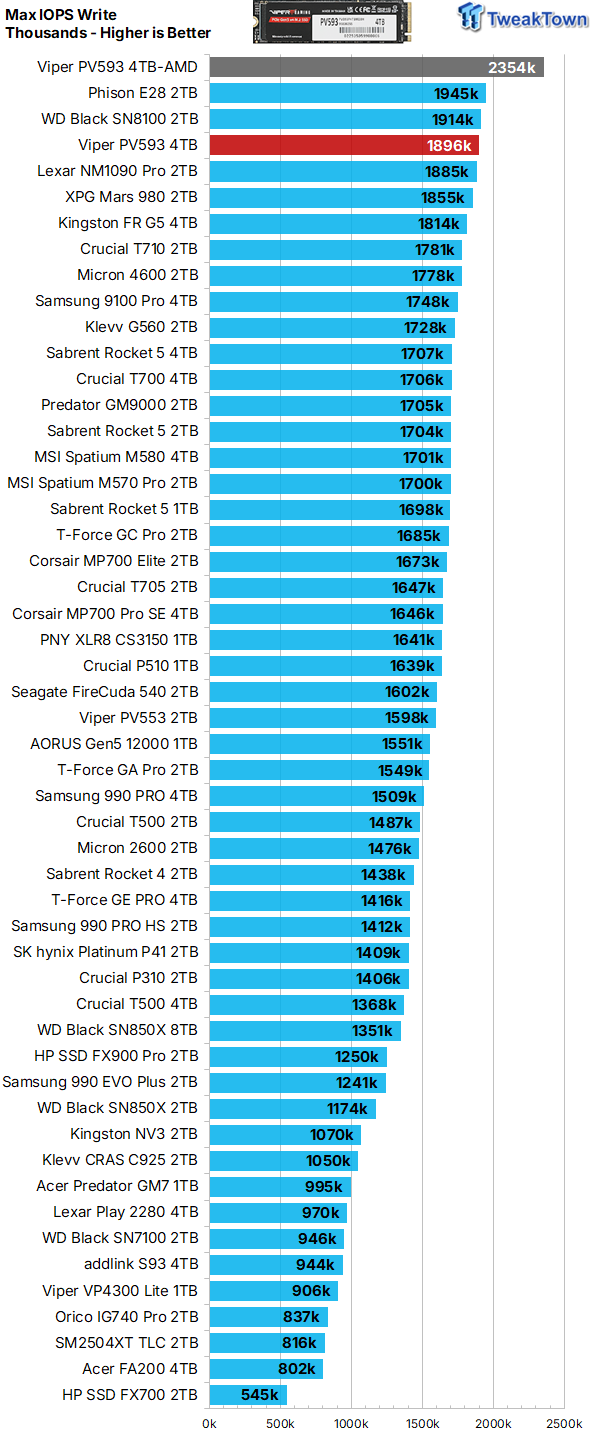
We have no issues meeting and exceeding the quoted factory max 4K random performance specifications. With more than 2 million 4K random read IOPs generated with both Intel and AMD, and 1.9 million plus 4K random write IOPS, again on both platforms, our test subject delivers as advertised and then some, even under our more demanding user state. Impressive.
ATTO
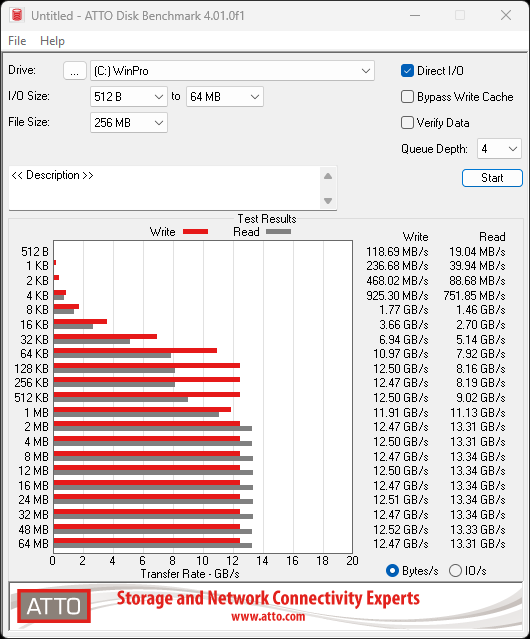
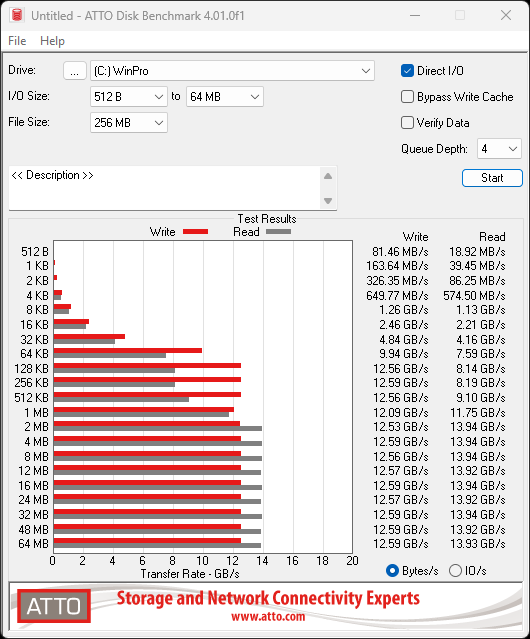
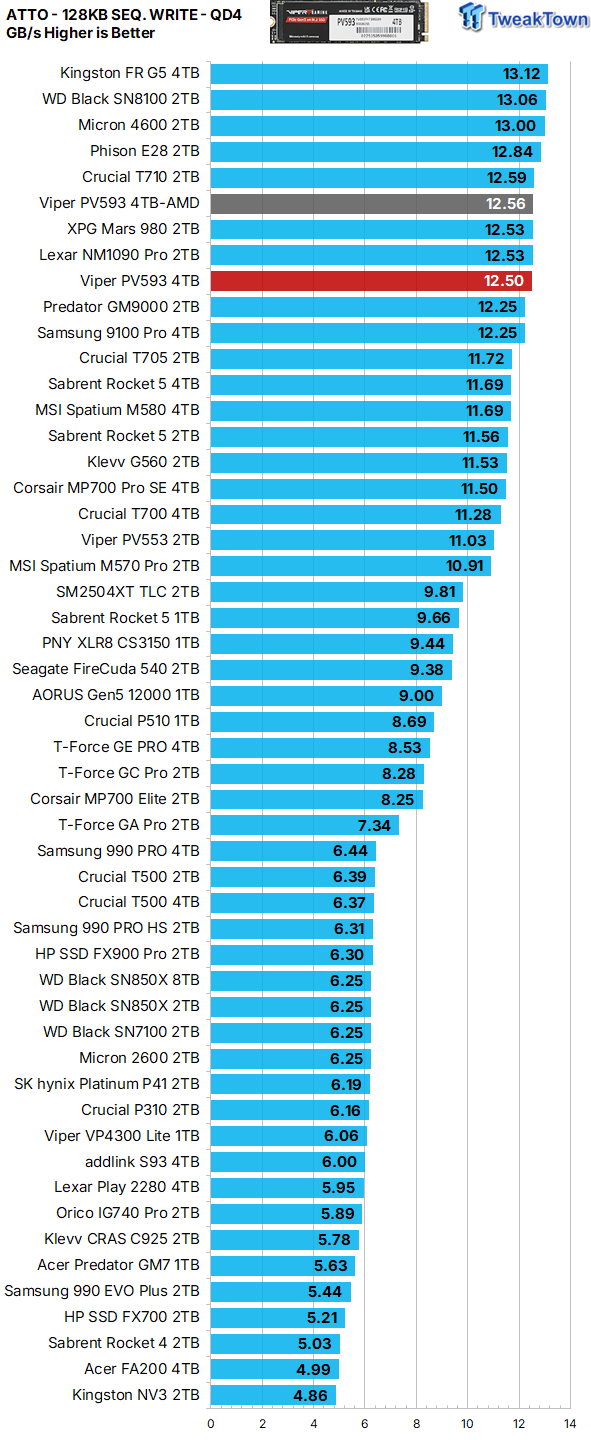
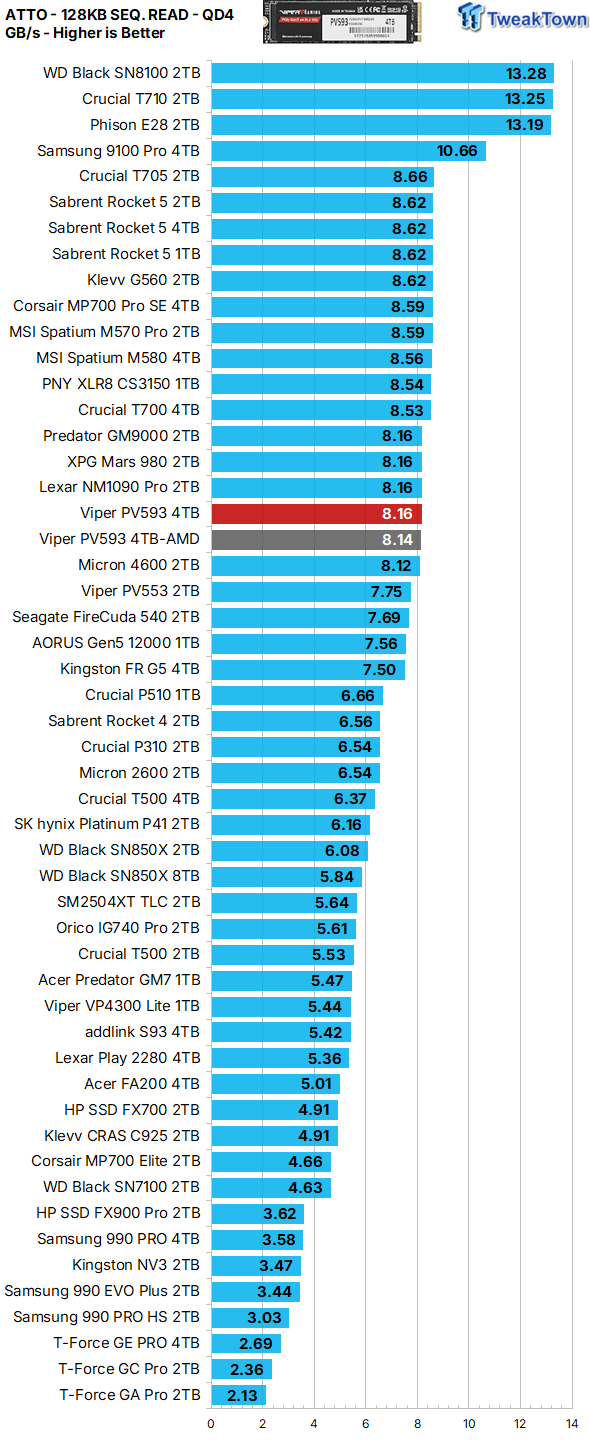
ATTO gives us a clear picture of what transfer sizes a particular SSD favors in terms of QD4 sequential throughput. We chart 128K transfers. At a queue depth of four, the Viper PV593 4TB favors sequential transfers of 2MB or larger when serving data to the host (reading) and 128KB or larger when programming (writing) data.
Real-World Testing: Transfers, 3DMark SSD Gaming Test, PCM10 Storage
Transfer Rates
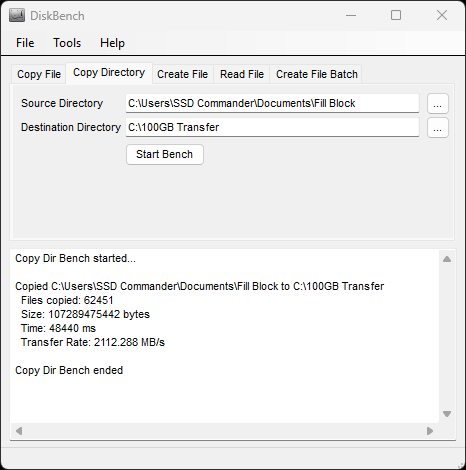
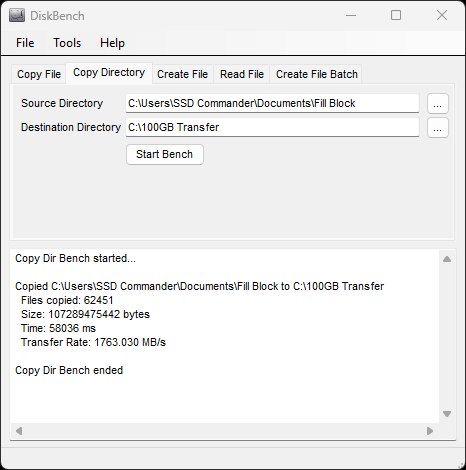
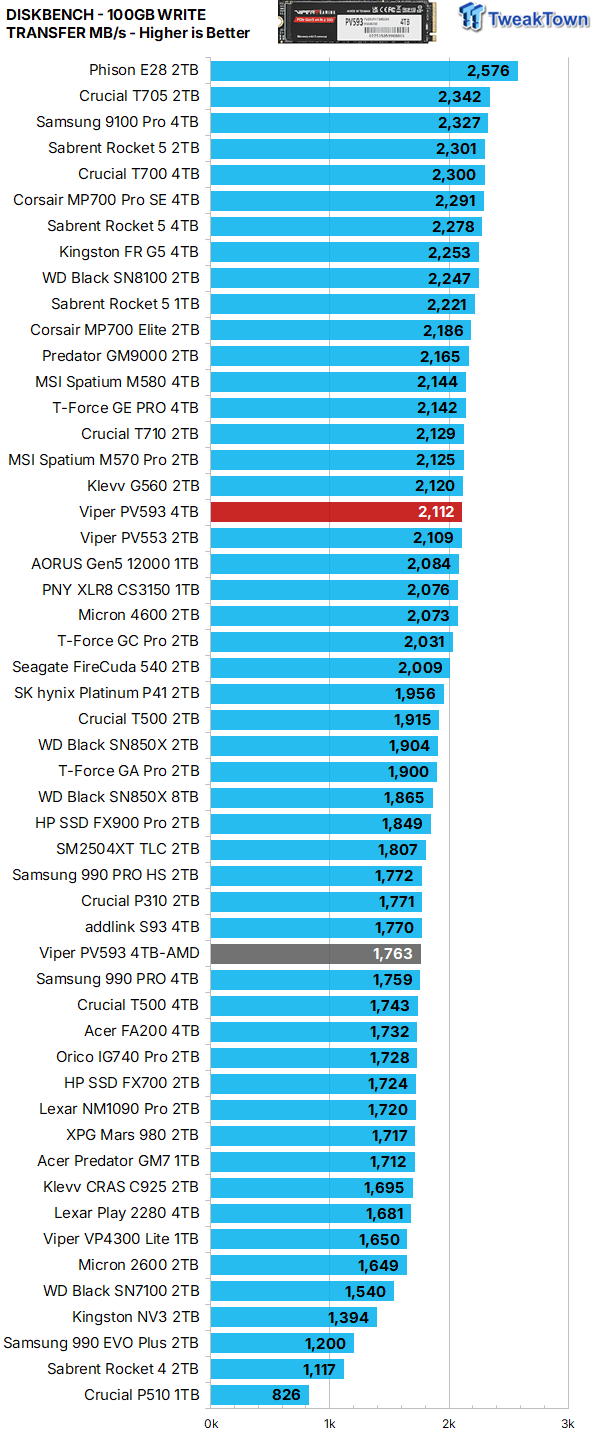
Our 100GB data transfer test is not your ordinary 100GB of data; ours is a crushing mix composed of more than 62K files. Write performance, random or sequential, is an infrequent operation and as such, we do not consider it to be an important performance metric in the consumer space. An example is how many times a game is installed vs. how many times it's played. Plenty good enough for our liking, especially as delivered on our Intel platform.
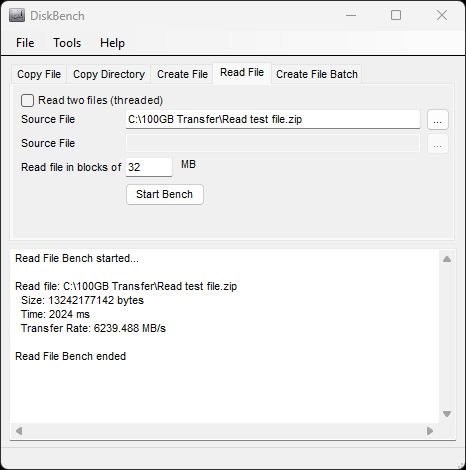
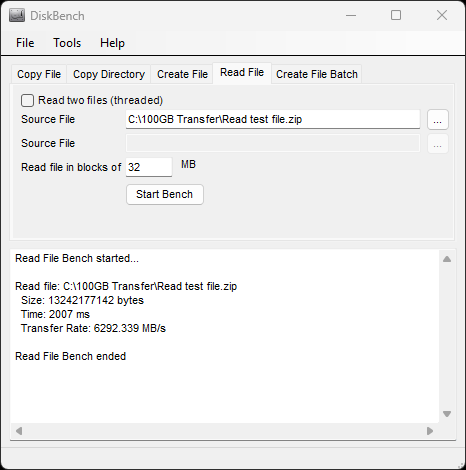
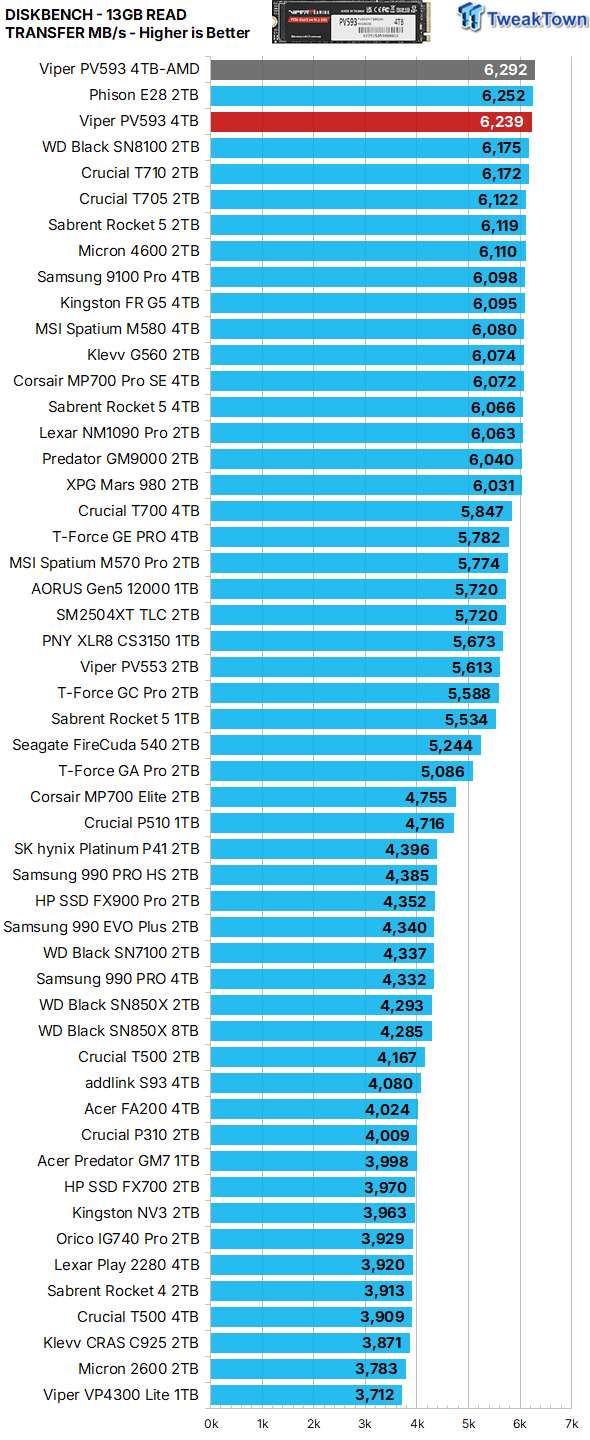
Unlike programming (writing) data, serving data to the host (reading) is typically an important performance metric as it relates to the consumer space. This is where transfer rates matter most, and we love what we see from our test subject. This is the best we've ever extracted from any retail SSD. Impressive.
3DMark SSD Gaming Test
UL's newest 3DMark SSD Gaming Test is the most comprehensive SSD gaming test ever devised. We consider it superior to testing against games themselves because, as a trace, it is much more consistent than variations that will occur between runs on the actual game itself. This test is the same as running the actual game, just without the inconsistencies inherent to application testing. In short, we believe that this is the world's best way to test an SSDs gaming prowess and accurately compare it against competing SSDs. The 3DMark SSD Gaming Test measures and scores the following:
- Loading Battlefield V from launch to the main menu.
- Loading Call of Duty Black Ops 4 from launch to the main menu.
- Loading Overwatch from launch to the main menu.
- Recording a 1080p gameplay video at 60 FPS with OBS (Open Broadcaster Software) while playing Overwatch.
- Installing The Outer Worlds from the Epic Games Launcher.
- Saving game progress in The Outer Worlds.
- Copying the Steam folder for Counter-Strike Global Offensive from an external SSD to the system drive.


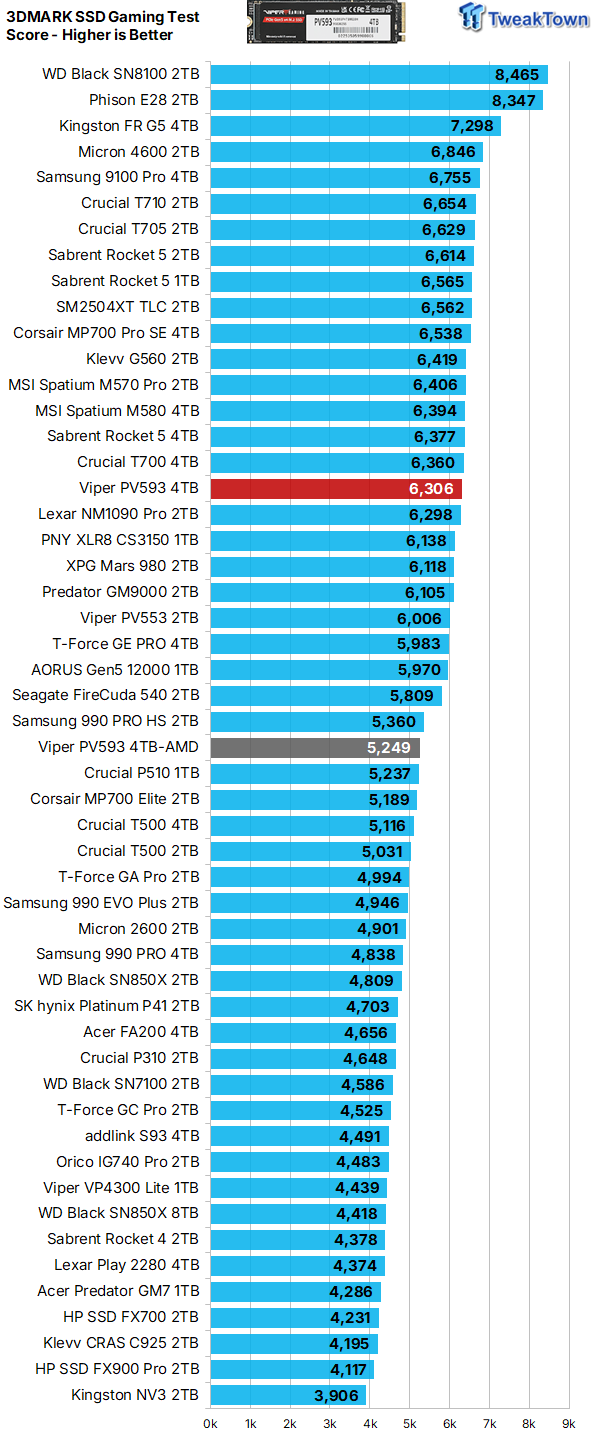
Gaming is a performance metric that matters to most DIY consumers, especially for the enthusiast crowd that TweakTown caters to. Now we've reached the point where results start to matter as they are a direct reflection of user experience.
We consider a score of 6,300 here to be somewhat of a milestone achievement. Our test subject delivers that and a bit more. This is the best we've seen coming from this hardware configuration. Outstanding.
PCM10 Storage Tests
PCMark 10 Storage Test is the most advanced and most accurate real-world consumer storage test ever made. There are four different tests you can choose from; we run two of them. The Full System Drive Benchmark and the Quick System Drive Benchmark. The Full System Drive Benchmark writes 204 GB of data over the duration of the test. These tests directly correlate with mainstream user experience.
PCMark 10 Full System Drive Benchmark
This test writes 204GB of data and covers a broad range of common consumer tasks, including booting Windows 10, file transfers, Adobe and Office applications, and startup times for games such as Battlefield V, COD Black Ops 4, and Overwatch. Unlike synthetic numbers, this is comprehensive real-world data, which is why we use it to rank SSDs in terms of user experience.


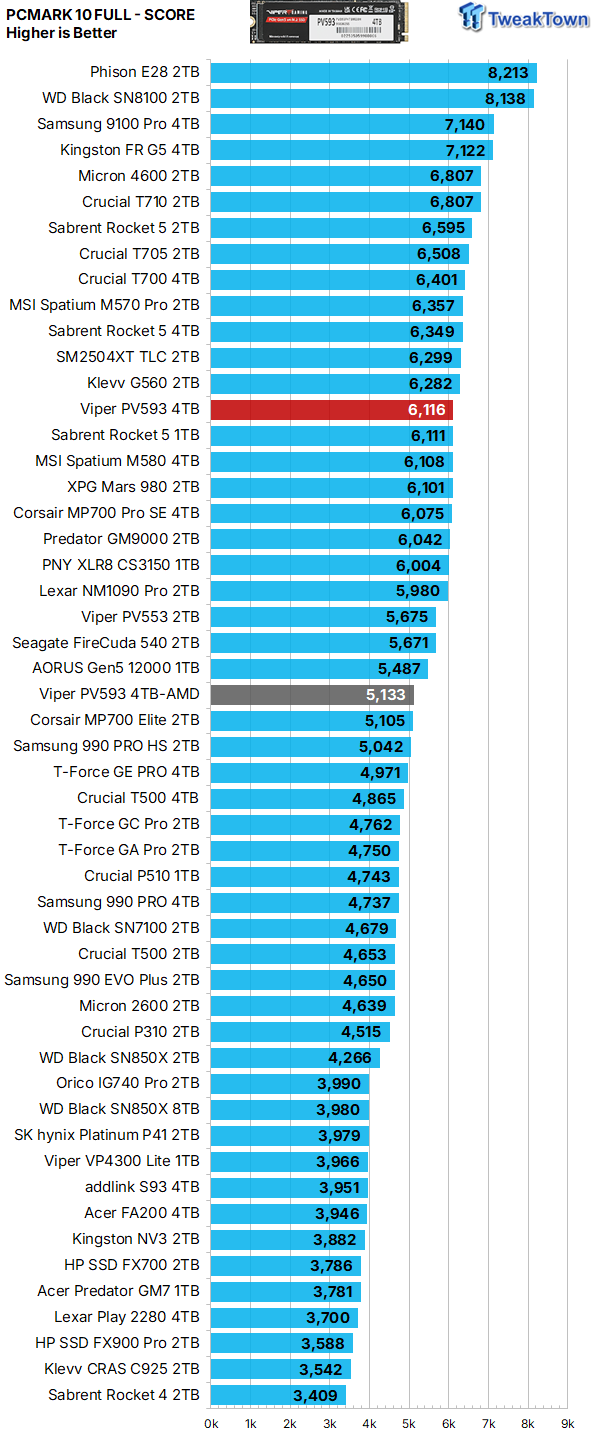
Again, our test subject delivers another high mark for this hardware configuration.
PCMark 10 Quick System Drive Benchmark
The Quick System Drive Benchmark writes 23 GB of data over the duration of the test.


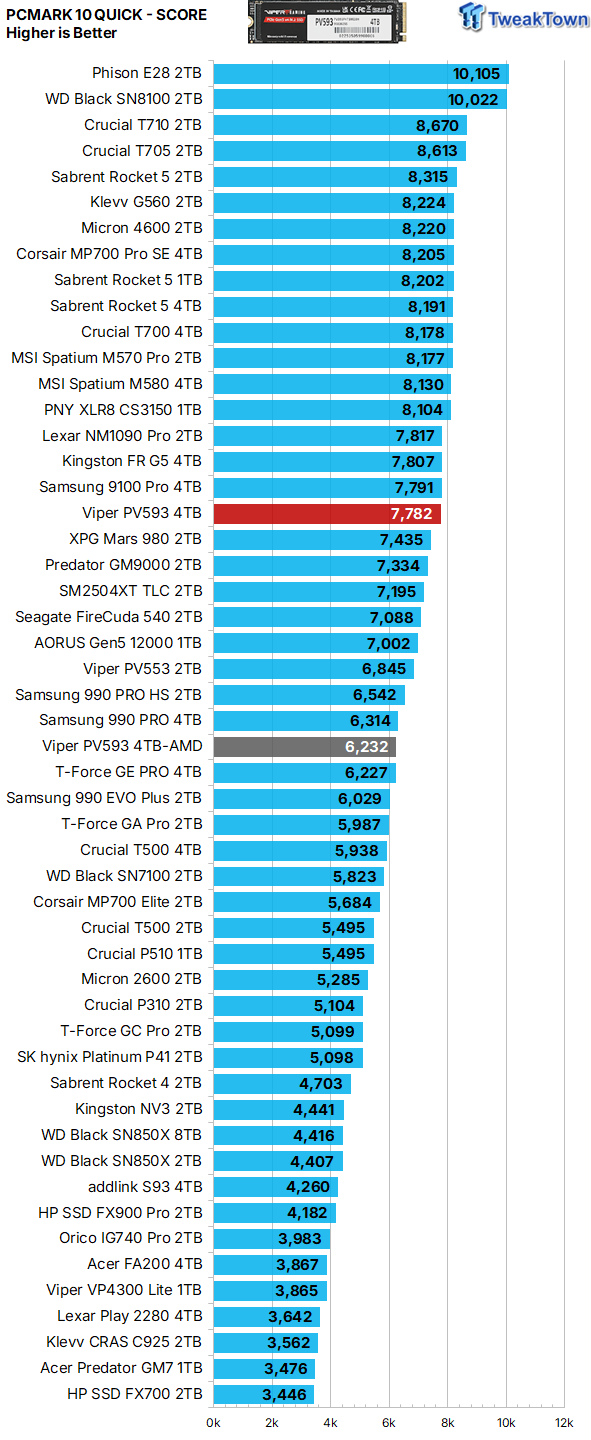
Of all the benchmarks we run, it can be argued that this one offers the best reflection of a typical consumer use case scenario. This time Lexar's NM1090 manages to clip our test subject, keeping its top spot for this hardware configuration.
Final Thoughts
Patriot briefly forayed into the PCIe Gen5 space last year with its Phison E26-controlled PV553 but seemingly pulled it back after a not-so-successful rollout, undoubtedly because the cost versus the heat versus the performance equation didn't appeal to enough consumers to make it a viable offering. Today, Patriot has remedied this unfortunate bit of recent history with its Viper PV593 SSD.
The Viper PV593, with its proven efficient hardware combination, gives us everything we want from a PCIe Gen5 flagship performer and nothing we don't want. The drive delivers massive real-world performance, blazing fast 14 GB/s speeds, a tame thermal profile, and does so for what we anticipate being an excellent price point.
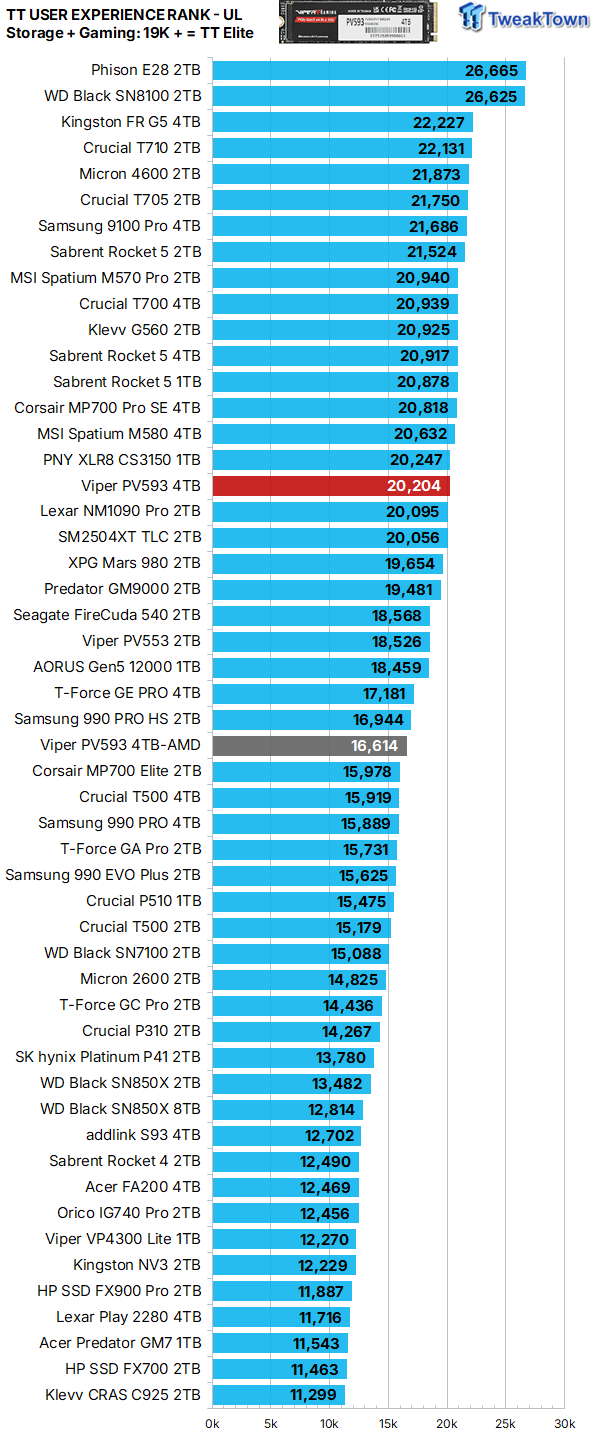
We rank SSDs in terms of overall user experience (performance where it matters most) as expressed by PCMark 10 storage and 3DMark gaming storage tests. Currently, we consider a user experience score of 19K or more to verify an SSD as a TweakTown Elite performer.
With a user experience score of 20,204, the Viper PV593 4TB is the best performing of its hardware configuration we've encountered so far. Impressive.

Massive performance and massive capacity, along with unparalleled efficiency, make for a highly desirable SSD if the price is right.


 HighPoint Rocket 1604L Gen5 x16 NVMe Software RAID AIC Review: half the price with full 59 GB/s speed
 UGREEN NASync DXP4800 GT Review: powerful 4-bay NAS with AMD Ryzen and dual 10GbE ports
 Phison E37T SSD Controller Exclusive Preview - The Fastest DRAMless SSD Platform Yet
 Seagate FireCuda X1070 4TB SSD Review - A New Mainstream Contender
 ASUSTOR Lockerstor 2 Gen2+ AS6702T v2 NAS Review - Fast Performance
 Assassin's Creed Black Flag Resynced sells over 5 times more copies than AC Shadows on Steam
 Obsidian to make a new Fallout game led by New Vegas director
 Even DDR4 RAM is not safe from the RAMpocalypse, prices rose over 50% in Q3 2026
 PlayStation Disc Phaseout Saga: What You Need to Know
 Samsung's first PCIe 6.0 SSD is now in mass production with ridiculous speeds
 Xbox's Elder Scrolls 6 strategy looks shakier after Bethesda layoffs
 The dreaded Steam Machine 'Red Line of Death' was fixed after a simple CMOS reset
 Samsung confirms next-gen Snapdragon power for its new foldable phones
 Apple's foldable iPhone may finally be ready for prime time in 2026
 Earth could escape being swallowed by the dying Sun, scientists say
 MOZA MGX1000 Instrument Panel Review: a realistic Garmin G1000 replica for immersive flight sims
 Simagic Zeus Formula Steering Wheel Review: premium build and advanced inputs for F1 racing
 GIGABYTE X870E Aero X3D Dark Wood Review - A woody goody
 The Super Mario Galaxy Movie (2026) 4K Ultra HD Blu-ray Review
 KTC H49S66 5K2K (5120x1440) 49-inch 180Hz Gaming Monitor Review
 Next Level Racing ERS3 Haptic Seat Review: immersive sim racing comfort with integrated haptics
 ASUS TUF Gaming X870-Pro WiFi7 W NEO Review - Tuffed up
 GIGABYTE GO27Q24G Gaming Monitor Review: Glossy OLED Gaming at 240Hz
 Lian Li B4-mATX Review: a compact mATX SFF case with excellent airflow and premium features
 Don't sell your Windows laptop until you do these things
 6 PC cleaning mistakes to avoid for safer hardware maintenance
 Phison and Intel Take Aim at Local AI's Memory Wall with aiDAPTIV
 How to Remap Keyboard Keys in Windows using Microsoft PowerToys
 7 tips to organize your Windows files for faster, easier access
 Intel Arc G3 Extreme first impressions with MSI's Claw 8 EX AI+ - Incredible power for an extreme price
 How to fix Wi-Fi Adapter Not Working on Windows laptops: troubleshooting tips
 Hisense U7SG 4K TV: Modern Entertainment for the New Age
 6 underrated Microsoft Word features worth using to boost your productivity
 Level Up Your PC Gaming with these Fantastic ASUS Prime Day Deals on GPUs, Motherboards, and More