


Our Verdict
Pros
- Incredible gaming performance
- Price
- Stand design
- OLED features
- Image clarity
Cons
- None
Should you buy it?
Introduction & Specification Details and Close-up
ASUS has made an effort to reduce the price of OLED gaming monitors with the release of the ROG Strix OLED X27UCDMG, which is a 27-inch 4K QD-OLED gaming monitor that sports a 240Hz refresh rate and 0.03ms response time.
OLED gaming monitors are the most expensive variant of gaming monitor available on the market, but as OLED pixel technology matures, they will become cheaper, and the XG27UCDMG is an example of that happening. The XG27UCDMG is a cut-down version of the ROG Swift OLED PG27UCDM, a gaming monitor that, when looking at the specifications, is extremely similar to the XG27UCDMG. However, there are a few key differences that have enabled ASUS to price the XG27UCDMG much lower than the PG27UCDM, making it a much more affordable OLED option for gamers.
Popular Now: The Witcher 3 remaster gets updated path tracing system requirements, requiring an RTX 5080 for 4KASUS has knocked off $200 from the price tag of the PG27UCDM to bring the XG27UCDMG down to about $900, depending on the website you are looking at. Currently, the XG27UCDMG is $979.99 at Best Buy and Newegg, while on Amazon, it's currently priced at $1,285. Despite these prices, I have seen the XG27UCDMG go on sale and hit the $900 mark, making it an extremely good value proposition for what you are getting. With that being said, let's see what ASUS has cooked up with the XG27UCDMG, and if it's worth purchasing the PG27UCDM over its cheaper sibling.
Specifications
| Item | Details |
|---|---|
| Model | XG27UCDMG |
| Size | 27-inch |
| Resolution | 3840 x 2160 |
| Panel Type | QD-OLED |
| Refresh Rate | 240Hz |
| Response Time | 0.03ms (GtG) |
| Brightness | 250nits |
| Contrast Ratio | 1,500,000:1 |
| Aspect Ratio | 16:9 |
| Viewing Angle | 178°/ 178° |
| Color Coverage | Color Space (DCI-P3): 99%, (sRGB) : 145% |
| HDR Support | HDR10 |
| Video Ports | DisplayPort 1.4 (DSC) x 1, HDMI (v2.1) x 2 |
| Ports | USB-C x 1 (DP Alt Mode), 3x USB 3.2 Gen 1 Type-A, USB-C PD: 90W |
| VESA Mounting | 100x100 |
| Adjustments | Tilt : Yes (+20° ~ -5°), Swivel : Yes (+45° ~ -45°), Pivot : Yes (+90° ~ -90°), Height Adjustment : 0~120mm |
| Warranty | 3-years |
| Net Weight (Kg) | Net Weight with Stand: 7.44 kg (16.40 lbs), Net Weight without Stand: 5.0 kg (11.02 lbs) |
Close-up


Best Deals: ASUS ROG Strix OLED XG27UCDMG
Price Trend:
Prices last scanned 2 hours and 20 minutes ago

7 days ago: $937.58 USD

7 days ago: $1222.45 CAD
7 days ago: $1500 CAD30 days ago: $1507 CAD


Design
There are very few differences between the PG27UCDM and the XG27UCDMG when it comes to physical design, with both of the monitors featuring the iconic ASUS "eye" logo on the back compartment that houses all of the components. In fact, the monitors are identical when looking at them from the back, with the only difference being in the stand.
While the XG27UCDMG uses a stand from the Stix line-up, the PG27UCDM uses a stand from the Swift line-up. The difference between the two is in the quality of the stand and the feet. The XG27UCDMG stand is slightly lighter, has a more simplified aesthetic, and features cheaper materials on the outer edges, with the XG27UCDMG using a more plasticy material versus the PG27UCDM.

Moreover, the feet on the PG27UCDM are forked compared to the square base on the XG27UCDMG. Personally, I prefer the square foot on the XG27UCDMG as it takes up less desktop real estate, making it more versatile for a range of desk sizes. Additionally, I just think the XG27UCDMG looks cleaner, and since the base is square, ASUS has slapped a cutout on it for a smartphone, which is a nice touch. Moving to the back of the monitor, the XG model has the same back enclosure as the PG variant, which has been split into two parts: one with the ROG "eye" logo on one side that is almost blurred with a plastic coating, and the other featuring ROG branding in the bottom left corner.
As I mentioned in my review of the PG variant, I'm not totally thrilled about the eye on the back enclosure, as the reflective plastic coating diffuses the light emitted by the LEDs in an unappealing way. But I do recognize this is personal preference, and ultimately a very small critique.
Our Latest Monitors Review Coverage
- Alienware AW3426DWM 34-inch 240Hz Gaming Monitor Review
- ASUS ROG Strix OLED XG34WCDMS Review: Tandem OLED Takes Ultrawide Gaming Further
- GIGABYTE MO27Q2A Gaming Monitor Review: 1440p, 280Hz, and QD-OLED is a winning combination
- ASUS ROG Strix XG129C Review: A $199 Gaming Monitor You Don't Play Games On
- KTC H49S66 5K2K (5120x1440) 49-inch 180Hz Gaming Monitor Review
Keeping to the back of the monitor and moving down to the connectivity options. Here's where ASUS has made some changes. The PG model features the bleeding-edge 1x DisplayPort 2.1 port, which increases the maximum bandwidth up to 80Gbps from 32.4 Gbps on DisplayPort 1.4. What is the difference between these DisplayPorts? In a side-by-side comparison, absolutely nothing at all. I've tested many monitors with 1.4 and compared them against 2.1 ports, and I have yet to see any visual difference in the output image.

DisplayPort 1.4 with DSC is completely fine at 4K 240Hz, and anyone who is claiming these high-end monitors NEED to have 2.1 isn't taking into account the real-world experience of the display. Yes, on paper it's technically better, but does "technically better" matter if it doesn't translate to real-world experience?
Now, it is possible that at higher resolutions, such as 8K, there would be some difference in visual quality. I can't comment on that as I haven't tested those displays. But out of what I have tested, I can't notice any difference between the two DisplayPorts. So, why would you want DisplayPort 2.1 over 1.4? The only way I'd recommend going for 2.1 over 1.4 is future-proofing yourself, but even then, it's a hard recommendation since DisplayPort versions are backwards compatible anyway. Moreover, DisplayPort 2.1 is exclusive to the latest generation of graphics cards, so it's only worth purchasing a monitor with 2.1 if you own one of those GPUs, making it an even harder recommendation.
As for the other connectivity options, the XG and PG models are identical with 2x HDMI 2.1, 1x USB-C, 3x USB 3.2 Gen 1 Type-A, 1x 3.5mm headphone jack, and 90W power delivery via the USB-C port.
Panel Breakdown
Since the PG and XG models use the exact same QD-OLED panel from Samsung Display, the panel performance between these two monitors is exactly the same. Additionally, ASUS has kept all of the premium features of the PG model in the XG, which is great to see. For example, the XG features the Neo Proximity Sensor, which is a feature intended to reduce the likelihood of burn-in.

It works through an infrared sensor integrated into the chin of the monitor, specifically under the ASUS eye logo on the front of the display. The sensor measures the distance between the user and the monitor, and when the set distance is exceeded by the user, say 90cm, the monitor screen will automatically turn black, giving those QD-OLED pixels a break.
This feature is fantastic and enables users to rest easy about burn-in occurring on their new monitor, as the pixels aren't working unnecessarily when the user isn't at the monitor. However, there is a caveat to this feature. It does take some testing to get it right. ASUS has equipped the feature with "Tailored Mode," which is what I recommend using, as it enables a custom distance to be set.
However, I found throughout my testing that during gaming, I move around much more than I expected, which sometimes made the monitor screen go black mid-game. It took some tweaking, but I eventually found that setting the distance further than I initially expected works best, as it accounted for any time I leaned back in my chair, readjusted my sitting position, etc.
As for the panel, this gorgeous Samsung Display QD-OLED panel is best-in-class when it comes to visual fidelity, as it's a 27-inch 3840 x 2160 (4K) panel with a 240Hz refresh rate. At those measurements and resolution, we have an intensely good Pixels Per Inch (PPI) of 163, which translates to ultra-crisp images. With the QD-OLED technology, we also get ultra-low response times of just 0.03ms (GtG), and an infinite contrast ratio that altogether makes for an unmatched visual experience.
There isn't a single difference between the panel in PG and the panel in the XG, so if you don't care about the stand or DisplayPort 2.1, you will be getting the exact same monitor, just much cheaper.
Performance
As with all of my gaming monitor reviews, I like to run the display I have under the spotlight through a variety of different games to see which type of gamer would best enjoy the display. That way, you can rule yourself/in or out depending on what type of games you play. Here are the games I tested on the XG27UCDMG: Overwatch 2, DOOM: The Dark Ages, League of Legends, God of War: Ragnarok, Cyberpunk 2077, Valorant, Apex Legends, Age of Mythology: Retold, Black Myth: Wukong, Counter Strike 2, and The Witcher 3: Wild Hunt.

The gaming experience with the XG, along with any other 4K 27-inch QD-OLED panel, is unmatched in this category of display. There truly isn't a better gaming experience at 27 inches, unless you are going for specific scenarios such as intensely high framerates beyond 240Hz. However, the XG is an example of 4K 27-inch gaming monitors providing the pinnacle PC gaming experience, with the only other monitor that can match it being a 32-inch 4K QD-OLED version of the same panel.
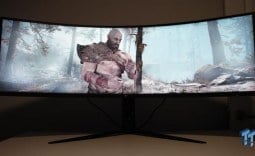
It cannot and shouldn't be understated how much the XG ate up every single game I threw at it. They all look stunning, and I experienced zero screen tearing, anomalies, or problems. Just the PG, the XG is a feast for the eyes and is a level of gaming performance that I can confidently recommend to any type of gamer, regardless of the genre of games they play.

The infinite contrast ratio creates rich, milky colors that pair perfectly next to the true black provided by the OLED pixels. The colors, combined with the 240Hz refresh rate and 0.03ms (GtG) response time, made the XG excel in games such as Apex Legends, DOOM: The Dark Ages, Overwatch 2, and League of Legends. With these kinds of specifications, the XG is great for both competitive and cinematic gaming, as the 4K QD-OLED pixels really show what they are capable of in cinematic titles, while the response time and refresh rate create a buttery experience in titles that call for clarity in fast motion-based games.
It is honestly hard to find a fault with the XG when it comes to the gaming experience. This is truly one of, if not the best, jack-of-all-trades PC gaming monitors. As I wrote in my PG review, I challenge anyone to find me a game that doesn't look and feel amazing on this monitor. 27-inch 4K QD-OLED is peak PC gaming.
Final Thoughts
So, should you buy the XG27UCDMG for $979? If you can catch this monitor on a deal and snag it for $900, I would absolutely pick it up if I were looking to make the jump from 1080p/1440p to 4K and weren't interested in 32-inch models. But even at $979, it's still an extremely good deal, especially when it's essentially a cutdown version of the PG27UCDM, but with the same gaming experience.

ASUS has removed some of the more expensive parts of the PG27UCDM and left the components to provide an identical gaming experience. So, if you don't care for DisplayPort 2.1, Dolby Vision, or the aesthetics of the stand, definitely choose the XG27UCDMG over the PG27UCDM as the gaming experience is identical, and you can save $200 by going with the XG.
In some ways, ASUS has made the PG27UCDM obsolete by releasing the XG27UCDMG, as gamers who only care about gaming performance should never opt for the more expensive variant, unless they are really looking to future-proof themselves with that DisplayPort 2.1 or plan to use the monitor for watching content that has Dolby Vision. Even then, I would still be steering those buyers to saving that $200 and going with the XG27UCDMG, as you get a better stand that takes up less desktop real estate.
Ultimately, the XG27UCDMG and the PG27UCDM stand as examples of what someone can experience in the world of PC gaming, and I cannot get enough of either. Incredible work here, ASUS.