














NASA has big plans for its return to the moon under the space agency's Artemis Program, and now a new proposal has surfaced under NASA's Innovative Advance Concepts (NIAC) Program that could, if approved, put a massive telescope on the dark side of the moon.
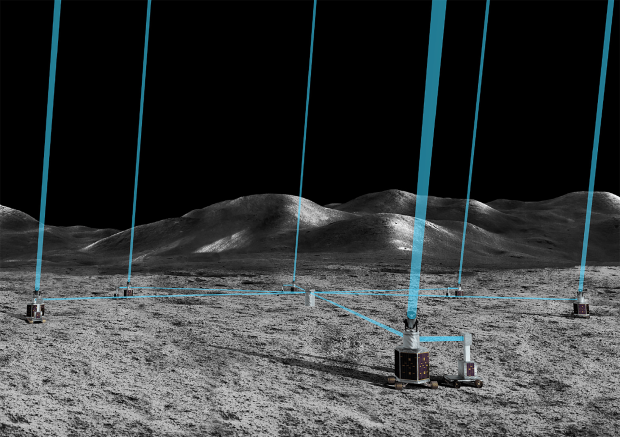
The new proposal written by Kenneth Carpenter and his colleagues at NASA Goddard Space Flight Center (GSFC) details a Long-Baseline Optical Imaging Interferometer (LBI) designed for the dark side of the moon, and would be called the Artemis-enabled Stellar Imager (AeSI). The telescope would consist of an array of smaller telescopes designed to image objects and regions of space in ultraviolet and visible wavelengths.
The proposal states there is massive potential for having an observatory on the lunar surface due to the "radio quiet" nature of the environment and prolonged periods of darkness. For those that don't know, the moon is tidally locked to Earth, meaning one of the sides of the moon is always facing toward Earth, hence the name description "dark side of the moon". Due to this gravitational phenomenon, two weeks on the lunar surface consists of one Earth day, which means the dark side of the moon will be in total darkness for two weeks at a time.
"One obvious candidate is extremely high-resolution interferometric imaging at visible and ultraviolet wavelengths. This can resolve the surfaces of stars, probe the inner accretion disks surrounding nascent stars and black holes, and begin the technical journey towards resolving surface features and weather patterns on the nearest exoplanets," writes NASA
This environment is perfect for high-resolution interferometric imaging, a method of observing the universe through gathering large swaths of light and identifying any patterns of interference.
"A fully developed facility will be large and expensive, but it need not start that way. The technologies can be developed and tested with 2 or 3 small telescopes on short baselines. Once the technology is developed, baselines can be lengthened, larger telescopes can be inserted, and the number of telescopes can be increased. Each of these upgrades can be accomplished with minimal disruption to the rest of the system," added NASA
![Photo of the PlayStation Store Gift Card [Digital Code]](https://m.media-amazon.com/images/I/41cEZpeUA1L._SL160_.jpg)


 NASA fast tracks plans to build a nuclear reactor on the Moon
 NASA unveils date for when humans will explore the Moon
 The iPhone 17 Pro has made it to space, as the Artemis II crew is seen throwing around Apple's flagship in zero gravity
 We are now beaming back incredible Full HD footage of the Moon before landings
 NASA confirms cracked heatshield in Orion test won't kill the astronauts going to the Moon
 Iconic N64 shooter GoldenEye 007 is getting a native PC port
 Diablo 4 is coming to the Switch 2 with both expansions in a special Age of Hatred Collection
 CXMT DDR5 memory hits 9,000 MT/s speed milestone on AMD AM5 motherboard
 Sony says PlayStation 6 release date and pricing are still up in the air
 Lexar's DRAM-less Thor Ultra series PCIe Gen 5 SSDs are built for desktop and laptop PC gaming
 Gaming monitors are next in line for a price hike as manufacturers can no longer absorb costs
 Linux 7.2 makes TSC support mandatory for x86 CPUs, but it's not like Windows 11's TPM 2.0 check
 ChatGPT can now build a timeline of everything you do on your Mac
 Redditor finds a working RTX 2080 Super in the dump, gets a huge free upgrade
 Redditor sends a gaming laptop with 64GB RAM for repair, comes back with 32GB RAM
 Cooler Master HAF II 500 Mid-Tower Chassis Review
 Corsair HS35 v3 Wireless Gaming Headset Review - An Affordable Winner
 D-Link F518 5G Wi‑Fi 6 AX1800 Mobile Hotspot Review: All-Day Mobile Hotspot
 Bose Lifestyle Ultra Speaker Review - Impressively Detailed Room-Filling Sound
 MSI Z890 Gaming Plus WIFI6E Review - Z890 for under $200
 Mortal Kombat (1995) 4K Ultra HD Blu-ray Review
 CPS PCCOOLER YS1200 ATX 3.1 80 PLUS Gold PSU Review
 ASRock X870E Taichi White Review: a premium AM5 motherboard with 10G LAN and WiFi 7
 Asetek Initium Pedal Modular Upgrades Review
 Thinkware U3000 Pro Review - Smart Dashcam with Wi-Fi quirks
 Using Multiple Monitors? Change these Windows settings for a Better Experience
 Windows Sandbox is The Windows Security Feature Most People Never Use
 I ditched the Windows 11 context menu for this open-source tool, and here's why
 Windows 11 may be encrypting your drive already, and I checked where my recovery key went
 GIGABYTE's 40 Days of INFINITY celebrates 40 Years of Innovation with stunning GeForce RTX graphics cards and rewards
 I swapped File Explorer for this free file manager and finally got the layout I wanted
 How to tell if someone has been using your Windows PC without your permission
 6 Task Manager tips for troubleshooting Windows performance problems
 ASUS ROG's 20th Anniversary Line-up of Premium PC Gaming Gear has Arrived - Here's Everything You Need to Know
 Six File Explorer tips every Windows user should know