




NASA's James Webb Space Telescope has pointed its extremely sensitive instruments at an exoplanet located 280 light-years away from Earth.
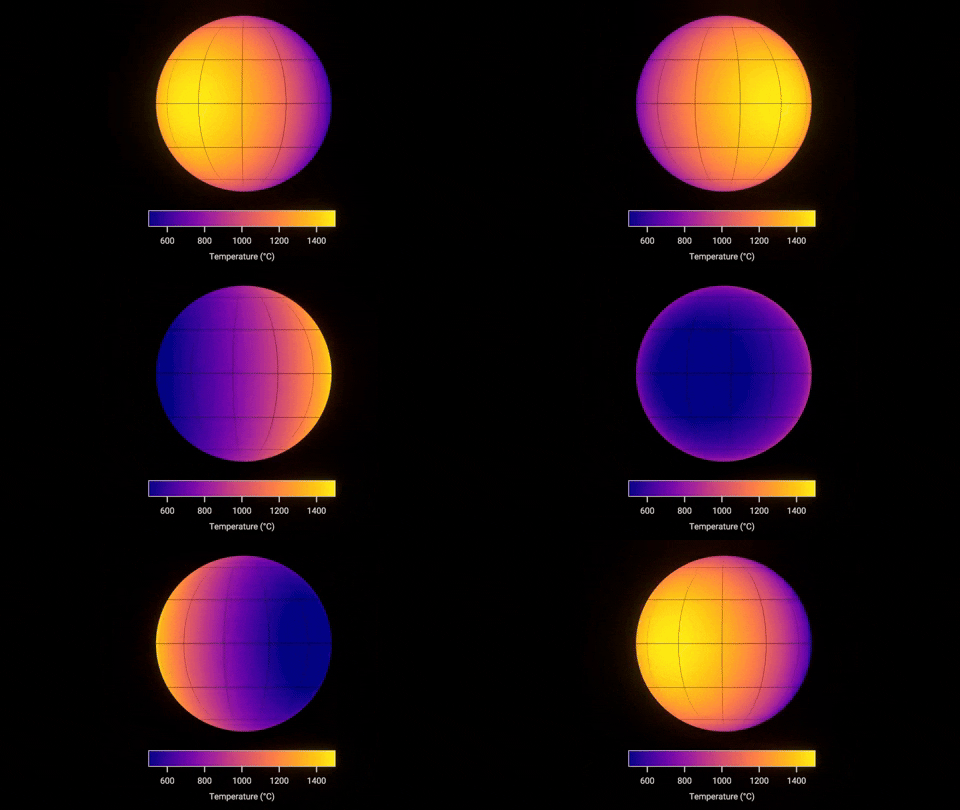
Researchers used the telescope's mid-infrared light spectrometer to map the weather patterns of an exoplanet known as WASP-43 b, a gas giant that is located in the Sextans constellation. The team published their findings in the journal Nature Astronomy where they explain that one side of the exoplanet is covered in thick cloud coverage, and the other side has clear skies. Additionally, the team found that WASP-43 b has equatorial winds that can reach speeds of up to 5,000 mph.
So, why is WASP-43 b so different from Earth? It's mostly due to its position relative to its host star. WASP-43 b orbits its host star at a distance of just 1.3 million miles, which results in the exoplanet becoming tidally locked with the star. When an astronomical object is tidally locked, there is continuous daytime and nighttime on specific sides of the object. An example of this would be the dark side of the moon.
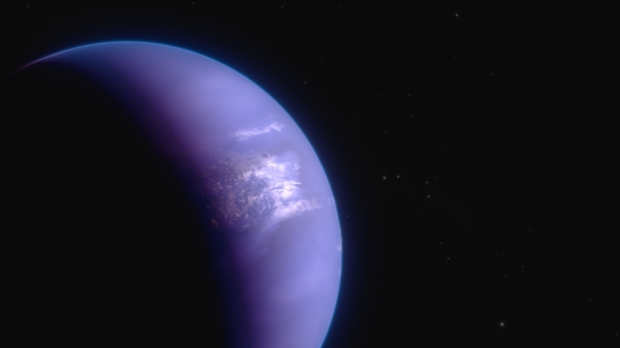
One side of the exoplanet is continuously blasted by rays from the sun, increasing surface temperatures to 2,300 degrees Fahrenheit on its dayside, which is hot enough to forge with iron.
"Both Hubble and Spitzer suggested there might be clouds on the nightside," Bell added. "But we needed more precise measurements from Webb to really begin mapping the temperature, cloud cover, winds, and more detailed atmospheric composition all the way around the planet."
"By observing over an entire orbit, we were able to calculate the temperature of different sides of the planet as they rotate into view," said Bell. "From that, we could construct a rough map of temperature across the planet."
![Photo of the $10 -PlayStation Store Gift Card [Digital Code]](https://m.media-amazon.com/images/I/41MT2s0Gm2L._SL160_.jpg)