









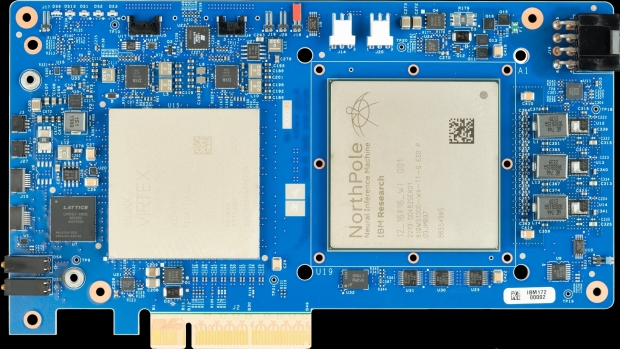




IBM Research has spent the last 8 years working on its first-ever AI-dedicated chip, which it just unveiled as NorthPole, with the tech giant saying it is 22x faster than any other industry offering.
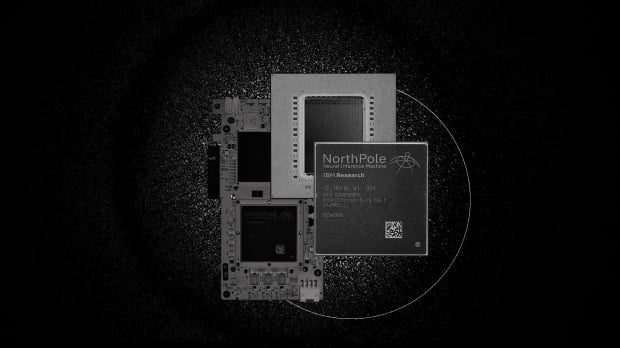
IBM's new AI accelerator, codenamed NorthPole has one aim: passing the computing performance of the industry leaders and meeting the insatiable demand for all-things AI. IBM is doing something a little different with its new NorthPole AI chip when compared to competitors in NVIDIA, AMD, and others.
The NorthPole project's leader, Dharmendra Modha, can see a bright future with the chip architecture being different. IBM Research has said that it is combining inference architectures into the chip itself, which is how Modha can refer to NorthPole as a "human brain". It has efficient CPU interconnectivity with an all-digital architecture that allows for inter-communication being much faster... which is where the dominance in AI processing comes from IBM's new NorthPole chip.
IBM is using the older and proven 12nm process node, but the company still thinks its new NorthPole AI chip on 12nm surpasses current-gen AI GPUs that are made on 4nm over at TSMC (Taiwan Semiconductor Manufacturing Company). How? IBM says it's due to using the ResNet-50 neural network model, which negates Moore's Law -- yeah -- and moves towards Huang's Law, which has individual chip stacking being the objective versus process shrinking.
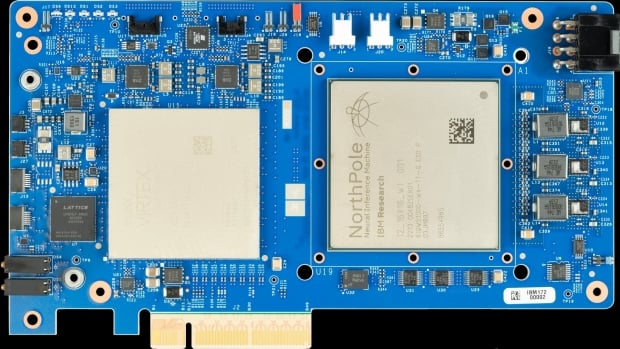
NorthPole measures 800mm square, packing only 22 billion transistors -- compare that to NVIDIA's GH100 AI die that measures in at a barely bigger 814mm square but packs an insane 80 billion transistors. NorthPole packs 256 cores that are capable of performing 2048 operations-per-core, per-cycle at 8-bit precision, so if the AI model fits inside of the memory, NorthPole is incredibly fast.
IBM's new NorthPole AI processor can only perform AI inferencing, so it can't be used to train large language models (LLM) like GPUs or CPUs from NVIDIA, AMD, and Intel. NorthPole cannot run GPT-4, in case you were wondering.
Modha said: "It's an entire network on a chip. Architecturally, NorthPole blurs the boundary between compute and memory. At the level of individual cores, NorthPole appears as memory-near-compute and from outside the chip, at the level of input-output, it appears as an active memory".
He added: "We can't run GPT-4 on this, but we could serve many of the models enterprises need," Modha said . "And, of course, NorthPole is only for inferencing".


 IBM unveils Telum II CPU with 8 cores at 5.5GHz, Spyre AI accelerator: 300+ TOPS, 128GB LPDDR5
 IBM announces world's first sub-1 nanometer chip with nanostack technology doubling transistor density
 Intel's new Gaudi 3 AI accelerator launched: cheaper than NVIDIA H100 AI GPU, but also slower
 AMD details Instinct MI300X MCM GPU: 192GB of HBM3 out now, MI325X with 288GB HBM3E in October
 Qualcomm unveils Wi-Fi 8 chip, commits to 6G global launch in 2029
 CXMT DDR5 memory hits 9,000 MT/s speed milestone on AMD AM5 motherboard
 Sony says PlayStation 6 release date and pricing are still up in the air
 Lexar's DRAM-less Thor Ultra series PCIe Gen 5 SSDs are built for desktop and laptop PC gaming
 Gaming monitors are next in line for a price hike as manufacturers can no longer absorb costs
 Linux 7.2 makes TSC support mandatory for x86 CPUs, but it's not like Windows 11's TPM 2.0 check
 ChatGPT can now build a timeline of everything you do on your Mac
 Redditor finds a working RTX 2080 Super in the dump, gets a huge free upgrade
 Redditor sends a gaming laptop with 64GB RAM for repair, comes back with 32GB RAM
 GPU Tweak III can now detect and shut down a PC when a 12V-2x6 graphics card goes over a certain current limit
 CPS PCCOOLER unveils all-in-one modular PC where you can replace the display and upgrade its hardware
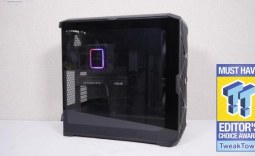 Cooler Master HAF II 500 Mid-Tower Chassis Review
 Corsair HS35 v3 Wireless Gaming Headset Review - An Affordable Winner
 D-Link F518 5G Wi‑Fi 6 AX1800 Mobile Hotspot Review: All-Day Mobile Hotspot
 Bose Lifestyle Ultra Speaker Review - Impressively Detailed Room-Filling Sound
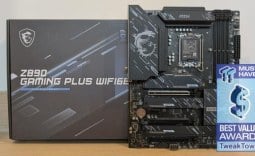 MSI Z890 Gaming Plus WIFI6E Review - Z890 for under $200
 Mortal Kombat (1995) 4K Ultra HD Blu-ray Review
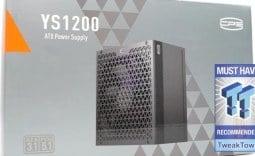 CPS PCCOOLER YS1200 ATX 3.1 80 PLUS Gold PSU Review
 ASRock X870E Taichi White Review: a premium AM5 motherboard with 10G LAN and WiFi 7
 Asetek Initium Pedal Modular Upgrades Review
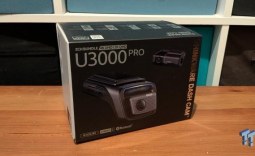 Thinkware U3000 Pro Review - Smart Dashcam with Wi-Fi quirks
 Using Multiple Monitors? Change these Windows settings for a Better Experience
 Windows Sandbox is The Windows Security Feature Most People Never Use
 I ditched the Windows 11 context menu for this open-source tool, and here's why
 Windows 11 may be encrypting your drive already, and I checked where my recovery key went
 GIGABYTE's 40 Days of INFINITY celebrates 40 Years of Innovation with stunning GeForce RTX graphics cards and rewards
 I swapped File Explorer for this free file manager and finally got the layout I wanted
 How to tell if someone has been using your Windows PC without your permission
 6 Task Manager tips for troubleshooting Windows performance problems
 ASUS ROG's 20th Anniversary Line-up of Premium PC Gaming Gear has Arrived - Here's Everything You Need to Know
 Six File Explorer tips every Windows user should know