











The skeletal remains of a "female vampire" have been uncovered in the village of Pien, Poland.

Researchers from the nearby Nicholas Copernicus University were conducting archaeological work at a seventeenth-century cemetery in the village when they uncovered the human remains, buried with a sickle and padlock. The researchers also found the skull adorning a silk cap, indicating the woman once held high social status. The sickle was laid over the throat, while one of the big toes was padlocked to supposedly 'prevent her returning from the dead.'
Professor Polinski said that the padlocked toe was likely symbolic of 'the closing of a stage and the impossibility of returning.' While he noted that the burial was unusual, similar burial sites have been found throughout the region, with bodies either having sickles placed similarly or skulls impaled with stakes or metal rods, under the belief that this would stop anyone returning from the dead.
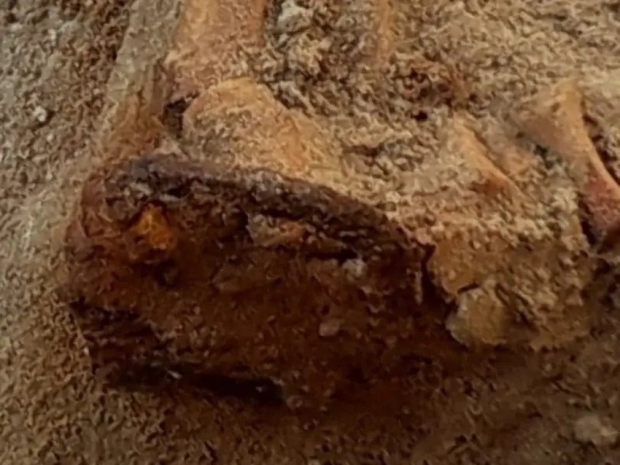
"Ways to protect against the return of the dead include cutting off the head or legs, placing the deceased face down to bite into the ground, burning them, and smashing them with a stone. The sickle was not laid flat but placed on the neck in such a way that if the deceased had tried to get up most likely the head would have been cut off or injured," said Professor Dariusz Polinski from the Nicholas Copernicus University, who led the research team.
In 2015, about 130 miles (209 kilometers) away in Drawsko, archaeologists found five sets of remains with sickles pressed against their throats or across their hips. They were found in a 400-year-old cemetery and included men and women ranging from 14 and 60 years old when they died.
"When placed in burials they were a guarantee that the deceased remained in their graves and therefore could not harm the living, but they may also have served to protect the dead from evil forces," said archaeologists from Drawsko at the time.

 Vampire The Masquerade: Bloodlines gets an impressive RTX Remix mod
 Blood of Dawnwalker features an omni-directional sword combat system
 Vampire Survivors-like Halls of Torment breaks 1 million sales, coming to PlayStation and Xbox
 Elder Scrolls IV: Oblivion Remastered's first big post-launch update is here
 Roblox loses $12 billion in market cap amid ongoing child predator controversy
 AMD Ryzen 7 7700X3D leaked, 8 cores up to 4.5 GHz, and 96MB L3 cache
 Forza Horizon 6 breaks player records on PC, premium edition copies achieve platinum sales
 Intel wants to make Wildcat Lake laptops cheaper under 'Project Firefly'
 Forza Horizon 6 finally works on the Steam Deck and Linux gaming PCs thanks to a Proton hotfix Valve silently pushed to Steam
 Fortnite back on App Store after missing out on billions during Epic v Apple court case
 LEGO Batman: Legacy of the Dark Knight confirmed hacked and uploaded hours before official launch
 Huawei unveils 4K 160Hz/320Hz dual-mode monitor with 100W USB-C charging
 Apple Watch to get new blood pressure sensing feature, slated to launch in 2026
 Krafton CEO's ChatGPT legal strategy backfires as Subnautica 2 breaks records
 Elon Musk loses OpenAI trial: statute of limitations prevented a Musk victory
 SAMA S50 Mid-Tower Chassis Review
 Montech Ten SFF Chassis Review
 PCCooler CPS RZ620M X CPU Cooler Review
 Memblaze PBlaze 7 7A40 Ocean 61.44TB Enterprise SSD Review - Oceans of QLC at 3.3 million IOPS
 MOZA SGP Sequential Sim Racing Shifter Review
 COLORFUL iGame GeForce RTX 5070 Ultra OC Review - When Style and Performance Meet
 GIGABYTE Z890 AORUS Elite WiFi7 Plus Motherboard Review - Right in the sweet spot
 PNY GeForce RTX 5080 Slim OC Review - A Compact 4K Powerhouse
 HP OmniBook 7 (Panther Lake) 16" Laptop Review
 ASUS ROG Strix X870E-E Gaming WiFi7 NEO - A Crosshair by any other name
 What Happens If You Don't Activate Windows 11? 5 Downsides Explained
 Fast Internet on Your Phone but Slow on Your PC? Try These Fixes
 The Snipping Tool quietly became the only screenshot app I keep installed on Windows 11
 How to Set Up a Windows Computer for a Senior User
 Bluetooth Toggle Missing in Windows? Try These Fixes
 GPU Overclocking Basics in Windows 11: Safe Performance Gains Without the Guesswork
 GIGABYTE's new Ultimate OLED Gaming Monitor Bundle includes Xbox Game Pass
 I automated 5 annoying Windows maintenance tasks, and my PC basically runs itself
 How to Fix Windows 11 Black Screen on Boot or After Login
 The first 8 settings I disable on every fresh Windows 11 install in 2026