












Roughly 500 light-years away in the Chamaeleon constellation, within its star-forming region is a reflection nebula designated IC 2631.
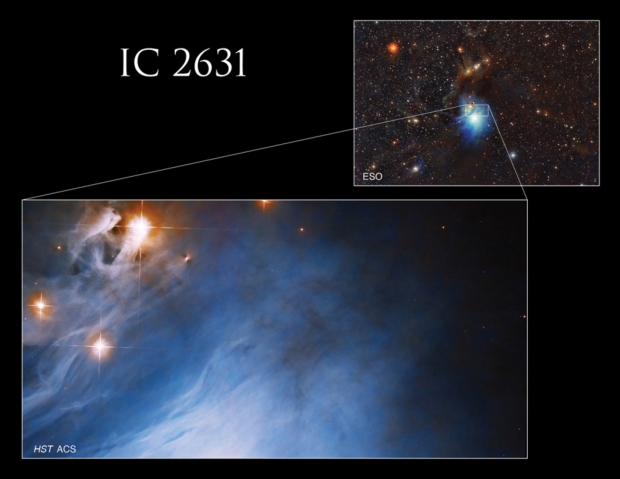
"Reflection nebulae are clouds of gas and dust that reflect the light from nearby stars. The starlight scatters through the gas and dust like a flashlight beam shining on mist in the dark and illuminates it. Because of the way light scatters when it hits the fine dust of the interstellar medium, these nebulae are often bluish in color," according to Hubble astronomers.
IC 2631 is the brightest nebula in the Chamaeleon Complex, where numerous protostars form and grow. Amongst the clouds of gas and dust, stars are born as clouds collapse under their gravity. The Hubble telescope can detect infrared emissions from the heat energy released from clouds contracting around a protostar. Once enough material gathers, and the protostar's core becomes dense and hot enough, it completes its transformation into a star.
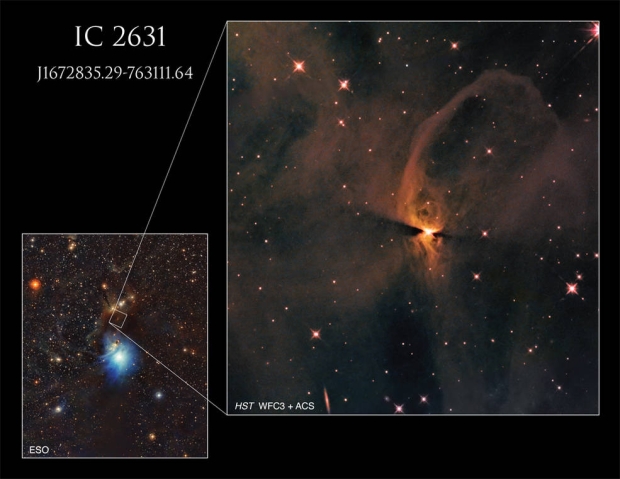
While the protostar J1672835.29-763111.64 was spotted in the IC 2631 region of the Chamaeleon constellation, in the constellation Aquila, another star-forming constellation designated G035.20-0.74 was captured, producing a beautiful image.
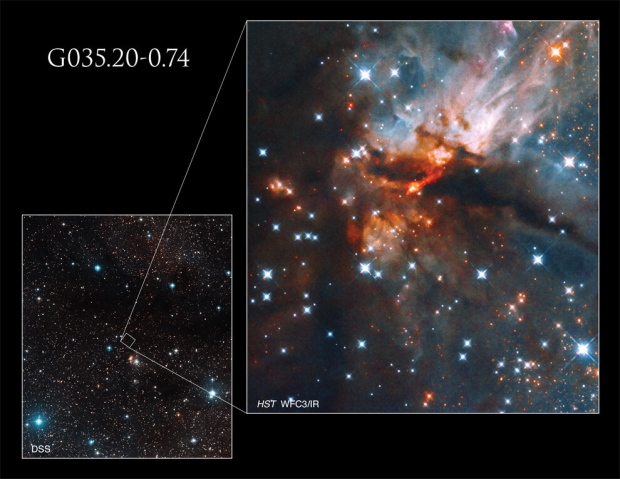
These images are part of a Hubble survey of 312 protostars previously identified with the Spitzer and Herschel infrared space observatories. Protostars are primarily visible in the infrared part of the electromagnetic spectrum since much of their energy is emitted as heat. The clouds of dust surrounding them obscure any visible light they emit. Combining these infrared observations with those from radio telescopes help researchers to see deeper into these hidden regions than they otherwise would.
More Hubble imagery can be seen on its website.


 NASA lifts the veil on the corpse of a star about 20 times as big as the Sun
 NASA telescope photographs planet-transforming grains in deep space
 World's most powerful telescope spots an 'Eye of Sauron' in deep space
 NASA captures a 'boom' in space from 600 million light years away
 NASA telescope discovers cosmic fossil lurking in deep space
 Twitch opts streamers into gen AI training by default, faces harsh backlash
 Sean Murray still plays the 2016 launch version of No Man's Sky
 China's YMTC has climbed to third place in global NAND flash shipments
 $100 GTA 6 version makes up 89% of pre-orders, analysts estimate
 HWiNFO's latest update quietly confirms Intel is working on Razor Lake-AX
 Nintendo puts Switch 2 price increase warnings on store demo kiosks ahead of September 1 hike
 GIGABYTE launches two new B450 motherboards as demand for AM4 stays high in 2026
 Microsoft finally makes up its mind and unifies Copilot features into one big app
 PS5 suffers from severe overheating after liquid metal eats into the heatsink
 AMD Ryzen 7 7800X3D CPU burns and swells even after using AMD's updated BIOS
 D-Link F518 5G Wi‑Fi 6 AX1800 Mobile Hotspot Review: All-Day Mobile Hotspot
 Bose Lifestyle Ultra Speaker Review - Impressively Detailed Room-Filling Sound
 MSI Z890 Gaming Plus WIFI6E Review - Z890 for under $200
 Mortal Kombat (1995) 4K Ultra HD Blu-ray Review
 CPS PCCOOLER YS1200 ATX 3.1 80 PLUS Gold PSU Review
 ASRock X870E Taichi White Review: a premium AM5 motherboard with 10G LAN and WiFi 7
 Asetek Initium Pedal Modular Upgrades Review
 Thinkware U3000 Pro Review - Smart Dashcam with Wi-Fi quirks
 Montech TG3 Mid-Tower Chassis Review
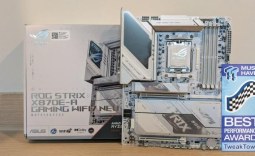 ASUS ROG Strix X870E-A Gaming WiFI7 Neo Review - A New Enticing Option
 I ditched the Windows 11 context menu for this open-source tool, and here's why
 Windows 11 may be encrypting your drive already, and I checked where my recovery key went
 GIGABYTE's 40 Days of INFINITY celebrates 40 Years of Innovation with stunning GeForce RTX graphics cards and rewards
 I swapped File Explorer for this free file manager and finally got the layout I wanted
 How to tell if someone has been using your Windows PC without your permission
 6 Task Manager tips for troubleshooting Windows performance problems
 ASUS ROG's 20th Anniversary Line-up of Premium PC Gaming Gear has Arrived - Here's Everything You Need to Know
 Six File Explorer tips every Windows user should know
 I switched my PC to encrypted DNS in Windows 11, and browsing felt more private
 Printer Not Working in Windows? How to fix detection, print queues and drivers