












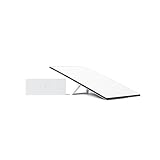
SpaceX has unveiled the Starlink V5 satellite internet kit, delivering nearly half a gigabyte per second of download speed in a more compact, lightweight form factor.

The latest iteration outperforms its predecessor in power efficiency and touts that it will enable seamless streaming, gaming, and video conferencing experiences for home users. According to the company, Starlink V5 brings peak speeds of up to 375+ Mbps, which is quite considerable when the median internet speed in the US is 306 Mbps, according to SpeedTest.net.
Starlink V5 actually marks a shift for SpaceX, as the company is now focusing on refining its hardware with the goal of making Starlink appropriate for stationary use. The idea is that SpaceX wants to grow its already expansive network, and making a Starlink that's suited for households or businesses now gives them the opportunity to achieve that goal.
Starlink V5 is currently available in select regions, with production expected to scale in the coming months, according to SpaceX. As more units ship, the service will expand into additional areas and become available for purchase in more regions across the US. Notably, Starlink V5 actually has lower peak download speeds than V4, which topped out at 400 Mbps.

Frequently Asked Questions
TweakBot answers common questions about this news using TweakTown's own coverage from this page and related content from our archive. Tap a question to reveal the answer, or type your own below.
What are the exact weight and footprint differences between Starlink V5 and the previous V4 dish?
Which regions currently have Starlink V5 available and how will regional availability expand as production scales?
How will the 25 Mbps lower peak speed of V5 versus V4 impact typical activities like streaming, gaming, and video conferencing?
Are there any tradeoffs mentioned between V5’s lower power use and its network performance or capacity compared to V4?
Have a question not listed here? Ask below and TweakBot will answer it.

However, V5 has a much smaller footprint and weight, measuring 6.4lbs (2.9kg) to 1.1lbs (2.4lbs). Additionally, V5 consumes less power at an average 35 - 50 W versus V4's 75 - 100W. So, with V5 you get a much smaller form factor that's lighter, but at the cost of 25 Mbps peak download speed.


 SpaceX's new Starlink dishes are in the works, will blast 1Gbps+ speeds to users
 SpaceX promises huge 2Gbps speeds with Starlink through next-gen satellites launching soon
 Starlink's new mobile community gateway tested: 8Gbps down with 'no land in sight'
 Elon Musk says the first Starlink satellite direct-to-cell phone constellation is now complete
 SpaceX launches Starlink's new direct-to-cell (DTC) technology, seamless global coverage
 Rumors claim Logitech already working on G Pro X2 Superstrike 2 with improved magnetic switches
 PS5 emulator boots GTA V on PC as first 3D games begin running
 NVIDIA cuts over half of Asian buyers from AI chip whitelist in China crackdown
 This new smartphone lets you snap on a second display when you actually need it
 Your Wi-Fi router could be helping Russian hackers, confirms US government in new warning
 NVIDIA and SEGA collaborate to bring Virtua Fighter and more SEGA games to RTX Spark
 Intel will make the majority of its next-gen Nova Lake-S CPUs in-house as 18A process yields improve
 MSI Afterburner is getting an update that will improve and enhance GPU overclocking for all users
 Here are some Nintendo Switch 2 dock mods that look like classic SNES, N64 and PlayStation consoles
 Star Wars creator George Lucas says, 'There's nothing you can do about it' when it comes to AI
 Samsung 990 2TB SSD Review - Ninth Gen QLC at PCIe Gen4 Speeds
 ASUS ExpertBook Ultra (Panther Lake) 14" Business Laptop Review
 ASUS ROG Raikiri II Xbox Wireless Controller Review - Ready to Take Control
 MOZA FMP18 Panel Bundle Review: authentic F/A-18 Hornet cockpit controls for flight sims
 Micron 6600 ION 245.76TB Enterprise SSD Review - Best in Class Programming Speeds
 MOZA MA3F EFCM Flight Control Module Review: authentic Airbus A320 autopilot panel for simulators
 Turtle Beach Stealth Pro II Wireless Gaming Headset Review - Premium Sound, Fantastic Features
 MOZA MGX1000 Instrument Panel Review: a realistic Garmin G1000 replica for immersive flight sims
 Simagic Zeus Formula Steering Wheel Review: premium build and advanced inputs for F1 racing
 GIGABYTE X870E Aero X3D Dark Wood Review - A woody goody
 I stopped digging through Windows menus after I set up this one folder
 Don't sell your Windows laptop until you do these things
 6 PC cleaning mistakes to avoid for safer hardware maintenance
 Phison and Intel Take Aim at Local AI's Memory Wall with aiDAPTIV
 How to Remap Keyboard Keys in Windows using Microsoft PowerToys
 7 tips to organize your Windows files for faster, easier access
 Intel Arc G3 Extreme first impressions with MSI's Claw 8 EX AI+ - Incredible power for an extreme price
 How to fix Wi-Fi Adapter Not Working on Windows laptops: troubleshooting tips
 Hisense U7SG 4K TV: Modern Entertainment for the New Age
 6 underrated Microsoft Word features worth using to boost your productivity