










At Computex 2026, NVIDIA unveiled Vera, its new CPU purpose-built for large-scale AI deployments and agentic systems. With its 88-core Arm-based design, it's a general-purpose data center-focused CPU powered by Arm v9.2-A 'Olympus' cores. Compared to the previous generation's Grace processor, NVIDIA claims a 1.5X increase in IPC and around 50% faster performance than existing x86 solutions.

Although a lot of the focus in the past has been placed on GPU performance, with the rise of AI factories and agents, the CPU is quickly becoming a critical component - and it's an area or market that's still relatively new for NVIDIA. Not so for AMD, which has been delivering its data center-focused EPYC processors for years now. When it comes to AI, AMD has released new performance benchmarks showing that its EPYC lineup, including the next-gen 256-core EPYC 'Venice' processor, outperforms NVIDIA Vera and Intel Xeon.
However, it's worth noting that these benchmarks are based on a single data-center rack with a 100 kW power budget, and Vera's performance is an estimate based on currently available data. "Data centers are provisioned in racks, and racks are bounded by a fixed power and thermal budget, finite floor space, software-compatibility requirements, and operational readiness," AMD explains. Adding that its numbers are based on a full workload set rather than a "single favorable benchmark."
And based on that, AMD's chart uses NVIDIA Vera and its 88 cores as the baseline. Here we see its current 192-core AMD EPYC 9965 'Turin' processor deliver 2.37X more performance, with the next-gen 256-core AMD EPYC 'Venice' processor delivering a 3.3X performance increase. Naturally, these numbers account for rack density, with EPYC Venice offering over 36,000 cores per rack compared to NVIDIA Vera's 22,500 cores. And when it comes to "performance-per-core," AMD adds that 'Venice' delivers a 27% advantage when compared to Vera.
"These AMD deployments run on standard liquid-cooled data center equipment, and the x86 software ecosystem enterprises already operate," AMD adds, in a nod to the specialized hardware and racks required for NVIDIA's new Vera Rubin platform. "Agentic AI infrastructure should be planned at the rack level, not around isolated component claims. On that basis, the conclusion is straightforward: AMD EPYC delivers higher deployable CPU throughput, x86 software continuity and a standards-based path to dense, AI-supporting infrastructure. And it's available today on shipping platforms. For enterprises scaling toward production agentic AI, that combination of density, compatibility and deployability is what turns performance into capacity."







 AMD shows off next-gen Zen 6-based EPYC 'Venice CPU, Instinct MI455X GPU for Helios AI racks
 NVIDIA's 'Vera' CPUs could outperform and outsell competing x86 offerings from Intel and AMD
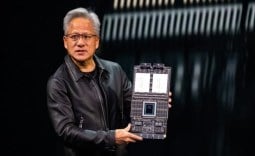 NVIDIA's Arm-based 'Vera' CPU benchmarked, beats Intel Xeon and AMD EPYC CPUs
 AMD teases next-gen Helios rack-scale platform: new EPYC + Instinct chips, battles NVIDIA Rubin
 AMD confirms production ramp of its EPYC 'Venice' server CPUs on TSMC's 2nm process
 Fable's new 30-minute gameplay deep dive shows you how to buy property, fancy clothes, and get a date
 Logitech's new Mobi Fold is a portable mouse that looks like a flip phone
 Rampant fraud forces Valve to cut Steam gift card sales
 Microsoft sets a Patch Tuesday record with 206 fixes, and finally patches every zero-day Nightmare Eclipse disclosed
 Todd Howard is playing Elder Scrolls VI and it looks 'amazing,' Xbox exec says
 Google orders Intel Foundry to produce over three million TPUs for 2028 amid TSMC capacity crunch
 Half-Life now runs on a 2007 Nokia N95 at 30 FPS with Bluetooth mouse support
 GIGABYTE's hidden Z990 motherboard at Computex reveals six NVMe slots and three PCIe 5.0 M.2 bays for Nova Lake-S
 Xbox to hold major layoffs as profit margins drop to 3%
 Xbox clarifies what 'console exclusive' actually means
 MOAIPLAY ORA PRO G1 850W ATX 3.1 PSU Review: high efficiency and 10-year warranty for $119.99
 Navman MiVue Smart True 4K Surround Dashcam Review - Seeing In All Directions At Once
 IQUNIX Magi96 Pro Aluminum Low Profile Mechanical Keyboard Review - Premium Build, Satisfying Sound
 Asetek Forte S-Series Racing Simulator Bundle Review
 Razer Pro Type Ergo Wireless Split Ergonomic Keyboard Review - Built for Comfort and Support
 ASUS ROG Strix Morph 96 Wireless Gaming Keyboard Review - Great Performance, More Affordable
 SAPPHIRE Radeon RX 9070 GRE PULSE OC Review - A New 1440p Challenger Has Arrived
 NZXT H6 RGB+ Compact Dual-Chamber Chassis Review
 ASRock Radeon RX 9070 GRE Steel Legend Review - The RDNA 4 Mid-Range Reshuffle
 ASRock Z890 Taichi Aqua Motherboard Review - Flagship features without the flagship price
 The PowerToys utilities I keep enabled on every Windows 11 PC, and the ones I turned off within a week
 TweakTown's Best of Computex 2026 Awards - The Best Hardware, Gaming Gear, and AI
 Phison E37T SSD Controller Exclusive Preview - The Fastest DRAMless SSD Platform Yet
 USB Ports Not Working in Windows 11? Try These Fixes
 ASUS WiFi Routers and Networking Solutions Deliver Long-term Security and Reliability with No Additional Cost
 Second Monitor Not Detected in Windows 11? Try These Fixes
 Turn Your Old Smartphone Into a Dedicated Webcam for Your Windows PC
 The Send To menu is the right-click feature on Windows 11 that nobody bothers to customize
 Windows 11 will not let you pin a folder to the taskbar, but a 30-second workaround does
 ASUS ProArt Displays Unlock Creativity with Professional Monitors for Everyone