

Reaching under the bezel for a brightness button is a small annoyance. I do it most evenings, feeling around for a joystick nub I still couldn't draw from memory. PowerToys' Power Display was supposed to solve that, and I turned it off three months ago while auditing the PowerToys utilities I keep enabled on every Windows 11 PC. However, the August 2026 release changed my mind.
I gave up on Power Display too early
Power Display controls external monitors over DDC/CI, the same channel that carries your display's on-screen menu. It reads what each panel reports it can do, then puts brightness, contrast, volume, input source, rotation, color temperature, and power state into one flyout. Microsoft shipped it with PowerToys 0.99 in April 2026.
Popular Now: Even the RTX 5090 can't hit 60FPS in Control Resonant without upscalingMy first impression wasn't great, though. My Lenovo P24q-20 monitor responded, but my laptop screen mostly didn't, and juggling two separate sliders felt no faster than reaching under the bezel. So it came off the list.
Version 0.101 arrived in August 2026 and added the pieces that were missing. Linked brightness moves multiple displays from one slider, the tray icon accepts mouse-wheel input, and a command-line interface ships alongside the app.
That combination pulled me back.
Turning it on takes about ten seconds. Open PowerToys, go to Input & Output > Power Display, and flip the Enable Power Display toggle. PowerToys asks you to confirm the first time, which is reasonable given what the module reaches for. After that,

Best Deals: Dell 24 Monitor - SE2426H - 23.8-inch FHD (1920x1080) 144Hz 1ms Display, in-Plane Switching (IPS) Te
Prices last scanned 3 hours and 42 minutes ago

7 days ago: $99.99 USD

7 days ago: $119.99 USD
7 days ago: $139.99 CAD


One flyout now runs both of my screens
The flyout stacks each connected display as its own card, numbered to match the Identify button so you're never guessing which panel is which. Brightness and contrast have their sliders, and rotation has a dropdown with Landscape, Portrait, and both flipped orientations. The sliders also respond to the mouse wheel, which moves them in steps of 5 unless you change the Mouse wheel increment setting.
Our Latest TweakTown Guides
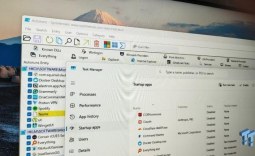
- I stopped trusting the Startup apps tab after I opened this utility on my PC
- I audited every credential Windows had stored for me and deleted three-quarters of them
- The Complete Windows 11 Tweaking Guide for 2026: What to Change and What to Avoid
- Using Multiple Monitors? Change these Windows settings for a Better Experience
- Windows Sandbox is The Windows Security Feature Most People Never Use


Two more controls hide behind small buttons on each card. The palette icon opens the color temperature switcher, which on my monitor lists sRGB (0x01), 6500K, 7500K, 9300K, and User 1 (0x0B). Those hex values are the preset values my panel reports for its color temperature feature, and Power Display lets you rename them to something readable under Custom VCP name mappings.

Frequently Asked Questions
Open a question for an answer from TweakTown's coverage of this guide, or ask your own below.
Does Power Display work with built-in laptop screens, or only external monitors?
How do you link brightness across multiple monitors in Power Display?
Which connection types can prevent Power Display from seeing a monitor's DDC/CI controls?
What is Maximum compatibility mode in Power Display, and when should you use it?
Have a question that isn't listed here? Ask below, and TweakBot will answer it.



The three-dot menu holds input source and power state. Mine offers DisplayPort-1 and HDMI-1 for inputs, then On, Off (DPM), and Off (Hard) for power. Switching inputs from the keyboard instead of the bezel is the single change I noticed most, and Settings lets you hide any control you never touch.
You won't see every control on every monitor, though. My P24q-20 has no speakers, so its volume slider stays grayed out.

Linked brightness and profiles handle the repetitive part
With two brightness-capable displays connected, a link button appears in the flyout footer. Turning it on collapses the individual sliders into one All displays card that tells you how many monitors are currently linked. It also tucks the per-monitor cards into a collapsible Individual displays section below.
This is the feature that fixed my actual complaint. My laptop panel and the Lenovo monitor sit at different native brightness levels, so every evening adjustment meant two separate trips.
Now one slider moves both, and the Exclude from linked brightness toggle keeps a display independent if one of them runs hotter.

The tray icon does the same job with less clicking. Under "Tray icon mouse wheel," you can pick Off, Primary display, or All displays, and mine sits on All displays. Scrolling over the icon dims everything without opening a window.
Profiles cover the rest. Save brightness, contrast, volume, and color temperature across selected monitors under a name like Work or Gaming, then apply it from the profile switcher. Pair that with the Light Switch utility and your monitors follow the Windows theme, with one profile for dark mode and another for light.
If you'd rather script it, PowerToys.PowerDisplay.Cli.exe does the same work from a terminal. Running list enumerates your displays, and set --monitor-number 1,2 --brightness 70 sets both at once, since each call changes one setting at a time. PowerToys has to stay running because the CLI routes its commands through the app rather than the hardware.
DDC/CI decides how far any of this goes
My own setup shows the limit clearly. In the Monitors list, the Lenovo is tagged DDC/CI, while my laptop's built-in panel is tagged WMI and carries a yellow banner reading "Monitor capabilities unavailable." That panel never reported its capabilities, so contrast, volume, input source, color temperature, and power state stay grayed out. Brightness is all that's left.

Connection quality matters just as much. Docks, USB-C hubs, and DisplayLink adapters often don't forward DDC commands, so a monitor that works fine on a direct DisplayPort run can vanish once it goes through a hub.
If a display is missing entirely, Maximum compatibility mode under Advanced will probe every supported feature directly. The screen may blank during that scan, and the monitor may stop answering until you power-cycle it.
I will mention one risk before you enable anything. Power Display reads each monitor's DDC/CI capabilities at startup, and on a small number of displays with malformed capability strings, that read can trigger a Windows kernel bug and crash the system. The fault sits in Windows, not PowerToys. After a crash, the module disables itself and excludes that monitor.
Two controls carry smaller warnings. Some monitors keep a color temperature value after Power Display closes and need a factory reset to undo it, and switching to an input with no signal blanks the screen until the physical buttons bail you out.
The buttons under the bezel have one job left
The joystick nub isn't gone from my desk; it's just demoted. It's the recovery tool now, for the rare occasion when a software switch strands me on a dead input. If you're setting this up, spend a few minutes on custom VCP name mappings so your inputs read plainly, then check which PowerToys modules still feel handy in tray space.