










Is the sound muted on your computer, and when you hover over the speaker icon in the system tray, you see the message, "No Audio Device Is Installed"? While this message suggests that no speakers or headphones are connected, it can also appear due to driver corruption, disabled audio services, or other system issues. Here's how you can fix the problem.
Ensure Your Speakers Are Properly Connected
Before moving on to more advanced fixes, start with the most obvious check: make sure your speakers or headphones are properly connected. A loose connection can prevent Windows from detecting the audio device. So, ensure that your audio output device is firmly plugged into the correct audio port and not the microphone jack.
Next, check for any visible damage to the cable or connector. To rule out a faulty audio port, plug your speakers into a different port. You can also connect them to another device to confirm that the speakers themselves are working properly. If the issue was caused by a connection or speaker problem, the error should disappear, and the sound should work again.
Restart Audio-Related Services
Windows relies on audio services to manage sound playback. If these services stop running, your system may fail to detect the audio hardware even when it's properly connected. To rule this out, you should check that these services are running and restart them if necessary. To do this, press Win + R, type services.msc, and press Enter.
In the Services window, locate the "Windows Audio" service, right-click it, and select "Restart." Then double-click the service, set the Startup Type to "Automatic," click "Apply," and then "OK." Afterward, repeat the same steps for Windows Audio Endpoint Builder and Realtek Audio services to ensure they are also running properly.


Best Deals: Razer BlackShark V3 Pro Wireless ANC Gaming Headset
Price Trend:
Prices last scanned 5 hours and 54 minutes ago

7 days ago: $249.99 USD30 days ago: $249.99 USD
7 days ago: $359.99 CAD30 days ago: $359.99 CAD
7 days ago: £355.1430 days ago: £355.16


Update or Reinstall the Audio Drivers
Outdated or corrupted audio drivers can also trigger the "No Audio Device Is Installed" error. Updating or reinstalling the drivers can help Windows detect and communicate with your sound hardware. To update the drivers, right-click the Start button and open "Device Manager." Then expand the "Sound, Video, and Game Controllers" section and locate your audio device.
Right-click the device, select "Update Driver," then choose "Search automatically for drivers." If updating doesn't resolve the issue, you should reinstall the driver instead. Right-click the audio device again and select "Uninstall Device," then confirm the prompt. After that, download the latest audio driver from your device manufacturer's website and install it manually.
Our Latest TweakTown Guides
- How to fix Wi-Fi Adapter Not Working on Windows laptops: troubleshooting tips
- 6 underrated Microsoft Word features worth using to boost your productivity
- 7 Windows settings to change right after installation for better privacy, security, and performance
- I stopped Windows 11 notifications from interrupting me with Do Not Disturb, Focus, and a priority list
- 7 ways to transfer data from Android to Windows PC quickly and easily

Set the Correct Default Audio Device
Do you use multiple audio output devices? If so, Windows might be using the wrong device as the default, perhaps one you recently disconnected, making it seem like no audio device is installed. Although Windows automatically selects the currently connected device, this may not always happen. So, you'll have to set the correct audio device as the default.
To do this, right-click the Start button and open "Settings." Navigate to System > Sound, scroll down, and click "More Sound Settings." In the "Playback" tab, locate the audio device you want to use, right-click it, and select "Set as Default Device." After that, hover over the speaker icon to check if the error has been resolved.

Disable Audio Enhancements
Windows audio enhancements are designed to improve the sound quality of your audio hardware, but they can sometimes interfere with your device and cause unexpected issues. To rule out this possibility, you should disable these enhancements so your system can properly detect and use your audio hardware.
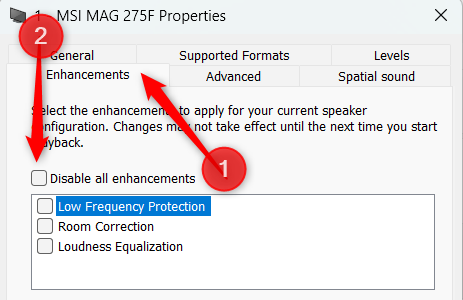
To do this, open the Sound properties window as described earlier. Go to the "Playback" tab, right-click your default audio device, and select "Properties." Next, switch to the "Enhancements" tab and check the box for "Disable All Enhancements." After disabling them, click "Apply," then "OK."
Perform a Power Flush on Your Device
Sometimes, Windows fails to detect your audio hardware because of residual power stored in your laptop or desktop. Performing a power flush can clear this leftover charge and may resolve the issue. To do this, shut down your PC, unplug the power cable, or remove the battery if you're using a laptop. Then, press and hold the power button for about 30 seconds.
This will discharge any remaining power. Afterward, reconnect the power cable or reinsert the battery, turn on your computer, and check if your audio device is now detected.
Install Optional Audio Drivers
While Windows installs most updates automatically, some updates, especially hardware-specific drivers, are marked as optional. You should check whether there's an optional update available for your audio device. To do this, open the Settings app, navigate to Windows Update > Advanced Options > Optional Updates, and expand "Driver Updates."
If you see any audio-related drivers listed, check their boxes and click "Download and Install." Once the downloads finish, click "Install All" and see if this resolves the issue.

Hopefully, following the fixes above will resolve the "No Audio Device Is Installed" error, allowing your sound to work again. If these steps don't fix the problem, you can try using System Restore to restore your computer to a time when audio was working properly. If that still doesn't help, have your device checked to rule out any potential hardware problems.


 How to fix Wi-Fi Adapter Not Working on Windows laptops: troubleshooting tips
 6 underrated Microsoft Word features worth using to boost your productivity
 7 Windows settings to change right after installation for better privacy, security, and performance
 I stopped Windows 11 notifications from interrupting me with Do Not Disturb, Focus, and a priority list
 7 ways to transfer data from Android to Windows PC quickly and easily
 First 30 minutes of Assassin's Creed Black Flag Resynced just got leaked
 PlayStation and Xbox record their worst May in decades after recent price increases
 'Get used to it,' says Lenovo as it expects high memory prices to remain the norm until at least 2030
 GTA 6 disc version not coming after all, sources say Rockstar Support email was misinterpreted
 Intel's dual-tile Nova Lake-S CPUs reportedly carry a 474W PL2 target, according to leaked Z990 power guidance
 Micron has signed agreements locking in record-high memory prices with major customers through 2030
 Microsoft quietly extends Windows 10 security updates to 2027
 Analyst believes Call of Duty, EA FC, and NBA 2K will move to $80 pricing
 Valve engineers claim release cadence for future Steam Machine versions will be shorter than the Steam Deck
 AMD engineer builds a Steam Machine competitor with a 3D printer, has an RTX 5060 inside
 Lian Li B4-mATX Review: a compact mATX SFF case with excellent airflow and premium features
 MSI MPG 322UR QD-OLED X24 Review: A Brighter, Tougher 4K 240Hz QD-OLED for $1099
 UGREEN NASync DXP4800 GT Review: powerful 4-bay NAS with AMD Ryzen and dual 10GbE ports
 Dell XPS 14 (2026) Laptop Review - Premium Quality, Impressive Performance
 Ocypus Sigma F36 BK ARGB Cooling Fan Review: high airflow and unified design in one frame
 PCCooler CPS RZ820 Display Review: a flagship-level CPU air cooler with an LCD screen
 UGREEN FineTrack Mini 2 Air Tracker Tag Review - Long battery life, lesser performance
 Speed Racer (2008) 4K Ultra HD Blu-ray Review: a stunning remaster of the cult classic
 MOAIPLAY ORA PRO G1 850W ATX 3.1 PSU Review: high efficiency and 10-year warranty for $119.99
 Navman MiVue Smart True 4K Surround Dashcam Review - Seeing In All Directions At Once
 Hisense U7SG 4K TV: Modern Entertainment for the New Age
 Level Up Your PC Gaming with these Fantastic ASUS Prime Day Deals on GPUs, Motherboards, and More
 GIGABYTE Wants to Kickstart Your New Gaming PC or Upgrade with These Limited-Time Deals
 I read the Windows Backup app screen carefully, and it does not back up what most people think
 Low Sound Volume on Windows 11? How to fix audio issues and restore normal volume