


Our Verdict
Pros
- Best Read Performance
- Best Mixed Workloads at 1-DWPD
- Superior Consistency
Cons
- None
Should you buy it?
Introduction and Drive Details
Every now and then we get our hands on something truly special. Something that distances itself from others in its class and does so in dominating fashion. Today is one of those rare occasions, and we are excited to demonstrate what KIOXIA'S flagship performance offering is serving up. Sometimes we glom onto a drive because it does one thing or another better than its competitors; sometimes it does several things better than the competition, and then there are the rare ones, the Kings of their class, that deliver more on all fronts.
Kioxia's CM9 Series is its flagship enterprise performer. The drive is engineered to outperform all others in its class, delivering every drop of performance that can currently be had over the PCIe Gen5 x4 interface via a flash-based SSD. Enabling this high level of performance is what it always comes down to, and that is the flash. You make the best flash; you can set the performance bar, and currently KIOXIA makes the industry's best.
KIOXIA's newest flagship performance enterprise PCIe Gen5 SSD, the CM9 at capacities of 6.4TB and up, comes arrayed with its cutting-edge BiCS 8 NAND, so we already know based on previous experience that it will, at 6.4TB and higher, hold a performance advantage over others arrayed with Micron, Hynix, YMTC, and probably Samsung as well. Our feeling that BiCS 8 is likely better flash than Samsung's latest V-NAND comes from our experience in the consumer space, where it has clearly demonstrated better performance.
KIOXIA's CM9 Series is engineered to deliver best-in-class performance for all applications including Artificial Intelligence, Machine Learning, Business intelligence, Data warehousing, Transactional and Relational Databases, Software defined storage/virtualization and more. Basically, everywhere, more performance equates to better profit margins.
The subject of today's review is KIOXIA's CM9-R read-intensive 15.36TB 1-DWPD SSD in the E3.S form factor. The E3 form factor is becoming increasingly popular because it is more efficient than conventional U.2 in terms of footprint/density and has a more modern interface designed specifically for NVMe SSDs. However, cooling can be a bit more challenging at a slim 7.5mm thickness, so we always like to take a quick look at temperatures when testing E3 or E1 SSDs.


Best Deals: KIOXIA CM7-R Series KCMYXRUG15T3 SSD
Price Trend:
Prices last scanned 22 hours and 51 minutes ago


Pictured above are temps taken nearing the end of 2-loops of 128K sequential write preconditioning, where we feel temperatures are likely at their highest. Typically, we could see temperatures near 70c here with standard air cooling, but not with our test subject. Here we find our 15.36TB test subject running at a relatively cool 56c with conventional air cooling.
Specs/Comparison Products
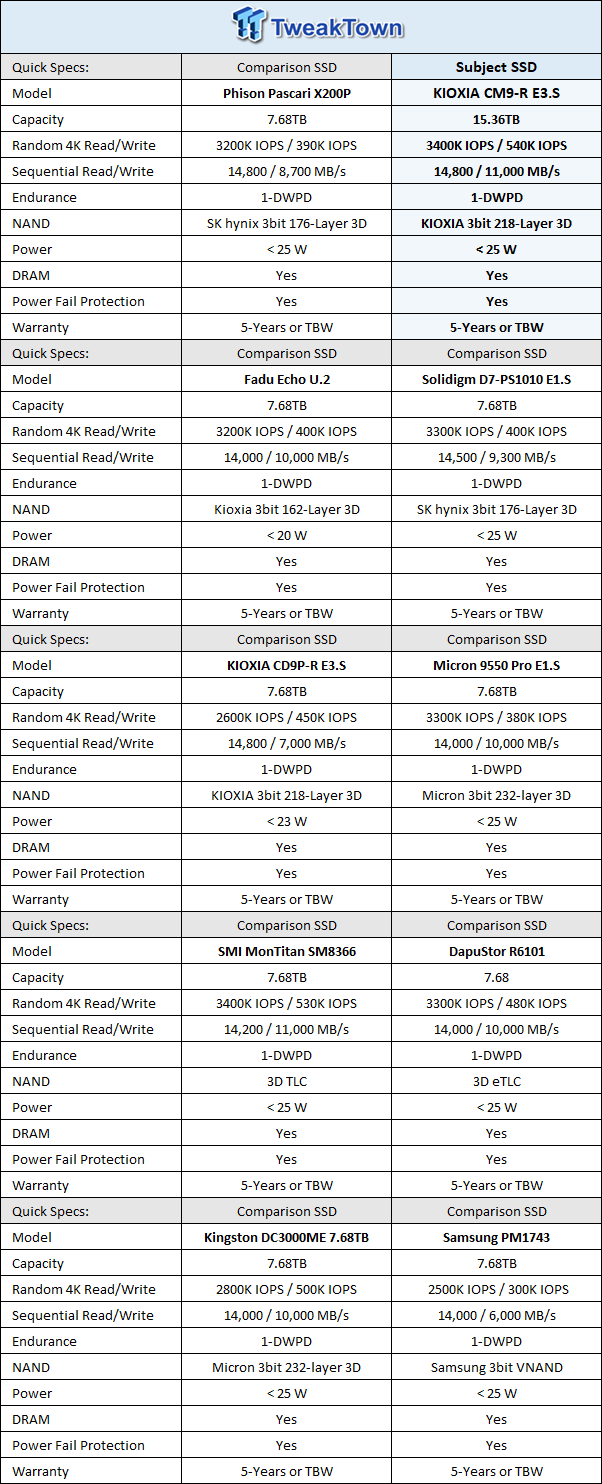
| Item | Details |
|---|---|
| Model | KIOXIA CM9-R 15.36TB |
| MSRP | NA |
| Model Number | KCM91PJE30T7 |
| Interface | PCIe Gen5 x4 |
| Form Factor | E3.S |
| Sequential BW | Up to 14,800 MB/s |
| Random IOPS | Up to 3400K IOPS |
| Warranty | 5-Years Limited |
KIOXIA CM9-R 15.36TB E3.S PCIe Gen5 x4 SSD


The drive we have in hand is a 1-DWPD design, E3.S form factor, 15.36TB in capacity, KIOXIA BiCS 8 TLC arrayed, and 16-channel controlled. This configuration is rated for up to 3.4 million IOPS and up to 14.8 GB/s sequential throughput. KIOXIA's CM9 Series SSDs are compatible with major operating systems such as RHEL, SLES, CentOS, Ubuntu, Windows Server, and VMware ESXi.
Our Latest SSD Review Coverage
- Micron 6600 ION 245.76TB Enterprise SSD Review - Best in Class Programming Speeds
- Memblaze PBlaze 7 7A40 Ocean 61.44TB Enterprise SSD Review - Oceans of QLC at 3.3 million IOPS
- KIOXIA CD9P-R 7.68TB E3.S Review - The Best-In-Class Data Center SSD
- DapuStor Roealsen6 R6060 E1.L 245.76TB SSD Review - Massive Capacity with Fast Retrieval
- Phison Pascari X200P 7.68TB Enterprise SSD Review - Sequential Read Champion
Test System Specs & Enterprise Testing Methodology
Enterprise SSD Test System
| Item | Details |
|---|---|
| Motherboard | ASUS Pro WS W790E-SAGE SE (Buy at Amazon) |
| CPU | Intel Xeon w7-2495X (Buy at Amazon) |
| GPU | GIGABYTE GeForce GTX 1650 (Buy at Amazon) |
| Cooler | Alphacool Eissturm Hurricane Copper 45 (Buy at Amazon) |
| RAM | Micron DDR5-4800 RDIMM (Buy at Amazon) |
| Power Supply | be quiet! Dark Power Pro 12 1200W (Buy at Amazon) |
| Case | PrimoChill's Praxis Wetbench (Buy at Amazon) |
| OS | Ubuntu 24.04.1 LTS |
A special thank you goes to Allyn Malventano; without his help, we wouldn't be where we are with our Linux-based Enterprise SSD testing platform.

Frequently Asked Questions
Open a question for an answer from TweakTown's coverage of this review, or ask your own below.
What systems and operating systems are compatible with the CM9 Series, including the 15.36TB CM9-R?
What performance differences does BiCS 8 TLC NAND make in the CM9-R compared with other flash arrays mentioned in the review?
What does the CM9-R's 16-channel controller contribute to its low-queue-depth performance?
How does the CM9-R behave in common database-style workloads like 8K 7030 and 8K 5050?
Have a question that isn't listed here? Ask below, and TweakBot will answer it.

Testing Methodology
TweakTown strictly adheres to industry-accepted Enterprise Solid State Storage testing procedures. Each test we perform repeats the same sequence of the following steps:
- Secure Erase SSD
- Write the entire capacity of the SSD 2x (2 loops) with 128KB sequential write data, seamlessly transition to the next step (sequential testing skips step 3)
- Precondition the SSD by filling the drive twice with random 4K, 8K, or IU of SSD writes
- Run test-specific workload with a 30-second ramp up for 5 minutes at each measured Queue Depth, and record average result
Benchmarks - Sequential
128K Sequential Write/Read

We precondition the drive with 100 percent sequential 128K writes at QD256 using 1-thread for 2-drive fills, receiving performance data every second. We plot this data to observe the test subject's descent into steady-state and to verify that steady-state is in effect as we seamlessly transition into testing at queue depth. A steady-state is achieved after 1-drive fill. Average steady-state 128K sequential write performance at QD256 is approximately 11,300 MB/s.


KIOXIA specs its CM9 Series SSDs as capable of delivering up to 11,000 MB/s 128K sequential write throughput. We are getting up to 11,300 MB/s, so it is even better than advertised. We like what we see at QD1, where our test subject is delivering the second-highest throughput of any of the SSDs, but we like the rest even better, where KIOXIA's flagship performer delivers a new lab record for sequential write throughput. Outstanding.


Here, the drive is factory spec'd for up to 14,800 MB/s 128K sequential read throughput. We are hitting up to a lab record-breaking 15,044 MB/s, so it is better than advertised and at a place where throughput matters most for read-intensive applications. We note its performance curve here is identical to that of Kioxia's CD9P-R that we recently reviewed, and just like its close cousin, our test subject delivers a superior performance curve; likewise dominating at the mid-range and then edging out the rest from there on up. Impressive.
Benchmarks - Random
4K Random Write/Read

We precondition the drive using 100 percent random 4K writes at QD256 for 2-drive fills, receiving performance data every second. We plot this data to observe the test subject's descent into steady-state and to verify that steady-state is in effect as we seamlessly transition into testing at queue depth. A steady-state is achieved after 1-drive fill. Average steady-state 4K random write performance at QD256 is approximately 590K IOPS.


Our 15.36TB model is rated at up to 540K 4K random write IOPS. We are getting up to 600K, so we are again extracting more than advertised. Again, we love what we are seeing at QD1, where programming performance matters most. Again, we are treated to another lab record for a 1-DWPD SSD. 600K IOPS here for a 7% OP SSD is stunning. Powerful.


Factory spec here is up to 3,400K IOPS. We are getting 3,553K IOPS with our configuration. As far as peak IOPS here, this is the second highest we've ever seen, where our test subject is bested by a mere 17K IOPS by the R6101. However, we still consider this a dominant performance curve here for our CM9-R because it is easily winning at queue depths of up to 256. Impressive.
4K 7030


The performance curve here is the best we've ever seen coming from a non-compressed a 1-DWPD SSD. This is what dominating real-world performance looks like. Amazing. This is what matters, and this is where our test subject has no equal in its class. Incredible.
4K 5050


As we add more programming into the mix, our test subject again leads at every measured queue depth. By QD64, that lead again turns into straight domination. Think of it: a 1-DWPD flash-based SSD cranking out over a million IOPS running a 50/50 workload. Unprecedented. This is what BiCS 8 brings to the table. Wow.
8K Random Write/Read

We precondition the drive using 100 percent random 8K writes at QD256 for 2-drive fills, receiving performance data every second. We plot this data to observe the test subject's descent into steady-state and to verify that steady-state is in effect as we seamlessly transition into testing at queue depth. A steady-state is achieved after 1-drive fill. Average steady-state 8K random write performance at QD256 is approximately 300K IOPS.


We expect 8K random to track pretty much the same as 4K random here, just at a lower IOPS rate because it's moving twice the amount of data. Our test subject delivers better than half of what we saw at 4K. And again, as we saw at 4K, at queue depths of 2 and higher, our test subject separates itself from the rest and delivers more lab records for a flash-based 1-DWPD SSD. Impressive.


Nice performance curve here, especially at queue depths of up to 32. Others can overtake our test subject here at queue depths exceeding 32, but not by much, and again overall we value performance at low queue depths over performance at high queue depths, so even here we consider this another in an unbroken string of wins so far for our test subject.
8K 7030


8K 7030 is representative of a common database workload. This is yet again the best performance curve for any SSD of its type that we've come across. Incredible. This is dominating performance where performance matters most. Up to 763K IOPS from a 1-DWPD SSD running a database workload. Unprecedented.
8K 5050


And finishing strong, our test subject delivers the best performance curve here that we've ever encountered from a 1-DWPD SSD, thereby sealing the deal for us as the CM9-R 15.36TB being the King of 1-DWPD performance.
Final Thoughts
Again, it's all about the flash. Our assertion that BiCS 8 is likely the most powerful of its kind currently in circulation is certainly bolstered by what KIOXIA's CM9-R 15.36TB delivered today. As we see it, this was a 100% win across the board, and what we saw today is indeed the current pinnacle of performance coming from a 1-DWPD SSD.

In our opinion, it's the undisputed KING of performance at 1-DWPD. Editor's Choice.