









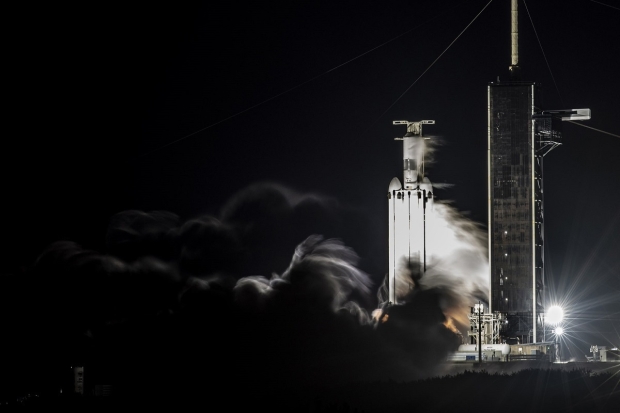




SpaceX has taken to its social media channels to announce the launch of its Falcon 9 rocket, which carried a new batch of Starlink satellites into orbit.
The Falcon 9 rocket launched from California's Vandenberg Space Force Base on Thursday, with the rocket transporting 53 new Starlink satellites into lower Earth orbit. After reaching the designated altitude and releasing the Starlink satellites, the Falcon 9's first stage made a reentry and successfully landed on the SpaceX drone ship called "Of Course I Still Love You", which is located on the Pacific Ocean. There were only eight minutes between the initial launch of the Falcon 9 to its first stage, successfully touching back down on the drone ship.
SpaceX writes on its website that this was the eighth launch and landing for this particular Falcon 9 first-stage booster, which also happened to be used to launch the Sentinel-6 Michael Freilich, NASA's Double Asteroid Redirection Test (DART) mission, and now, six Starlink missions. So far, SpaceX has launched more than 3,500 Starlink satellites into low Earth orbit, enabling for more coverage of its satellite internet service, which it recently announced was now available for moving objects such as RVs. However, there is a big catch with that new service.
As for the total number of orbital launches this year, SpaceX has conducted a staggering 49 separate orbital launches, with close to 66% of those being Starlink-based missions.
In other SpaceX news, Elon Musk's company was recently fined nearly $20,000 for an accident that resulted in a SpaceX worker being put in a coma for months on end. The accident occurred while the worker was conducting checks on SpaceX's Raptor V2 engine.
Additionally, SpaceX recently released a video that showed its Launch and Catch tower called Mechazilla using its chopstick arms to life Ship 24 on top of Booster 7, creating the highly anticipated Starship launch vehicle - SpaceX's next-generation rocket that is poised to be the transportation method to the Moon and Mars. The completed stacking of the two parts pieced together by Mechazilla created the 394-foot-tall rocket that is expected to undergo its first orbital test flight hopefully before the end of the year.


 SpaceX to deploy model next-gen Starlink satellites on its new Starship launch
 SpaceX's successful Starship flight grabbed by giant mech arms
 Elon Musk confirms Starship will launch on Friday, SpaceX reveals mission goals
 SpaceX pencils in date for next flight of the world's most powerful rocket
 SpaceX launches Starlink's new direct-to-cell (DTC) technology, seamless global coverage
 CPS PCCOOLER unveils all-in-one modular PC where you can replace the display and upgrade its hardware
 NVIDIA and LG are building a next-generation humanoid robot that will make its debut at CES 2027
 Intel will continue supplying Raptor Lake CPUs for 'years to come' thanks to the memory crisis
 NVIDIA's next-gen 'Feynman' GPUs to be built with TSMC's 1.6 nm A16 process
 OLED monitor shipments have doubled in a year, with ASUS as the global leader
 SK Hynix is running out of SSD replacements, leaving customers with inadequate refunds
 Kingdom Hearts 4 reveals Pixar's Coco-inspired Land of the Dead world and late 2027 release window
 Budget GPU shortages to get even worse in second half of 2026, warns PC Partner
 Intel plans an entry-level Panther Lake chip with 4 Xe3 cores for handhelds
 AMD denied any review samples for the Radeon RX 9050 because it's embarrassing
 Cooler Master HAF II 500 Mid-Tower Chassis Review
 Corsair HS35 v3 Wireless Gaming Headset Review - An Affordable Winner
 D-Link F518 5G Wi‑Fi 6 AX1800 Mobile Hotspot Review: All-Day Mobile Hotspot
 Bose Lifestyle Ultra Speaker Review - Impressively Detailed Room-Filling Sound
 MSI Z890 Gaming Plus WIFI6E Review - Z890 for under $200
 Mortal Kombat (1995) 4K Ultra HD Blu-ray Review
 CPS PCCOOLER YS1200 ATX 3.1 80 PLUS Gold PSU Review
 ASRock X870E Taichi White Review: a premium AM5 motherboard with 10G LAN and WiFi 7
 Asetek Initium Pedal Modular Upgrades Review
 Thinkware U3000 Pro Review - Smart Dashcam with Wi-Fi quirks
 Windows Sandbox is The Windows Security Feature Most People Never Use
 I ditched the Windows 11 context menu for this open-source tool, and here's why
 Windows 11 may be encrypting your drive already, and I checked where my recovery key went
 GIGABYTE's 40 Days of INFINITY celebrates 40 Years of Innovation with stunning GeForce RTX graphics cards and rewards
 I swapped File Explorer for this free file manager and finally got the layout I wanted
 How to tell if someone has been using your Windows PC without your permission
 6 Task Manager tips for troubleshooting Windows performance problems
 ASUS ROG's 20th Anniversary Line-up of Premium PC Gaming Gear has Arrived - Here's Everything You Need to Know
 Six File Explorer tips every Windows user should know
 I switched my PC to encrypted DNS in Windows 11, and browsing felt more private