Pawsey Supercomputing Centre down in Perth, Australia chose Hewlett Packard Enterprise (HPE) for its next-gen Setonix supercomputer, but now we have some more details on the specs inside of the new supercomputer.
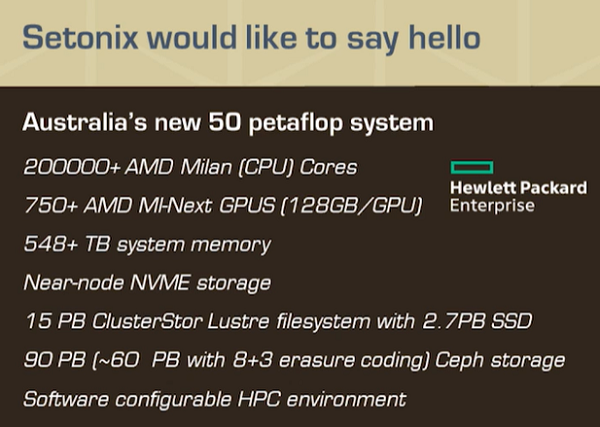
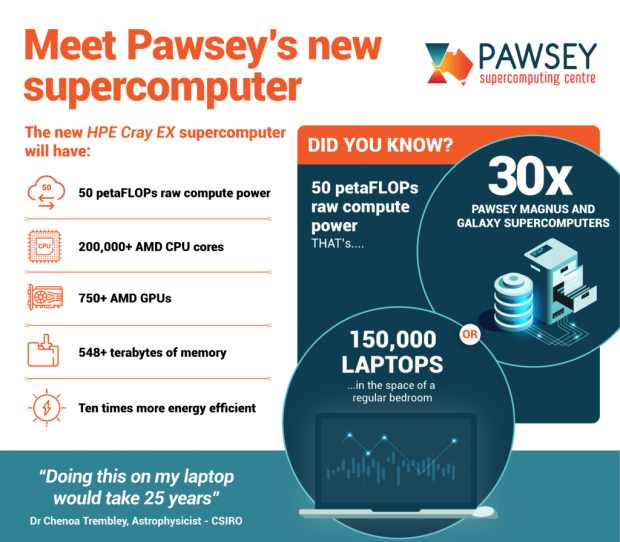
Setonix will have over 200,000 AMD EPYC "Milan" CPU cores, over 750 AMD Mi-Next GPUs with 128GB of VRAM per GPU, over 548TB of system memory, near-node NVMe storage, 15PB ClusterStor Lustre filesystem with 2.7PB SSD and 90PB of Ceph storage.
The additional details on Pawsey's next-gen Setonix supercomputer were provided by Pawsey CTO Ugo Varetto.
Pawsey's new Setonix supercomputer will be built by HPE, with the new HPE Cray EX system being used across a wide array of projects including COVID-19 research through to the precursor telescopes and the Square Kilometre Array.
Pawsey Centre Executive Director Mark Stickells explained when Setonix was unveiled: "On delivery, this will be the fastest public research supercomputer in Australia, potentially the Southern Hemisphere, and it is an enormous leap forward for Australian research. Setonix will help researchers around the world manage the data collected through the Square Kilometre Array. It will support our role as part of the international consortia helping advance COVID research".
He added: "It will help us better understand climate change, the warming of oceans, the genomics of plants that can tolerate drought - or, the genome of a furry little marsupial on a remote island in WA. It is a project that underscores WA's importance to international scientific collaboration".
- Why the name Setonix? Pawsey Centre Executive Director Mark Stickells says that "the name Setonix was chosen as a nod to the unique marsupial, which has become both a WA icon and a global tourist attraction. Pawsey has long had an affinity with the quokka - one of our existing systems was used by UWA Associate Professor Parwinder Kaur to map the quokka genome as part of an international conservation effort".
"The quokka is an iconic Western Australian animal that has helped promote our State to the world, just as our work at Pawsey helps raise the profile of Western Australian and Australian researchers on the world stage".