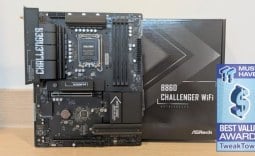
HUDIMMs are a new type of DDR5 module designed to make DDR5 more affordable, but at the cost of memory performance and density. YouTuber Tech Yes City benchmarked a simulated HUDIMM memory configuration with a single UDIMM DDR5 module in games to see if gaming performance takes a hit when using these lower-performing modules.
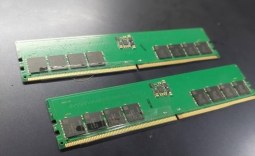
To recap, HUDIMM memory stands for Half-Unbuffered DIMM, and as the name states, it cuts the amount of subchannels a traditional DDR5 module has in half. Instead of two 32-bit subchannels, HUDIMMs only have one 32-bit subchannel. This helps memory manufacturers make cheaper sticks, as HUDIMMs only need half the amount of memory ICs to make a working product, but it also cuts memory bandwidth in half, making DDR5 HUDIMMs barely any better than DDR4 memory (depending on memory speeds).
For testing, Tech Yes City used a Ryzen 7 9800X3D and Core Ultra 7 265K paired with a single DDR5 UDIMM. He initially tried to simulate HUDIMM memory by taping off half of the pins on a DDR5 UDIMM, but couldn't get it to work. Luckily, using a single fully functioning DDR5 UDIMM (with no tape) was still sufficient for testing, as one DDR5 UDIMM has the same amount of subchannels as two HUDIMMs paired together in a traditional dual-channel configuration.
- Read more: Steam Machine loses up to 20% of its performance with its out-of-the-box single 16GB DDR5 SO-DIMM
- Read more: GIGABYTE's new D5 Single Boost can push a single DDR5 stick to 8,400 MT/s
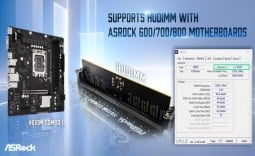
- Read more: ASRock's HUDIMM DDR5 memory with just one sub-channel could help lower memory prices on Intel boards
The YouTuber tested this synthetic HUDIMM configuration in Cyberpunk 2077, Counter-Strike 2, and Marvel Rivals against a standard 2x16GB kit of DDR5 memory. Surprisingly, both the 9800X3D and 265K ran all three games very well with the simulated HUDIMM configuration and yielded no noteworthy performance differences. In Cyberpunk 2077 (at low settings), the Ryzen 7 9800X3D achieved 209 FPS average with one DDR5 stick and 207FPS with two sticks. The Ultra 7 265K produced 188 FPS average with one DDR5 stick and 196 FPS average with two sticks.
In Counter-Strike 2 (at low settings), both CPUs showed very unusual behavior, with frame rates being better with the single stick configuration compared to having two sticks hooked up to each CPU. The Ryzen 7 9800X3D produced an identical 754FPS average across both memory configurations, with the single stick config producing 22% better 0.1 lows. The Core Ultra 7 265K produced similar behavior, achieving 637 FPS average and 0.1% lows of 178 FPS with one DDR5 stick, and 602 FPS average with 173 FPS for the 0.1% lows with two sticks installed.
Marvel Rivals (at low settings) did not exhibit this behavior but showed virtually equal performance across both memory configurations for both chips. The Ryzen 7 9800X3D produced 155-156 FPS average, and the Core Ultra 7 265K 151-155 FPS average with single and dual stick configurations.

The YouTuber's results reveal that modern Intel and AMD CPUs don't benefit much from having two UDIMM DDR5 sticks connected in a typical dual-channel configuration, at least for gaming. This bodes well for HUDIMM, where a set of two HUDIMM modules should be sufficient for gaming purposes. Unfortunately, the YouTuber was not able to test what a single HUDIMM module would be capable of, but likely gamers will run into memory allocation issues before bandwidth problems become an issue. A single HUDIMM stick will likely be limited to 8GB of memory, as these sticks are designed to be as cheap as possible.
However, Tech YES City's game selection is quite small, so take these performance results with a grain of salt. Ray tracing games are known to be more memory-intensive, so there's a chance that more demanding games will run faster on traditional UDIMM DDR5 in a dual-channel setup (Cyberpunk 2077 was tested with RT disabled). Regardless, for easier-to-run games, HUDIMMs appear to be sufficient for gamers looking for "cheap" DDR5 amid the ongoing memory shortage crisis. We still don't have pricing on upcoming HUDIMM DDR5 memory, but likely a set of two sticks will be as cheap as a single DDR5 UDIMM.