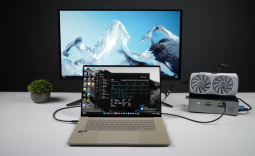
Qualcomm's Snapdragon X2 Elite series has proven itself to be a decently competitive gaming lineup compared to competing chips from Intel and AMD. However, the chip has thus far not been integrated into any handheld gaming PCs, raising the question of how this chip would perform if someone were to stick one of these chips into a handheld device. YouTuber ETA Prime answered that question in a recent video testing the X2 Elite in its low-wattage mode to simulate handheld gaming. The results show the chip is more than capable of a playable experience at 17 to 20 watts.
The YouTuber tested Red Dead Redemption 2, Cyberpunk 2077, Ratchet and Clank: Rift Apart, Japanese Drift Master, and Mortal Kombat on a laptop paired to an X2 Elite Extreme X2E94100 rated at up to 4.7GHz, and 48GB of memory running at nearly 9600MT/s. The chip can be controlled with three power modes: performance mode offering up to 60 watts, balanced mode offering 45 watts, and low-power mode offering 16-23 watts of power headroom.
Red Dead Redemption 2 achieved around 75 FPS in performance mode at 1080p high settings, and just under 60 FPS in low-power mode at 720p high settings. Cyberpunk 2077 achieved around 65 FPS in performance mode at 1080p high settings and a similar frame rate in low-power mode running at 720p high settings. Ratchet and Clank: Rift Apart ran at around 68 FPS at 1080p medium settings in performance mode. Dropping to the low-power mode and 720p resolution, the game achieved a similar frame rate. Japanese Drift Master ran at around 60 FPS using performance mode at 1080p high settings and around 60 FPS again in the low-power mode at 720p high settings. Mortal Kombat ran at 60 FPS in performance mode at 1080p medium settings and 60 FPS in low-power mode at 720p high settings.
- Read more: YouTuber benchmarks RTX 4060 on Snapdragon X2 Elite laptop using RTX Spark developer driver
- Read more: Lisuan LX7G100 GPU achieves playable FPS in system with no Intel AMD or NVIDIA hardware inside
- Read more: BIOS modded single-slot AMD Pro GPU from 2016 can play Cyberpunk 2077 at up to 60 FPS at 1080p
The YouTuber's tests confirm that the Snapdragon X2 Elite's power efficiency is good enough to provide a playable gaming experience at power envelopes handhelds normally run at (i.e., 17-20 watts). For reference, outgoing handhelds packing the AMD Ryzen Z2 Extreme, such as the MSI Claw, only achieve under 55 FPS at 800p in Cyberpunk 2077 with the game's lower Steam Deck graphical preset at 17 watts (based on testing from the same YouTuber). At a more performant 30W envelope, we have already seen benchmarks of the X2 Elite running against the Apple M5, Core Ultra X7 series, and Ryzen AI HX 370 with varying degrees of competitiveness.
The hardware capability is there, but the only question that remains is whether or not manufacturers will take the leap and make a Windows handheld with an X2 Elite series SoC inside. Unfortunately, there are many downsides to using Qualcomm's latest SoC in a handheld despite its performance chops. The main issue is gaming reliability; Qualcomm hasn't fully ironed out the X2 Elite's game compatibility issues. Some AAA games still crash, including F1 25 and Doom: The Dark Ages. Popular overlay tools such as RTSS are also known to trigger game-related problems. Qualcomm has the capability to fix these issues through GPU driver updates, but there's no telling how quickly these issues will be ironed out.
Other issues include the X2 Elite and Elite Extreme's 12-18-core configuration, which is extremely overkill for a handheld system and could prove to be a detriment to battery life. The ARM-to-x86 Microsoft Prism emulation layer these chips have to use is potentially another battery-draining source. All in all, manufacturers are better off going with a more appropriate chip, such as AMD's Z2 Extreme, which doesn't suffer from these compatibility issues, including the overhead of translating x86 code to ARM instructions, at least for now.