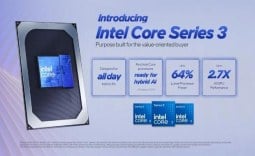


A new benchmark has surfaced on Geekbench, thanks to BenchLeaks on X (formerly Twitter), showcasing the Core 3 304, another supposed Wildcat Lake (WCL) chip caught in the wild. The chip demonstrates a near doubling in performance versus Intel's incumbent Twin Lake (Nx50), a series of low-power E-core only processors.
Intel officially unveiled Wildcat Lake at CES this year under the Core 300 series branding. These chips omit the "Ultra" designation reserved for the flagship Panther Lake lineup. Wildcat Lake features (up to) a 2P+4LPE design, employing the same core architecture as Panther Lake: Cougar Cove for the P-cores and Darkmont for the LPE-cores. Intel is equipping these chips with a 2 Xe3 core integrated GPU, which is accompanied by an 18 TOPS NPU for on-device AI.
Popular Now: RTX 5090 owner adds two 8-pin connectors to GPU with daughterboard mod dropping cable temps below 40CUnlike the complex Foveros 3D-stacking used in premium tiers, Wildcat Lake features a traditional multi-chip design (likely through UCIe), including the Compute Tile hosting the CPU, iGPU, Memory Controller, NPU, and Media Engines, fabricated on Intel 18A, while the Platform Controller tile is dedicated to I/O and connectivity, built on an external node, believed to be TSMC's N6.
Several of these processors have started propping up in benchmarks, including a recent demonstration of two models: the Core 3 310 and Core 5 320, both 6-core (2P+4LPE) SKUs. The newly discovered Core 3 304 appears to be the most entry-level SKU in the stack, carrying a unique 5-core layout, missing out on one performance core for a 1P+4LPE configuration.
It is unlikely we will see core counts drop below this threshold, as Intel's LP-E cores are architecturally baked into four-core clusters, grouped into a low-power island. Exact cache configurations are unknown, but if consistent with Panther Lake, we're likely looking at 7MB of L2 Cache (3MB per P-core + 4MB per LPE cluster), 3MB of L3 Cache (3MB per P-core), and 4MB of SLC (System Level Cache).
For the duration of this test, the CPU cores are clocked at a maximum of 4.28 GHz. The test bench is an Intel RVP (Reference Validation Platform), a specialized test system used by developers and manufacturers (OEMs/ODMs) to test, validate, and debug new Intel processor architectures before they are publicly released.
The CPU is equipped with 16GB of soldered LPDDR5x memory. The CPU scored 2,472 points and 6,708 points in the single-core and multi-core categories, respectively. This puts it more than 2x faster than the E-core only N250 in both departments. For a more accurate comparison, this is roughly on par with the current-generation Core 3 100U (RPL-U), which is a 2P+4E counterpart; the Wildcat Lake chip is still 12% faster in single-threaded performance and 27% faster in multi-threaded performance.

While this seems like a modest improvement over Raptor Lake-U, which is equipped in many entry-level laptops, Intel's wild card is battery life. Due to the 18A process and power-efficient LPE-cores (the same ones in Panther Lake), laptops with Wildcat Lake will be able to offer much more battery life than Raptor Lake-U, similar to Lunar Lake and Panther Lake, without sacrificing the system's snappiness and performance, a compromise you see with Intel's N-series chips.
This also appears to be Intel's reply to the MacBook Neo. While Apple's silicon will still lead in raw performance and IPC, Wildcat Lake allows Intel to bring competitive performance and similar battery life to a much broader range of price points and form factors.