We have the full specs leak for the next-gen PlayStation 6 console, which should be powerful enough to offer console gamers the world of 4K 120FPS (and beyond) gaming.
In his latest video, leaker Moore's Law is Dead outed the full specs of Sony's next-gen PS6 console, with AMD's new semi-custom "Orion" APU at its heart, fabbed on TSMC's new 3nm process node. Inside, it'll feature 7-8 x Zen 6c + Zen 6 LP (9-10 cores in total depending on if any cores are disabled) with up to 40GB of GDDR7 memory clocked at 32Gbps on a 160-bit memory bus.
GPU-wise, AMD's new Orion APU for the PS6 features between 52-54 RDNA 5 CUs clocked at between 2.6GHz and 3.0GHz with 10MB of L2 cache (with 34-40 TFLOPs of compute power). MLID notes that the RDNA 5-based GPU inside of the PS6 chip is organized into 3 x Shader Engines, each with 9 Workgroups each for a total of 27 Workgroups.
- Read more: AMD Orion APU specs full leak: PS6 ready for next-gen gaming in 2027
- Read more: PS6 perf estimates: Radeon RX 9070 XT level, next-gen Xbox around RTX 5080
- Read more: PS6 spec rumor update: 3 x faster than PS5, lower power and cheaper than the PS5
- Read more: The next-gen Xbox won't fight the PS6, pre-built PCs + AMD chips = new Xboxes
Sony's next-gen PS6 will reportedly be backwards compatible with both PS5 and PS4 games, with no mention of PS3 backwards compatibility says MLID, while the PS6 aiming for mid-2027 to enter manufacturing, and fall 2027 for its big release.
MLID has been leaking out for months now that we'll see a 2-3x performance jump from the PlayStation 6 for rasterization, and somewhere between 5-10x the performance in ray tracing. His example at the 10-minute mark of his video is a fantastic way of showing what he means, where a YouTuber recently tested Alan Wake 2 on the base PS5 without path tracing and was getting around 30FPS.
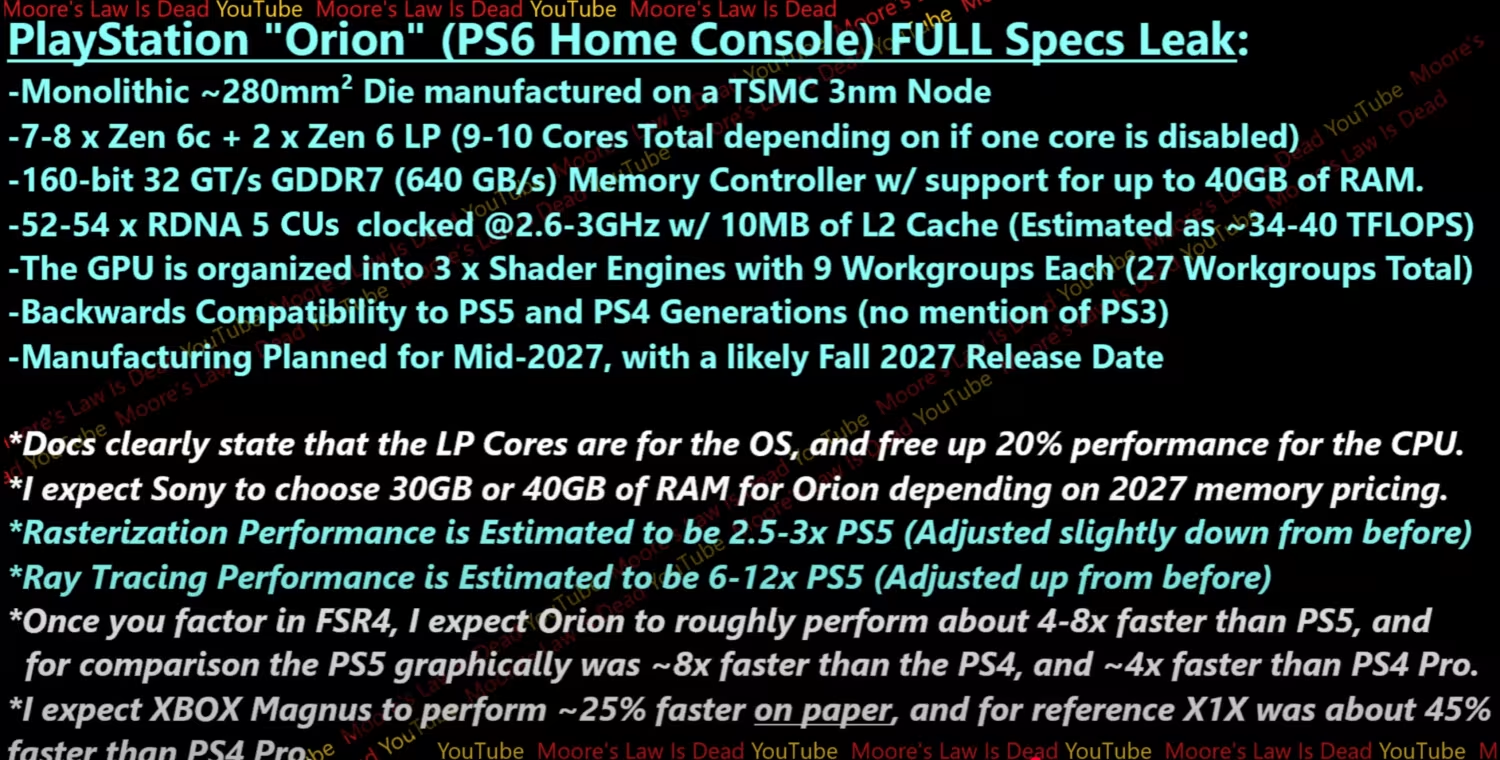
PlayStation "Orion" (PS6 Home Console) FULL Specs Leak:
- Monolithic ~280mm² Die manufactured on a TSMC 3nm Node
- 7-8 x Zen 6c + 2 x Zen 6 LP (9-10 Cores Total depending on if one core is disabled)
- 160-bit 32 GT/s GDDR7 (640 GB/s) Memory Controller w/ support for up to 40GB of RAM.
- 52-54 x RDNA 5 CUs clocked @ 2.6-3GHz w/ 10MB of L2 Cache (Estimated as ~34-40 TFLOPS)
- The GPU is organized into 3 x Shader Engines with 9 Workgroups Each (27 Workgroups Total)
- Backwards Compatibility to PS5 and PS4 Generations (no mention of PS3)
- Manufacturing Planned for Mid-2027, with a likely Fall 2027 Release Date
However, the base PS5 drops down to an unplayable 10FPS or so with path tracing enabled (which is far harder on the chip and performance than ray tracing). However, if the PS6 is somewhere between 5-10x faster in RT performance over the base PS5, then 5-10x that slow 10FPS with path tracing enabled turns into more like 60-120FPS... which would be an incredible increase for the PlayStation 6.
This means PS6 = RTX 5090 levels of ray tracing performance.
Once FSR4 or PSSR 2 upscaling is thrown into the equation, then we're looking at the new PS6 to be around 2.5-3x faster in rasterization than the base PS5, and ray tracing on the PS6 should be a far bigger 6-12x faster than the base PS5. Once FSR4 or PSSR 2 are used, MLID expects to see the next-gen PS6 to be around 6-12x faster than the base PS5.
MLID also notes for the next-gen PS6:
- Docs clearly state that the LP Cores are for the OS, and free up 20% performance for the CPU.
- I expect Sony to choose 30GB or 40GB of RAM for Orion depending on 2027 memory pricing.
- Rasterization Performance is Estimated to be 2.5-3x PS5 (Adjusted slightly down from before)
- Ray Tracing Performance is Estimated to be 6-12x PS5 (Adjusted up from before)
- Once you factor in FSR4, I expect Orion to roughly perform about 4-8x faster than PS5, and for comparison the PS5 graphically was ~8x faster than the PS4, and ~4x faster than PS4 Pro.
- I expect XBOX Magnus to perform ~25% faster on paper, and for reference PS5 was about 45%...