














Our Verdict
Pros
- Monster Capacity
- Sequential Read
- Low Queue Depth Performance
- Mixed Workloads
- [heading]Introduction[/heading]
Cons
- None
Should you buy it?
AvoidConsiderShortlistBuyIntroduction and Drive Details
Micron's 6600 ION 245.76TB SSD is not just another ultra-high-capacity SSD. This drive is indeed something special because it can digest random data at up to 3.5x the speed of its contemporary competitors, making mixed workloads such as database and email viable options for the first time at 245.76TB.
So why is this possible for Micron's highest capacity, 6600 ION, and not so for most of its competitors of the same capacity? Well, that comes down to its more compact Indirection Unit, or IU. An SSD's IU is a result of how much onboard DRAM the SSD is packing. Ideally, the ratio of DRAM to NAND is 1:1 or 1GB of DRAM per 1 TB of storage, which enables full real-world potential for random write speeds. A 1:1 ratio typically gives an SSD an IU of 4K.
However, as we get into capacity points of 64TB and up, limitations start to come into play where it is no longer feasible to keep that ideal 1:1 DRAM to NAND ratio. Limitations on the amount of onboard DRAM include three primary factors: cost, footprint, and power draw. Take, for example, the current pinnacle of capacity: 256TB. To deliver an ideal 1:1 ratio would require the drive to have 256GB of DRAM onboard, which hits all three of the major limitations, making it currently unfeasible due to cost, footprint, and power draw.
This has caused players in this arena to increase the ratio of NAND to DRAM to as much as 16:1, which would be an IU of 64K at 256TB or a total of 16GB of onboard DRAM. Now this is fine and dandy if you are only doing sequential programming or serving back data to the host which is why this new wave of ultra capacity QLC SSDs are typically considered viable for read-intensive applications only, as direct host to device random programming (randomly writing to it) is typically incredibly slow, which is why we commonly see specs like 2 million IOPS random read and 15 thousand IOPS random write at the 256TB capacity point.
So, to summarize the last paragraph, if random writes are in the mix (mixed workloads), these ultra-capacity, high IU SSDs are typically going to step on a rake, so to speak, unless there is a vast and costly caching mechanism in front of them that can convert random programming to sequential programming.
This is where Micron's newest differs from most of its competition, especially at 256TB. Micron's first 256TB PCIe Gen5 QLC SSD, the 6600 ION, cuts that 16:1 ratio we just spoke of back to a 4:1 ratio or an IU of 16K. The storage giant has accomplished this feat by attacking the three aforementioned hurdles head-on. Cost is dealt with because they fab their own DRAM. Footprint because they make some of the world's densest DRAM packages. And power draw because they make some of the world's most power-efficient DRAM as well as NAND.
Our Latest SSD Review Coverage
- Memblaze PBlaze 7 7A40 Ocean 61.44TB Enterprise SSD Review - Oceans of QLC at 3.3 million IOPS
- KIOXIA CD9P-R 7.68TB E3.S Review - The Best-In-Class Data Center SSD
- DapuStor Roealsen6 R6060 E1.L 245.76TB SSD Review - Massive Capacity with Fast Retrieval
- Phison Pascari X200P 7.68TB Enterprise SSD Review - Sequential Read Champion
- Micron 9550 Pro E1.S 15mm 7.68TB SSD Review - G8 Flash for Read-Intensive AI Storage Compute

Best Deals: Micron 5210 Ion Enterprise SSD
Prices last scanned 2 hours and 49 minutes ago


As we see it, 256TB of flash with a whopping 64GB of onboard DRAM opens up some new frontiers for Micron's 6600 ION QLC arrayed SSD that haven't even been a consideration for much of its competition. With an IU of just 16K, some mixed workload applications are now indeed viable landing spots for this quarter petabyte powerhouse. Think of it: 10 petabytes in a 2U server competently running your database. Incredible.
Okay, now that we are somewhat acquainted with what makes Micron's 245.76TB SSD different than the rest, let's see what kind of performance our test subject can deliver via our Xeon-powered enterprise test bench.

Frequently Asked Questions
TweakBot answers common questions about this review using TweakTown's own coverage from this page and related content from our archive. Tap a question to reveal the answer, or type your own below.
How does the 6600 ION’s 16K IU affect sustained random write performance under heavy mixed workloads compared to drives with 64K IU?
What CPU, platform, or driver requirements are needed to reach the published 13.7 GB/s sequential and 1.78M IOPS numbers?
Are there specific VMware ESXi or Linux kernel versions recommended for optimal compatibility and performance with the 6600 ION?
What power and thermal considerations should I plan for when deploying multiple 245.76TB E3.L 6600 ION drives in a 2U server?
Have a question not listed here? Ask below and TweakBot will answer it.

Specs/Comparison Products
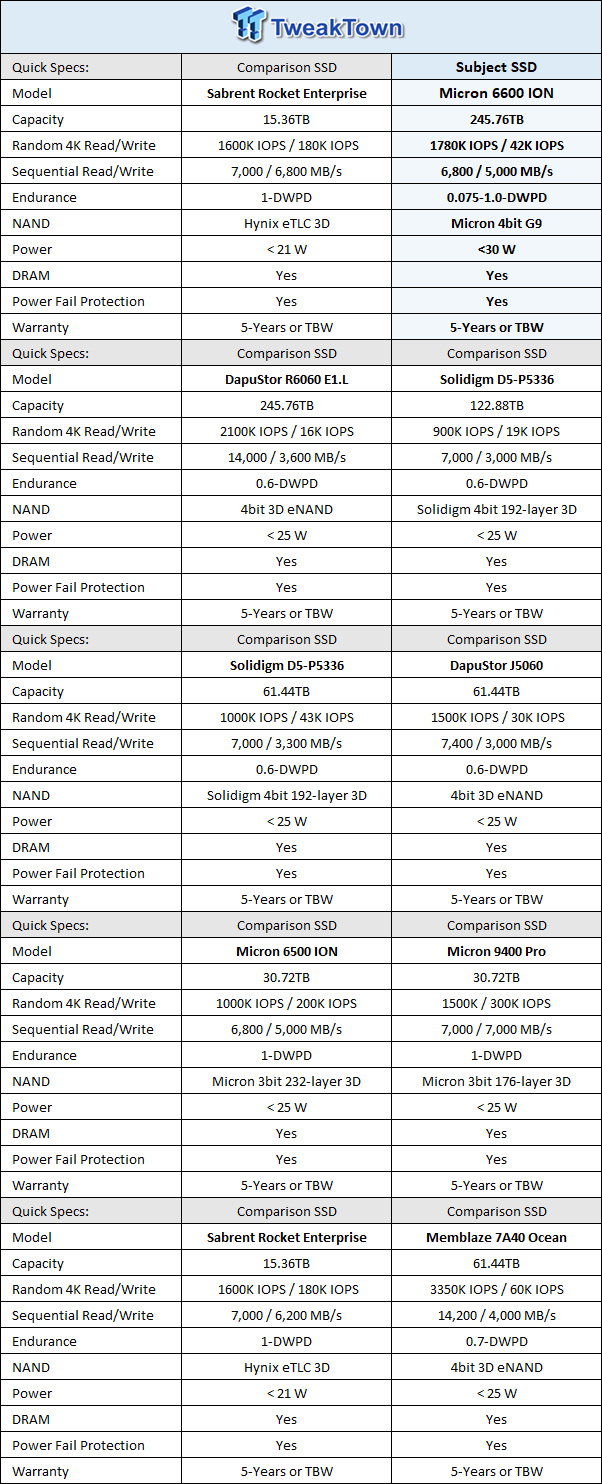
| Item | Details |
|---|---|
| Model | Micron 6600 ION 245.76TB |
| MSRP | NA |
| Model Number | LUN-G2MU064R-245.77T |
| Interface | PCIe Gen5 x4 |
| Form Factor | E3.L |
| Sequential BW | Up to 13,700 MB/s |
| Random IOPS | Up to 1780K IOPS |
| Warranty | 5-Years Limited |
Micron 6600 ION 245.76TB PCIe Gen5 x4 E3.L SSD


The drive we have in hand is an up to 1-DWPD design, E3.L form factor, 245.76TB in capacity, Micron G9 QLC arrayed, and 16-channel controlled. This configuration is rated for up to 1.78 million IOPS and up to 13.7 GB/s sequential throughput. 6600 ION Series SSDs are compliant with the NVMe 2.0d specification, including Full Data Path Protection, Power Failure Protection, NVMe-MI over SMBus/PCIe VDM, and Firmware Upgrade without Reset.
Micron 6600 ION Series SSDs are compatible with major operating systems such as RHEL, SLES, CentOS, Ubuntu, Windows Server, and VMware ESXi.
Test System Specs & Enterprise Testing Methodology
Enterprise SSD Test System
| Item | Details |
|---|---|
| Motherboard | ASUS Pro WS W790E-SAGE SE (Buy at Amazon) |
| CPU | Intel Xeon w7-2495X (Buy at Amazon) |
| GPU | GIGABYTE GeForce GTX 1650 (Buy at Amazon) |
| Cooler | Alphacool Eissturm Hurricane Copper 45 (Buy at Amazon) |
| RAM | Micron DDR5-4800 RDIMM (Buy at Amazon) |
| Power Supply | be quiet! Dark Power Pro 12 1200W (Buy at Amazon) |
| Case | PrimoChill's Praxis Wetbench (Buy at Amazon) |
| OS | Ubuntu 24.04.1 LTS |
A special thank you goes to Allyn Malventano; without his help, we wouldn't be where we are with our Linux-based Enterprise SSD testing platform.
Testing Methodology
TweakTown strictly adheres to industry-accepted Enterprise Solid State Storage testing procedures. Each test we perform repeats the same sequence of the following steps:
- Secure Erase SSD
- Write the entire capacity of the SSD 2x (2 loops) with 128KB sequential write data, seamlessly transition to the next step (sequential testing skips step 3)
- Precondition SSD by filling the drive twice with 4K or 8K random writes or IU of SSD
- Run test-specific workload with a 30-second ramp-up for 5 minutes at each measured Queue Depth, and record average result
Benchmarks - Sequential
128K Sequential Write/Read

We precondition the drive with 100 percent sequential 128K writes at QD256 using 1 thread for 2-drive fills, receiving performance data every second. We plot this data to observe the test subject's descent into steady-state and to verify steady-state is in effect as we seamlessly transition into testing at queue depth. Steady-state is achieved after 1-drive fill. Average steady-state 128K sequential write performance at QD256 is approximately 3,100 MB/s.


Micron specs its 6600 ION 245.76TB SSD as capable of delivering up to 3,000 MB/s 128K sequential write throughput. We are getting up to 3,159 MB/s, so the factory spec here seems to be spot on.


Here the drive is factory spec'd for up to 13,700 MB/s 128K sequential read throughput. We are hitting up to 13,900 MB/s, so again exactly as advertised. We really appreciate the superior performance curve indicated by better performance at lower queue depth than we typically see at this capacity point. Looking at the chart, we can see a clear advantage that PCIe Gen5 brings to the table as compared with the PCIe Gen4 SSDs that populate our chart. Roughly double the sequential throughput potential. Impressive.
Benchmarks - Random
4K Random Write/Read

We preconditioned the drive using 100 percent random 16K (IU aligned precon) writes at QD256 for 2-drive fills, receiving performance data every second. We use the IU of the drive here because preconditioning at 4K would take roughly 56 days due to the capacity of our test subject. We plot this data to observe the test subject's descent into steady-state and to verify steady-state is in effect as we seamlessly transition into testing at queue depth. A steady state is achieved after 1-drive fill. Average steady-state random write performance at QD256 is approximately 50K IOPS - factory spec here is 42K IOPS, so significantly better than advertised. We note excellent consistency here as well.


Interestingly enough, 4K random write performance is advertised as being the same IOPS as 16K random write, which is what we used to precondition the drive. Performance here at 4K is again coming in at up to 51K IOPS, or 9K better than advertised. Impressive and notably more than 3x what we are seeing from the R6060 245.76TB with an IU of 64K. This is where the 6600 ION has a major advantage over much of its competing quarter-petabyte competition.


Factory spec here is up to 1,780K IOPS. We are getting exactly that with our test configuration.
4K 7030


This type of mixed workload at this capacity point is usually not a viable application; however, our 16K IU test subject makes what we feel is a compelling argument. As we see it, read-heavy mixed workloads are in the mix for the first time we know of at 245.76TB. Again, more than 3x what we are seeing from the R6060 with an IU of 64K. More onboard DRAM is making a huge difference here. Impressive.
4K 5050


Again, more than 3x better than an IU 64K SSD of the same capacity.
8K Random Write/Read

We preconditioned the drive using 100 percent random 16K (IU aligned precon) writes at QD256 for 2-drive fills, receiving performance data every second. We use the IU of the drive here because preconditioning at 8K would take roughly 28 days due to the capacity of our test subject. We plot this data to observe the test subject's descent into steady-state and to verify steady-state is in effect as we seamlessly transition into testing at queue depth. A steady state is achieved after 1-drive fill. Average steady-state random write performance at QD256 is approximately 50K IOPS. We note excellent consistency here as well.


8K random write performance is looking about the same as we are seeing at 4K, and that again is excellent, as at 8K we are moving twice the amount of data as we are at 4K. This is typical of what we have been seeing from this capacity point in that the IOPS is the same at 4K as it is at 8K, but what is not typical is our test subject is doing it at more than 3x the speed of some of the others with the same capacity.


Outstanding performance curve here. In fact, we are of the opinion that it is the best performance curve of the QLC SSDs appearing on this chart, including the 7A40, due to our test subject delivering more at QD16-128. Excellent.
8K 7030


8K 7030 is representative of a common database workload. Again, for the first time at this capacity point, we are seeing numbers that, in our opinion, make our test subject a viable option for this type of workload. Amazing and again more than 3x better than the 64K IU R6060 245.76TB.
8K 5050


Again, more than 3x better than the IU 64K SSD of the same capacity.
Final Thoughts
As we see it, our test subject is breaking new ground for its capacity point. We are of the considered opinion that read-heavy 7030-type mixed workloads that can benefit from ultra-high-capacity SSDs are in play for the 6600 ION 245.76TB. The more DRAM, the better the random programming gets, and this SSD is packing 4x more than we've ever encountered at 245.76TB.

It's groundbreaking and easily the best of its kind that we've encountered to date. In fact, we believe it's the one to beat in its class. Editor's Choice.


 Memblaze PBlaze 7 7A40 Ocean 61.44TB Enterprise SSD Review - Oceans of QLC at 3.3 million IOPS
 KIOXIA CD9P-R 7.68TB E3.S Review - The Best-In-Class Data Center SSD
 DapuStor Roealsen6 R6060 E1.L 245.76TB SSD Review - Massive Capacity with Fast Retrieval
 Phison Pascari X200P 7.68TB Enterprise SSD Review - Sequential Read Champion
 Micron 9550 Pro E1.S 15mm 7.68TB SSD Review - G8 Flash for Read-Intensive AI Storage Compute
 Giveaway: Win an NZXT H6 RGB+ Case, Kraken Elite AIO, RGB Fans and 1200W PSU
 Ubisoft responds to Black Flag Resynced DLC critics by telling them they're 'not a requirement'
 NVIDIA is reportedly preparing the GeForce RTX 5090 SE to sit between the RTX 5080 and 5090
 id founder John Carmack comments on sad fate of studio
 Report: Minecraft profits used to fund Xbox games portfolio
 Assassin's Creed Black Flag Resynced has $80 worth of cosmetics and time-saving DLC
 Need For Speed seemingly on ice as Criterion becomes a Battlefield studio
 51 Ubisoft employees who worked on the successful Assassin's Creed Black Flag Resynced have just been laid off
 AMD expands Ryzen 200 and 100 'Hawk Point' APU lineup with 11 new SKUs
 Open-Source Windows alternative ReactOS runs Half-Life 2 on a GTX 960
 MOZA MA3F EFCM Flight Control Module Review: authentic Airbus A320 autopilot panel for simulators
 Turtle Beach Stealth Pro II Wireless Gaming Headset Review - Premium Sound, Fantastic Features
 MOZA MGX1000 Instrument Panel Review: a realistic Garmin G1000 replica for immersive flight sims
 Simagic Zeus Formula Steering Wheel Review: premium build and advanced inputs for F1 racing
 GIGABYTE X870E Aero X3D Dark Wood Review - A woody goody
 The Super Mario Galaxy Movie (2026) 4K Ultra HD Blu-ray Review
 KTC H49S66 5K2K (5120x1440) 49-inch 180Hz Gaming Monitor Review
 HighPoint Rocket 1604L Gen5 x16 NVMe Software RAID AIC Review: half the price with full 59 GB/s speed
 Next Level Racing ERS3 Haptic Seat Review: immersive sim racing comfort with integrated haptics
 ASUS TUF Gaming X870-Pro WiFi7 W NEO Review - Tuffed up
 Don't sell your Windows laptop until you do these things
 6 PC cleaning mistakes to avoid for safer hardware maintenance
 Phison and Intel Take Aim at Local AI's Memory Wall with aiDAPTIV
 How to Remap Keyboard Keys in Windows using Microsoft PowerToys
 7 tips to organize your Windows files for faster, easier access
 Intel Arc G3 Extreme first impressions with MSI's Claw 8 EX AI+ - Incredible power for an extreme price
 How to fix Wi-Fi Adapter Not Working on Windows laptops: troubleshooting tips
 Hisense U7SG 4K TV: Modern Entertainment for the New Age
 6 underrated Microsoft Word features worth using to boost your productivity
 Level Up Your PC Gaming with these Fantastic ASUS Prime Day Deals on GPUs, Motherboards, and More