
Our Verdict
Pros
- Exceptional image quality
- Anti-glare coating
- Gaming performance
- Entertainment hub
- Versatility
Cons
- No USB-C Port
- High price point
- Brightness slightly low
Should you buy it?
Introduction & Specification Details and Close-up
Samsung is no stranger to the gaming monitor market, making some of the highest-end displays that money can buy, and now the company has unveiled its latest OLED gaming monitor, the Samsung Odyssey G8, a 32-inch 4K 240Hz beast.

The Odyssey G8, or simply the G8 for the remainder of this review, is a direct competitor to LG's 32GS95UE and ASUS PG32UCDM, the latter of which I have reviewed and scored quite highly. Just like the PG32UCDM, the G8 is rocking Samsung's latest third-generation QD-OLED panel, and while a fourth-generation is available in the 27-inch size, there isn't one available yet in 32 inches.
Samsung is positioning this latest G8 at the premium end of gaming monitors, pricing it at $1,399 on its website, making it more expensive than the PG32UCDM, and the most expensive 32-inch OLED gaming monitor I have ever tested. With the price tag comes an immaculate grey and silver design aesthetic that makes the G8 stand out amongst the pack of predominantly black gaming monitors.
Coupled with the premium look are premium-level features, with Samsung angling the G8 at the highest end of PC gaming setups. The panel is capable of 4K at 240Hz, paired with a 0.03ms (GtG) response time.
Specifications
| Item | Details |
|---|---|
| Model | Odyssey G8 |
| Size | 32-inch |
| Resolution | 3840 x 2160 (4K) |
| Pixels Per Inch (PPI) | 138 |
| Panel Type | QD-OLED |
| Refresh Rate | 240Hz |
| Response Time | 0.03ms (GtG) |
| Brightness | 250nits |
| Contrast Ratio | 1,000,000:1 |
| Aspect Ratio | 16:9 |
| Viewing Angle | 178°(H)/178°(V) |
| Color Coverage | Color Gamut (DCI Coverage): 99% (CIE1976) |
| HDR Support | HDR10 |
| Video Ports | 1x DisplayPort 1.4, 2x HDMI 2.1 |
| USB Ports | 2x USB-A 3.0 downstream, 1x USB-B upstream port, 1x 3.5mm headphone jack |
| VESA Mounting | 100 x 100 |
| Adjustments | Height, tilt, swivel, pivot |
| Warranty | 3 years |
Close-up


Best Deals: Samsung Odyssey G8 Gaming Monitor
Price Trend:
Prices last scanned 7 hours and 50 minutes ago

7 days ago: $716.58 USD30 days ago: $899.99 USD
7 days ago: $998 CAD30 days ago: $1198 CAD
7 days ago: £64930 days ago: £649

7 days ago: $129930 days ago: $1469


Design
Samsung's Odyssey line of gaming monitors is one of the best-looking on the market, as the company makes a real effort to ensure the Odyssey line stands out in a crowd of predominantly black, RGB-riddled displays, with a clean, minimalist design aesthetic.

The metallic silver finish across the monitor adds to the premium aesthetic Samsung is going for, which is further enhanced by a very slim front bezel, sturdy build quality, a slim profile, and a smooth, yet strong shell. The stand on the G8 is also metal and enables users to adjust the height of their monitor, the angle of the tilt, swivel, and even pivot.
Moving to the back of the display, Samsung has equipped the G8 with a textured panel and subtle angular lines that break up the mostly solid metal back panel housing. The angular lines move toward the center of where the stand connects to the back of the monitor, and around the outer edges of where the stand connects, Samsung has placed a vibrant RGB light. This light can be changed and customized within the On-Screen Display (OSD).
Our Latest Monitors Review Coverage
- ASUS ROG Strix OLED XG34WCDMS Review: Tandem OLED Takes Ultrawide Gaming Further
- GIGABYTE MO27Q2A Gaming Monitor Review: 1440p, 280Hz, and QD-OLED is a winning combination
- ASUS ROG Strix XG129C Review: A $199 Gaming Monitor You Don't Play Games On
- KTC H49S66 5K2K (5120x1440) 49-inch 180Hz Gaming Monitor Review
- GIGABYTE GO27Q24G Gaming Monitor Review: Glossy OLED Gaming at 240Hz

The top of the G8 features a long air-vent grill that cools the internal components. Moving down to the connectivity options, Samsung has equipped the G8 with a range tailored to both PC and console gaming. Additionally, there are ports typically used by creators to access the USB ports on the monitor's back. Here's what's available: 1x DisplayPort 1.4, 2x HDMI 2.1, 2x USB-A 3.0 downstream, 1x USB-B upstream port, 1x 3.5mm headphone jack, and a power port. Next to the connectivity options is the multi-directional joystick for controlling the OSD.
It's quite unfortunate that Samsung decided against including a USB-C port on this monitor, as that would have gone perfectly with the "extremely" premium design and feature set the company was going for. It's become quite the standard on gaming monitors, especially those priced at the higher end, to offer a USB-C port with PD charging capabilities, as many gamers like to use the easy-to-access charging port for devices such as smartphones, gaming headsets, mice, laptops, and tablets.

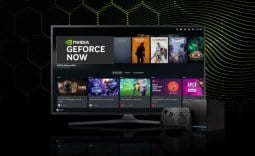
Additionally, the monitor features a headphone jack and comes with speakers that produce surprisingly good sound for a monitor. Samsung has integrated its Gaming Hub and Smart TV apps into the G8 gaming monitor, making it home media-friendly so users can use it not only for gaming but also for media viewing.
Personally, I see all of these features as quite a hindrance, especially when PC gamers who are likely to purchase this monitor for a 4K 240Hz refresh rate will simply be pulling up streaming services and media via browsers or native PC apps. Or if they had a console also connected, it's more likely they will be using that to watch content.

However, I can recognize potential value for someone who wants to sit back and really feel the "TV" experience by using the provided remote to browse content. It's not for me personally, but Samsung does provide this option, making the G8 not just a gaming monitor, but also an entertainment hub.
Panel Breakdown
Moving back up to the display itself, Samsung has developed a new coating that it's touting as "OLED Glare Free," and by all accounts, it's extremely impressive. Glare was -and still is -one of the biggest problems with OLED displays, as it significantly increases the brightness in the areas it hits, resulting in colors being completely washed out.

But Samsung's new Anti-Reflection film has really made some leaps and bounds in the reduction of glare, even from direct light sources. The improvement is so drastic that I can safely say this is one of, if not the best, anti-glare OLED panels I have ever tested.
Other areas of the panel performance that are worth noting are the intensely saturated color profile. Samsung has done a fantastic job at balancing the colors of the G8, and while most QD-OLED monitors are already great to look at, the G8 is particularly gorgeous. However, there is a downside.

I noticed the brightness of the G8 was quite low compared to other QD-OLED monitors I have tested, and throughout my testing time, I had to increase the brightness up to 100% to enjoy the display fully. It's a small critique, but I feel this Samsung panel is duller than the competition, not by much, but still enough to be worth mentioning.
With a 32-inch panel and a resolution of 3840 x 2160, the Odyssey G8 delivers 138 Pixels Per Inch, making it more than suitable for cinematic and competitive titles. The 4K resolution paired with the 240Hz refresh rate and 0.03ms (GtG) response time means the G8 is stellar at basically any title you throw at it.

The only differentiating factor would be the personal preference with size when it comes to what type of game you like to play. For example, competitive shooters are traditionally played on smaller monitors, typically 27 inches and below, while cinematic gamers enjoy larger displays for the increased immersion.
For me personally, the 32-inch is the jack-of-all-trades display, as it's the perfect size to really show off the slower cinematic titles where colors and detail can be appreciated more, while also stopping right before the "too big" line for first-person shooter titles that can really take advantage of that 240Hz refresh rate.
Performance
So, how does the G8 fare in what matters most - games? Firstly, with every monitor I test, I like to include several different genres of games to see where the monitor performs the best and to hopefully inform a gamer what their experience will be like if they played their favorite type of game on the display under the spotlight.

For the G8, I tested the following games: League of Legends, Apex Legends, Overwatch 2, Black Myth: Wukong, Cyberpunk 2077, The Witcher 3, God of War Ragnarok, Valorant, DOOM: The Dark Ages, Age of Mythology: Retold, Borderlands 4, and Battlefield 6.
As I previously mentioned, the G8 absolutely dominated every single game that I threw at it. This is an immaculate gaming monitor that I believe a gamer would be hard-pressed to find a title that doesn't look and feel incredible on. Titles such as League of Legends, Apex Legends, Overwatch 2, DOOM: The Dark Ages, and Battlefield 6 all took advantage of that 240Hz refresh rate and 0.03ms response time, meaning I felt absolutely dangerous in-game as my mouse movements felt one-to-one with what was happening on the screen.

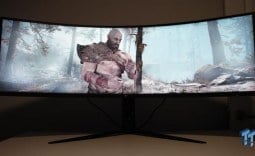
The slower titles, such as God of War: Ragnarok, Cyberpunk 2077, The Witcher 3, Black Myth: Wukong, and Age of Mythology: Retold, demonstrated the impeccable color performance, and particularly the level of contrast that can be provided by a QD-OLED panel. Each of these titles showed impressive levels of detail through deep blacks, paired with high-resolution imagery. Colors popped, appeared vibrant and milky, even in titles that aren't as graphically impressive, such as Age of Mythology: Retold.
Like I said, it's more of a challenge to find a game that doesn't look good on a QD-OLED panel, rather than finding one that does.

For those considering purchasing the G8 for both work and play, I'm happy to report that text fringing issues have almost disappeared entirely and are a non-issue at this PPI and on most third-generation QD-OLED panels, such as the one within the G8. Samsung has done quite a lot of work in this department, and I can verify the progress they have made.
From the first generation QD-OLED panel being unrecommendable for word processing tasks, to the second generation, where significant progress was made at ironing out the problem, to now the third generation, where I can comfortably recommend it to someone who wants the monitor for spreadsheet work, word processing activities, and video editing + gaming.
Final Thoughts
So, should you buy the Samsung Odyssey G8? Well, what you have here is an extremely premium 32-inch OLED gaming monitor that is retailing for $1,399, but is regularly discounted to about the $1,000 mark. If you are after a top-of-the-line gaming monitor that holds nothing back, besides a USB-C port, the G8 is an incredible pick up, but I would wait until you catch it on sale, as the full retail price is a bit of a stretch when compared to the competition.

The ideal owner of an Odyssey G8 will want a display that does it all, meaning they will want to take advantage of the suite of entertainment options Samsung has integrated into the G8, not just the gaming side. The G8 is a TV/monitor hybrid, and an owner should want to take advantage of that entertainment side of the monitor, as I believe a strictly PC/console gamer will be leaving quite a lot on the table in terms of monetary value if they were to use the G8 for desktop/console use exclusively.
If you are looking for a top-of-the-line QD-OLED panel for PC gaming and aren't too fussed about giving up the suite of entertainment options, the G8 will still provide an incredible experience and come with top-notch build quality to boot. However, if you are buying on a budget and want to save a few dollars, competitors such as MSI's 322URX, which features the same gaming specs (4K @ 240Hz) on the same QD-OLED panel, but for $100 less, or the 321CURX, a curved version that's also 4K @ 240Hz, but for $999.