













Microsoft has warned users about an active cryptojacking campaign that uses AI chatbots to serve malicious downloads disguised as trusted PC utilities. Microsoft Defender Experts and the Security Research Team said in a report published Tuesday that "this emerging delivery technique extends social engineering beyond conventional search results and increases the visibility of malicious software recommendations."
The campaign impersonates legitimate system utilities like CrystalDiskInfo, HWMonitor, Display Driver Uninstaller, FurMark, K-Lite Codec Pack, and PDFgear. The idea is to target applications favored by PC users with high-performance GPUs to gain access to systems with higher cryptocurrency mining potential, rather than infecting a large number of machines at random.
Downloads from this cryptojacking campaign have also been found to establish persistent remote access through ScreenConnect deployments. ScreenConnect, also known as ConnectWise Control, is a legitimate remote management tool widely used by IT administrators, but it can also be leveraged for data theft, lateral movement, or ransomware.
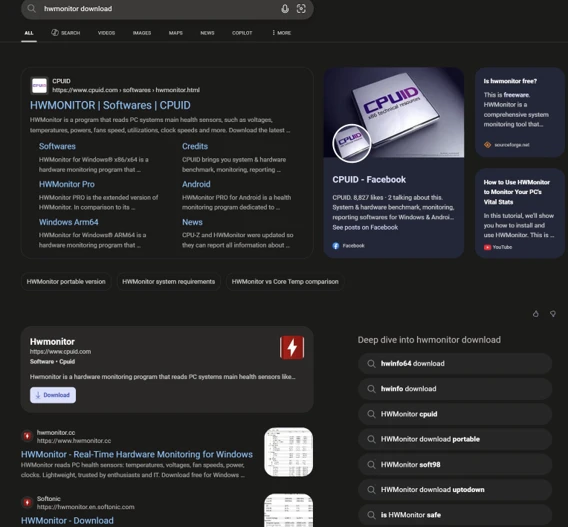
The attack uses two techniques to push users into downloading infected utilities instead of the official ones. SEO poisoning creates malicious websites that mimic legitimate ones and are engineered to rank highly for queries like "download HWMonitor" or "latest CrystalDiskInfo." At the same time, attackers manipulate AI chatbots by influencing their training data to recommend attacker-controlled domains as trusted download sources.

In April 2026, Microsoft identified cases in which users were directed to malicious websites through interactions with LLM-based chatbots rather than through traditional search engine results. Links were provided to malicious downloads masquerading as official ones, bypassing long-trusted websites in favor of newly established fake ones that exploit the recommendation system. Despite these safety concerns, companies continue to push AI responses deeper into search results, with Google recently doubling down on AI, making AI Mode and Gemini central to Search.
That said, if you want to keep your PC malware-free, it's better to avoid relying on AI chatbots to download such system utility tools. Instead, manually visit official sources and, even if you do use AI recommendations, double-check that they point to legitimate, verified websites before downloading anything.


 You can debloat Windows 11 in just 2 clicks with this new intuitive tool
 Assassin's Creed Hexe to be revealed 'relatively soon' according to insider
 LG claims that you can improve your aim by up to 38% by playing on a 480Hz OLED monitor
 Pixel 11 Pro Fold leak may reveal Google's next big foldable upgrade
 Sony's $500 million lawsuit heats up after choice to end PlayStation disc production
 Spacecraft confirmed to be approaching one of Earth's seven mysterious 'quasi-moons'
 AI models could soon get cheaper as OpenAI, Meta, and xAI enter a new price war
 SAP escapes EU penalty by easing customer lock-in concerns
 Cursor builds AI agent 'Sand' to rival Anthropic's Claude Cowork
 PocketMage is a distraction-free pocket computer with a wizard-themed operating system
 Samsung is holding your health data hostage to train its AI
 MOZA FMP18 Panel Bundle Review: authentic F/A-18 Hornet cockpit controls for flight sims
 Micron 6600 ION 245.76TB Enterprise SSD Review - Best in Class Programming Speeds
 MOZA MA3F EFCM Flight Control Module Review: authentic Airbus A320 autopilot panel for simulators
 Turtle Beach Stealth Pro II Wireless Gaming Headset Review - Premium Sound, Fantastic Features
 MOZA MGX1000 Instrument Panel Review: a realistic Garmin G1000 replica for immersive flight sims
 Simagic Zeus Formula Steering Wheel Review: premium build and advanced inputs for F1 racing
 GIGABYTE X870E Aero X3D Dark Wood Review - A woody goody
 The Super Mario Galaxy Movie (2026) 4K Ultra HD Blu-ray Review
 KTC H49S66 5K2K (5120x1440) 49-inch 180Hz Gaming Monitor Review
 HighPoint Rocket 1604L Gen5 x16 NVMe Software RAID AIC Review: half the price with full 59 GB/s speed
 I stopped digging through Windows menus after I set up this one folder
 Don't sell your Windows laptop until you do these things
 6 PC cleaning mistakes to avoid for safer hardware maintenance
 Phison and Intel Take Aim at Local AI's Memory Wall with aiDAPTIV
 How to Remap Keyboard Keys in Windows using Microsoft PowerToys
 7 tips to organize your Windows files for faster, easier access
 Intel Arc G3 Extreme first impressions with MSI's Claw 8 EX AI+ - Incredible power for an extreme price
 How to fix Wi-Fi Adapter Not Working on Windows laptops: troubleshooting tips
 Hisense U7SG 4K TV: Modern Entertainment for the New Age
 6 underrated Microsoft Word features worth using to boost your productivity