












Tesla's TeraFab project is a joint venture between Tesla, SpaceX, and xAI, dubbed by Elon Musk as "the most epic chip-building exercise in history." Tesla claims its $25 billion Austin chip factory would roughly match 70% of TSMC's current global output. This would allow Tesla to reduce its reliance on foundries like TSMC and Samsung by building domestic semiconductor production lines capable of producing chips at volumes significantly larger than those of any other foundry.
However, given that Tesla has no node IP or semiconductor industry experience, many were skeptical about how a car company, a rocket company, and an AI startup could develop 2nm-class process technology from scratch and scale it to 1 million. The most likely path forward was always a partnership with an existing foundry, and it appears Intel has now been chosen for that role.
Intel confirmed its involvement in the TeraFab project on its official X page, stating that it aims to help TeraFab reach 1 trillion watts of compute per year for future AI and robotics workloads.
Musk pitched TeraFab as a vertically integrated mega-facility that would combine design, lithography, fabrication, memory, advanced packaging, and testing under one roof. With Intel now in the picture, it is clear that the company will bring the process technology, manufacturing expertise, and advanced packaging capabilities needed to make such a facility viable.
For Tesla, partnering with Intel makes sense, as existing foundries haven't expanded fast enough to meet future demand for Tesla's AI hardware. Even the best-case supply scenarios from TSMC and Samsung were not enough to cover the AI5, AI6, and Optimus chips the company needs. The Optimus robot program is the largest single driver of chip demand, estimated to require 20 million chips per year. That is approximately six times Tesla's current chip demand across its entire automotive business.

This leaves Intel as one of the few companies capable of operating at advanced process nodes while also offering industry-leading packaging technologies such as Foveros 3D stacking and EMIB. It also aligns with Musk's preference for a US-based supply chain, making Intel a natural partner alongside Samsung and TSMC.
Intel has not yet shared details about the process technology, packaging approach, or specific foundry model for TeraFab. However, the chipmaker's stock rose nearly 5% following the announcement of its partnership with Tesla, SpaceX, and xAI.


 Elon Musk says Tesla will need 100-200 billion AI chips per year, wants to build his own fabs
 Elon Musk wants to move at 'light speed' on the Terafab project
 Tesla plans to use Intel's next-gen 14A process for its TeraFab project
 Google orders Intel Foundry to produce over three million TPUs for 2028 amid TSMC capacity crunch
 NVIDIA CEO bucks Elon Musk's plans to build chip fab, says what TSMC does is 'extremely hard'
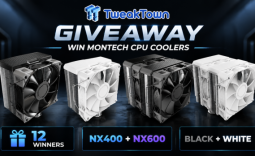 Giveaway: 12 Winners Will Score MONTECH NX400 and NX600 CPU Coolers
 GIGABYTE's next-gen 4K 32-inch AORUS ELITE gaming monitor with Tandem WOLED panel delivers 1,500 nits of HDR peak brightness
 Sony reminds players they don't actually own digital PlayStation games amid disc-production backlash
 GTA 6 'build' that's 113GB in size is currently circulating online, and it's fake
 Windows 11 update has broken some PC games, and RGB lighting could be the issue
 Assassin's Creed Odyssey becomes the highest-rated entry in the franchise, thanks to Nolan's 'The Odyssey'
 PlayStation gamers' planned week-long 'PS Blackout' begins today
 Nintendo Switch 2 will rise to £419.99 in the UK, starting September 1
 One retailer says 91% of attempts to buy DDR5 memory are coming from bots
 Jensen Huang signed NVIDIA RTX Pro 6000 graphics card sells for $57,450 at auction
 GTA 6 leaks have reportedly led to a morale drop at Rockstar, with Netflix frustrated as well
 ASUS ROG Strix OLED XG34WCDMS Review: Tandem OLED Takes Ultrawide Gaming Further
 Cooler Master MasterFan A120 Fan Review
 GIGABYTE MO27Q2A Gaming Monitor Review: 1440p, 280Hz, and QD-OLED is a winning combination
 Cooler Master V8 ACE 3DHP BLACK CPU Cooler Review
 ASUS ROG Strix XG129C Review: A $199 Gaming Monitor You Don't Play Games On
 Cooler Master HAF II 500 Mid-Tower Chassis Review
 Corsair HS35 v3 Wireless Gaming Headset Review - An Affordable Winner
 D-Link F518 5G Wi‑Fi 6 AX1800 Mobile Hotspot Review: All-Day Mobile Hotspot
 Bose Lifestyle Ultra Speaker Review - Impressively Detailed Room-Filling Sound
 MSI Z890 Gaming Plus WIFI6E Review - Z890 for under $200
 Using Multiple Monitors? Change these Windows settings for a Better Experience
 Windows Sandbox is The Windows Security Feature Most People Never Use
 I ditched the Windows 11 context menu for this open-source tool, and here's why
 Windows 11 may be encrypting your drive already, and I checked where my recovery key went
 GIGABYTE's 40 Days of INFINITY celebrates 40 Years of Innovation with stunning GeForce RTX graphics cards and rewards
 I swapped File Explorer for this free file manager and finally got the layout I wanted
 How to tell if someone has been using your Windows PC without your permission
 6 Task Manager tips for troubleshooting Windows performance problems
 ASUS ROG's 20th Anniversary Line-up of Premium PC Gaming Gear has Arrived - Here's Everything You Need to Know
 Six File Explorer tips every Windows user should know