
Our Verdict
Pros
- Build quality
- Value
- Overall experience
- Upgrade options
Cons
- Hydraulic upgrade costs more than the handbrake
Should you buy it?
Introduction, Specifications, and Pricing
Hot on the heels of the Zeus Series launch, Simagic is now launching the all-new TB-Neo, a modular handbrake aimed at drifters and rally enthusiasts. In the standard configuration, the TB-Neo is priced at $139, with upgrades available to customize the overall experience.
Among the highlights listed by Simagic in their reviewer information, the TB-Neo includes:
- Expandable Modular System: The TB-Neo's modular design supports interchangeable elastomers, an optional hydraulic module, and P-HPR linear haptic reactors. Drivers can customize resistance and feedback characteristics to match different driving styles and preferences.
- Full-Range Adaptive Sensing Tech: Simagics' patented Full-Range Adaptive Sensing Technology intelligently optimizes signal gain across the entire input range, preserving exceptional detail at lighter inputs without sacrificing stability at higher loads. Every input remains consistent and precise across the full 0 - 100 kg range, from subtle corrections to full-force pulls, delivering smooth, responsive performance throughout.
- Die-Cast Aluminum Body: Constructed from high-strength die-cast aluminum alloy and refined through precision CNC machining for exceptional rigidity and durability.
- Adjustable Handbrake Feel: Interchangeable elastomers let you fine-tune resistance and handbrake feel to suit your driving style. Comes pre-installed with yellow springs and includes additional hardness options for further tuning.
- Dual Modes, Five Angles: TB-Neo supports both horizontal and vertical handle configurations, with five adjustable angle positions to accommodate different driving preferences and installation setups.
- Broad Ecosystem Compatibility: Multiple connectivity options provide flexible integration across different setups, while support for the full P-HPR lineup enables telemetry-based haptic feedback.
- High-Precision Load Cell Sensor: A high-precision load cell ensures accurate input capture and consistent signal response, delivering a stable, reliable handbrake feel in every use.
- Software, Tuning, and Customization: SimPro Manager lets users adjust settings for different driving styles and scenarios. P-HPR haptic modules also support SimHub integration for additional customization options.
The TB-Neo seems to offer a lot, then, and given it's not something I have ever contemplated adding to my sim rig, purely due to the type of racing I compete in, I am starting to wonder if the TB-Neo will make me want to take up rally and drifting, and expand the range of racing I can enjoy. Will it transform me into Colin McRae or Ken Block? I am not sure, but I am excited to find out!
Packaging

Simagic's packaging of the TB-Neo is nice and familiar, with a full-color sleeve over a brown cardboard box. The front shows the new TB-Neo, with the Simagic and TB-Neo logos at the top.


Best Deals: PXN HB S USB PC Handbrake for Sim Racing wheel
Prices last scanned 20 hours and 15 minutes ago


The back of the sleeve shows the product dimensions; the TB-Neo measures 382.5mm tall, 209.5mm long, and 73.5mm wide. Overall, it weighs 1.36kg, with optional upgrades increasing that. Simagic also lists what is included on the back of the packaging.
Unboxing the Simagic TB-Neo


After sliding off the sleeve and opening the cardboard box, everything is well protected in open-cell foam. The top layer includes a user guide and Simagic stickers. Below, the handbrake itself is nestled in foam, with all accessories and cables included.

Simagic provides cables to connect directly to your PC via USB, or to a Simagic wheelbase to save USB ports. Mounting hardware to connect to your cockpit is also included, with screws and T-nuts.
Our Latest Racing Review Coverage
- Simagic Zeus Sport Steering Wheel Review
- Asetek Initium Pedal Modular Upgrades Review
- Simagic Zeus Formula Steering Wheel Review: premium build and advanced inputs for F1 racing
- Next Level Racing ERS3 Haptic Seat Review: immersive sim racing comfort with integrated haptics
- Asetek Forte S-Series Racing Simulator Bundle Review


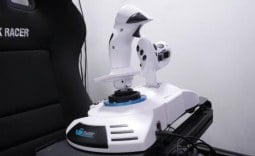
Looking around and holding the TB-Neo, it feels durable, robust, and well-made, while Simagic has kept the traditional black-and-red color theme. The main body is made of aluminum alloy, with ABS and PC components to complete the build. It includes a 100kg load cell with a 12-bit high-precision sensor for accurate control.

Frequently Asked Questions
Open a question for an answer from TweakTown's coverage of this review, or ask your own below.
What do the interchangeable elastomers change on the TB-Neo, and how easy is it to tune the handbrake feel?
Can the TB-Neo be mounted both vertically and horizontally on a cockpit, and how many angle positions does it offer?
What firmware or software setup is required after installing the TB-Neo in SimPro Manager?
Have a question about this content not listed here? Ask below and TweakBot will answer it.


Viewed from the bottom, you can see the mounting holes on either end. Simagic includes M6-12 pan head screws and M6-40 profile nuts to attach to a frame.

Connection ports are placed on the side of the upright, with USB-C and RJ45 available. Power and connection for a P-HPR are also provided should you want to add haptic feedback.


The TB-Neo arm provides height and angle adjustment by removing the screws on the sides. This adjustment lets you mount the handbrake vertically and reposition the arm as needed. Given my cockpit layout, I will test in the default position, but this might suit other users better. The handle screws onto the top of the arm and is made of POM.

Both sides of the handbrake arm include a mounting point for a P-HPR reactor, which I will be installing a little later.


Removing the spring barrel is a simple process and lets you adjust the handbrake's tension. You can swap elastomers for softer or stiffer combinations and adjust the handbrake play.

Simagic includes a range of elastomers to adjust the handbrake feel and provides a guide in the manual to demonstrate different settings. For testing, I'll check out these recommended configurations before adding some extras.

Simagic was kind enough to send over a P-HYSi and a P-HPR GT reactor for testing, so I will show the installation process here. Simagic developed the P-HYSi for their pedals, and I use them on the P1000 pedals on my day-to-day rig. The P-HYSi features a rotatable oil reservoir suitable for the TB-Neo when used in a vertical configuration or in its default position.


With the hydraulic upgrade installed, you'll get more precise control and a better feel. The P-HYSi includes all mounting tools and hardware, along with a large selection of elastomers and springs. Simagic provides some examples in the TB-Neo user guide, but given the variety on offer, I suggest you take some time to get a feel for it and dial the handbrake in to your preference.


In its default form, the P-HYSi includes red and blue elastomers within the chamber, and this will be my starting point for testing. Given that this was developed for Simagics pedals, the elastomers and springs are the default pedal inclusion.


Installation is straightforward: remove the spring barrel and front pivot, slide the P-HYSi into position, and secure it at the front with the pin. At the rear, the P-HYSi includes another pin that secures through the ball pivot, and two grub screws hold everything in place.

The final add-on to install is the P-HPR GT reactor, again more typically found with Simagic pedals, but it's good to see Simagic broaden the use case for some of its products, just like the P-HYSi. While it's not a dedicated solution, I like the modularity of certain components, which adds versatility to the ecosystem as a whole.


I won't cover the installation in depth; again, it's a simple process of screwing the included bracket to the reactor, then installing it onto the handbrake arm. The P-HPR GT is connected to the port on the side of the handbrake, with a separate power adapter also included. I covered the pedal haptics in the P1000 review, so it's much the same here in the installation process.

The P-HYSi adds $179 to the price, currently on offer from $199 on the Simagic website, while the P-HPR GT and power supply add another $69, currently discounted as a bundle from a standard $80. Overall, the upgrades add to the overall cost, so it will be interesting to see whether they are worth the extra investment, or whether the TB-Neo is sufficient in its standard offering. I will now go through the software and setup, test the TB-Neo in all the configurations I have, and let you know what is good, what's bad, and whether you need the extras.
Installation & Software

Attaching the TB-Neo to my Trak Racer TR120S V2 was really easy, using the provided hardware; I have mounted it to the side of the frame, with my USB hub close by for connection. I've also run power to the handbrake for the P-HPR GT.


Simagic has updated their SimPro Manager software for the TB-Neo, and for testing, I have V3.2.1.13313 installed. After updating SimPro Manager, the TB-Neo required new firmware before we could access the settings. As usual, the process is seamless, and SimPro Manager remains one of my favorite sim software suites; it's simple and intuitive, with no needless bulk.


The TB-Neo requires few settings, with calibration and adjustable curves available from the main page, plus dead zone fine-tuning. If you have a P-HPR GT module installed as I have here, you can decide which effects to activate, fine-tune each one, and try them out before jumping into your sim of choice.
Kris' Sim Racing Test System Specifications
| Item | Details |
|---|---|
| CPU | Intel Core Ultra 7 265K (Buy at Amazon) |
| Motherboard | MSI B860 Tomahawk Wi-Fi (Buy at Amazon) |
| RAM | Team Group T-Force Delta DDR5 32GB (2x16GB) 6000MHz CL30 x2 (Buy at Amazon) |
| SATA SSD | Samsung 870 QVO 1TB (Buy at Amazon) |
| NVMe SSD (Primary) | Samsung 990 EVO Plus 4TB (Buy at Amazon) |
| NVMe SSD (Secondary) | Seagate FireCuda 540 2TB (Buy at Amazon) |
| HDD | Seagate BarraCuda 2TB 3.5-inch (Buy at Amazon) |
| GPU | ASUS ROG Strix RTX 4080 OC Edition (Buy at Amazon) |
| Power Supply | be quiet! Pure Power 13 M 1000W (Buy at Amazon) |
| Cooler | be quiet! Pure Loop 3 360mm (Buy at Amazon) |
| Case | Corsair Frame 4500X (Buy at Amazon) |
| Keyboard | be quiet! Dark Mount (Buy at Amazon) |
| Mouse | Logitech G502 HERO (Buy at Amazon) |
| Sim Rig | Trak Racer TR120S V2 |
| Haptics | Trak Racer Haptic Kit 2x 100W Puck |
| Display 1 | Acer XV322QK KV (Buy at Amazon) |
| Display 2 | Acer VG272U V3 (Buy at Amazon) |
| Lighting | Govee H6056 Flow Plus Light Bar x2 (Buy at Amazon) |
| Macro Pad | Mountain Display Pad (Buy at Amazon) |
Final Thoughts
I first ran the TB-Neo through its paces on Assetto Corsa, trying out a few drift cars before moving over to Assetto Corsa Rally. As I mentioned earlier, I have never really got to grips with rally or drifting, so I've never needed a handbrake before, but I am happy to report that this might change going forward.
With the handbrake in its standard configuration, it's a pleasant experience and quite intuitive to get the hang of. It wasn't long before I was coming into turns and, with a quick pull of the handbrake, changing the rotation of the car and shooting off into the distance. Swapping out the elastomers changes the feel, and as with the P1000 pedals, I could spend a lot of time trying all sorts of combinations until I found the perfect balance.

Moving over to the P-HYSi, it transforms the handbrake feel and makes it even more of a joy to use. While it adds quite a bit to the overall cost, I think it's worth considering for serious rally and drift enthusiasts. Once again, trying spring and elastomer configurations took the feel from one extreme to another, but I did quite like the standard elastomer setup the P-HYSi ships with. Granted, I have no prior experience with sim handbrakes, but the standard elastomers would be a great starting point.

The P-HPR GT adds an extra element to the TB-Neo, and while I like it, it probably wouldn't be my first upgrade for the TB-Neo, since the P-HYSi offers so much more in terms of user experience and enjoyment. I love the P-HPR GT units on my P1000 pedals, and they certainly have a place on the TB-Neo; I just think the money could go toward the hydraulic option instead. If you have the cash to spare, having both will certainly bring a more immersive experience overall, but even without either upgrade, the TB-Neo offers more than enough for those looking for a new handbrake.
The Simagic TB-Neo is compact and doesn't take up much room on the side of my rig; it's easy to set up and works effortlessly. A 100kg load cell lets you use just a little or the full range, making it suitable for all ages and experience levels. Overall, for the initial $139 investment, the TB-Neo is robust enough for long-term use and gives the end user upgrade options if you want or need them. Whether you run a Simagic ecosystem or not, the TB-Neo is a joy to use and would complement any sim setup.