Our Verdict
Pros
- Good build quality
Cons
- Too expensive
- Mediocre panels
- Disappointing design
- Requires software
Should you buy it?
Introduction & Specification Details and Close-up
The Aura Triple Aero 15.6 Pro Max is an ambitious portable multi-monitor setup that is intended to transform any laptop into a full desktop-grade workstation with its three 15.6-inch 1920 x 1080p displays.

The Pro Max, which will be referred to for the remainder of this review, is currently priced at $599 on the Aura website. The Pro Max is closer to semi-portable than fully portable, due to the weight of the aluminium frame, and while it is quite heavy, it makes up for that in the potential productivity enhancement a user can get from plugging in a laptop and getting to work.
With its three 15.6-inch Full HD IPS monitors, the Pro Max offers a panoramic cockpit-style viewing experience, providing a user with over 40 inches of horizontal workspace. The Pro Max is tailored toward high-productivity users, not gamers, as each display has a 10ms response time and is only 60Hz. Ideally, it would be used by someone who needs quite a lot of desktop real estate for multiple web browser tabs, documents, PDF files, spreadsheets, creative editing, etc.
It supports laptops between 12 inches and 18.5 inches, and both macOS (including M1 - M4) and Windows systems from 7.1 through to Windows 11.
Specifications
| Item | Details |
|---|---|
| Model | Triple Aero 15.6-inch Pro Max |
| Size | 15.6-inch x 3 |
| Resolution | 1920 x 1080 x 3 |
| Pixels Per Inch (PPI) | 141 |
| Panel Type | IPS |
| Refresh Rate | 60Hz |
| Response Time | 10ms |
| Brightness | 350 nits |
| Contrast Ratio | 1200 to 1 |
| Aspect Ratio | 16 by 9 |
| Viewing Angle | 85 degrees |
| Color Coverage | 100% sRGB |
| HDR Support | None |
| Video Ports | 3x mini HDMI |
| USB Ports | 2x USB-C |
| VESA Mounting | None |
| Adjustments | Hinge support |
| Warranty | 1 year |
Close-up



Best Deals: Aura Displays | Triple Boost Pro 15.6" | Portable Monitor Extender
Price Trend:
Prices last scanned 12 hours and 23 minutes ago

7 days ago: $529 USD30 days ago: $529 USD
7 days ago: $790.90 CAD30 days ago: $870.70 CAD


Design
Aura has taken a big swing with the Pro Max, and I can commend them for that. I have never seen a portable monitor designed this way, and even looking at it set up in my office was quite a spectacle. The Pro Max feels quite well-built, with a solid aluminium frame and a height-adjustable display railing system. Each display folds in on itself and then collapses onto the frame of the Pro Max, forming an almost briefcase-like orientation for the portable workstation.

With all this potential productivity enhancement comes a cost of weight, as the Pro Max weighs 7 pounds, making it far less portable than most portable monitors. I think the Pro Max would be closer to semi-portable, or even stationary, than completely portable, as there is no way you will want to take this thing to coffee shops or even friends' houses. The Pro Max is more suited for a setup and leave scenario, as I can't imagine many people will want to lug it around.
Moving back to the design. Users unfurl the Pro Max through its hinge system, which does feel quite sturdy. None of the monitors has sag, and when they are put into place, they stay there and don't slowly retract over time to their initial position. Additionally, the monitors don't wobble much at all, even when the desk is bumped. The price of having such a heavy stand is a lack of portability, but what you get is an extremely sturdy workstation.
Our Latest Monitors Review Coverage
- ASUS ROG Strix OLED XG34WCDMS Review: Tandem OLED Takes Ultrawide Gaming Further
- GIGABYTE MO27Q2A Gaming Monitor Review: 1440p, 280Hz, and QD-OLED is a winning combination
- ASUS ROG Strix XG129C Review: A $199 Gaming Monitor You Don't Play Games On
- KTC H49S66 5K2K (5120x1440) 49-inch 180Hz Gaming Monitor Review
- GIGABYTE GO27Q24G Gaming Monitor Review: Glossy OLED Gaming at 240Hz

An unfortunate missed opportunity is the railing system, which only has three slots for the height adjustment to slot into. Given the price of the Pro Max, I would have liked to see a different design for the railing system that allows users to adjust the Pro Max's height to their preferred height. Furthermore, if the railing system were slightly wider, users could fit USB-C cables in the gaps, which would have made for a much cleaner setup and easier access to ports on a laptop. This is a very big missed opportunity, in my opinion.
Moving up to the middle display. This monitor is where all the connectivity options are, and boy, do we have a bit to talk about with these ports, but I will save that for the Performance section of the review. There are 3x mini-HDMI ports and 2x USB-C ports. One of the USB-C ports is Power Delivery and corresponds to the provided 65W charging brick. The other is the USB-C port for connecting directly to a laptop. On-Screen Display (OSD) controls are located alongside the ports and enable control for brightness, contrast, color, inputs, etc.
Panel Breakdown
Each of the panels in the Pro Max is a 15.6-inch 1920 x 1080p (Full HD) IPS matte panel, designed to provide wide viewing angles, decent color reproduction, and consistent clarity. Each panel is capable of 350 nits of brightness and a 1200:1 contrast, making them visibly crisp and reasonably vibrant. The matte finish does play a significant role here as it's designed to reduce reflections and glare caused by external light sources.

Glare and reflections are common issues for monitors in the workplace, as users are typically unable to change lighting positions, their own position, or deal with an abundance of natural light. The anti-glare film does a great job at reducing reflections. These panels aren't designed for gaming, nor are they designed to push the envelope of what is possible with IPS panel technology. They are instead designed to provide a consistent experience across all three displays and provide bulk desktop real estate.
If that is the goal, which I believe it is, it has been achieved. As for the panel performance, specifically, how they look when plugged in. I can't say I absolutely loved what I saw, as the colors looked quite dull and drowned out next to my MacBook Pro display. But then again, I imagine the Pro Max monitors are going to be used for extra displays and not the main display, which a user would choose their laptop display for.
Performance
So, how did the Aura Triple Aero 15.6 Pro Max perform? In short, not so great. Despite its impressive build quality and general design, the performance of the Pro Max almost made me pull my hair out. After initial setup and powering on the displays, I plugged in the provided USB-C cable into my MacBook Pro. I expected each display to recognize the new connection immediately. However, this doesn't work as the SiliconMotion driver software for macOS needs to be downloaded.

This was a bit of a head turner at first, but not a worry, as it's an easy download and install. However, when downloading and installing the driver, it asked permission to record my MacBook screen. Having no other option than to grant it access to viewing my desktop, I proceeded. I rebooted my MacBook and unplugged the Pro Max. I then powered on the MacBook and re-plugged in the Pro Max via the USB-C cable once I hit the desktop. What I received instead of three monitors working over a single USB-C port was one monitor constantly flashing on and off.
I reinstalled the drivers and updated my 2017 MacBook Pro, which supports USB-C DisplayPort Alt Mode, to the latest version of macOS, Tahoe 26.1, which the Silicon Motion website states is supported. This still didn't fix the problem. I decided to move to my Windows 11 machine that sports an MSI MPG X870E Carbon WiFi motherboard paired with an AMD Ryzen 7 9800X3D. I installed the Windows 11 drivers, but I still couldn't get all three Pro Max monitors recognized in Windows 11's display settings.
Alas, I had no other option than to take advantage of the three mini-HDMI ports on the Pro Max. However, this is when I noticed that Aura doesn't include 3x mini-HDMI-to-HDMI cables, and that no laptop or desktop I know of has 3 HDMI ports for me to connect to. Here's what I did to get it to work. I used three USB docks with HDMI ports to plug in the mini-HDMI cables, and then ran USB-C cables to my laptop.
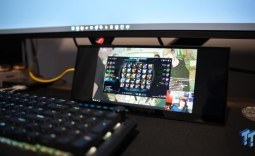
That is why, in the above photos, you can see a bunch of cables running from the laptop to the Pro Max. Unfortunately, this whole process was extremely annoying, and it was only possible to get the Pro Max working because I had additional mini-HDMI cables and three spare USB docks with HDMI ports on them. It made me realize that if the drivers don't work on a user's machine, they would have to go out and buy all this additional equipment to get the Pro Max to work, including 2x USB-C cables, 1x dock with 3x HDMI ports, and 2x mini-HDMI cables.
Aura could have at least included 3x mini-HDMI cables in the box so a user would only have to buy 1x dock with 3x HDMI ports, especially considering this display setup is $599...
Final Thoughts
So, should you buy the Aura Triple Aero 15.6-inch Pro Max? In my opinion, no. The Pro Max is simply too expensive and far too much of a headache to get set up for me to recommend it to anyone comfortably.

For $599, you get a semi-portable triple-monitor setup that may not even work with your machine. Additionally, the Pro Max lacks any cable routing solution, the software requests access to screen monitoring for an unknown reason, and the panel quality in the displays isn't anywhere near what I would expect from a $599 setup. In conclusion, don't bother.