







Business, Financial & Legal - Page 3
Catch up on business, finance, and legal news shaping tech, gaming, and science - mergers, lawsuits, antitrust, IPOs, Big Tech earnings, and market trends. - Page 3
Stay Updated
Follow TweakTown for breaking tech news, reviews, and daily updates.


As an Amazon Associate, we earn from qualifying purchases. TweakTown may also earn commissions from other affiliate partners at no extra cost to you.
Intel CEO confirms ongoing collaboration with NVIDIA on new products
What started as a congratulatory social media post turned into one of the industry's more significant moments this week. Intel CEO Lip-Bu Tan posted on X to acknowledge NVIDIA CEO Jensen Huang receiving an honorary doctorate in science and technology at Carnegie Mellon University, but also used the moment to publicly confirm that the two companies are still actively developing products together. It is the clearest public signal of forward progress since the partnership was announced, and the market noticed, with Intel's stock ticking up following the post.

To recap, Intel and NVIDIA announced their strategic partnership roughly eight months ago in a deal both companies described as historic. The two companies planned to collaborate across data centers and consumer PCs, with Intel building custom x86 CPUs that NVIDIA would integrate into its AI infrastructure platforms, as well as x86 SoCs featuring integrated NVIDIA RTX GPU chiplets targeting a range of consumer devices. NVIDIA also backed the deal with a $5 billion equity investment in Intel, which has since received regulatory clearance.
Public updates from either side have been relatively sparse since the initial announcement, which is part of why Tan's post generated so much attention. While the actual development work appears to be taking place out of the public eye, the CEOs of both companies have now confirmed that the collaboration is still active.
Continue reading: Intel CEO confirms ongoing collaboration with NVIDIA on new products (full post)
Sony taps TSMC as a manufacturing partner for next-gen image sensors in a new Japan-based joint venture
Sony is teaming up with chip manufacturing giant TSMC to form a joint venture to build a sensor fabrication facility in Japan for next-generation image sensors. The two companies announced a non-binding memorandum of understanding to form a strategic partnership to co-develop and co-manufacture these sensors.

The proposed joint venture would have Sony as the majority and controlling shareholder, leading the project at its newly constructed fabrication facility in Koshi City, Kumamoto Prefecture, while leveraging TSMC's manufacturing expertise to produce sensors with enhanced performance compared to what is available today.
The move comes as part of CEO Hiroki Totoki's plan to shift the company away from its physical assets and toward IP. That strategy has already seen Sony pull out of TV manufacturing, handing TCL a 51% stake of its Bravia division. Beyond manufacturing, the two companies are also eyeing opportunities in physical AI applications, specifically automotive and robotics, where high-performance sensing is becoming increasingly critical.
For the first time, AMD has overtaken Intel in data center revenue for Q1
AMD recently reported very solid Q1 2026 earnings, thanks in large part to the AI boom and rising semiconductor demand. Of the $10.3 billion in revenue for the first quarter of 2026, $5.8 billion was data center revenue driven by sales of AMD EPYC processors and Instinct GPUs. That is a staggering 55.9% of AMD's total revenue in Q1 2026, and 57% higher than its data center revenue in Q1 2025.

In the process, AMD has overtaken Intel in data center revenue and achieved a new milestone. According to a DigiTimes report, this is the first time AMD has generated more revenue from its data center division than Intel in the first quarter of the year. Although AMD had previously surpassed Intel in other quarters (Team Red has been ahead since the third quarter of 2025), this is the first time they have taken the lead in Q1 as well.
AMD generated $4.3 billion from its data center division in Q3 2025, compared with $4.1 billion from Intel. The same trend continued in Q4 2025, with AMD generating $5.4 billion, while Intel managed $4.7 billion. Of course, the Q1 2026 results did not alter this pattern. However, looking at the data compiled by DigiTimes, this might be the start of AMD's long-term dominance that Intel might not be able to shake for some time.
Intel is reportedly making chips for Apple again in a preliminary deal that reunites two old partners
The Wall Street Journal reports that Apple and Intel have reached a preliminary agreement for Intel to manufacture some chips for Apple devices. According to the Journal, talks between the two companies have been ongoing for more than a year, with discussions intensifying in recent months. The current scale of the agreement remains unknown, with no details on which Apple products or chip families would be involved, nor whether production would use Intel's existing 18A process or a future node like 14A.

This follows Bloomberg's recent report that Apple held exploratory discussions with both Intel and Samsung about having them manufacture Apple processor chips in the US. The Journal adds that over the last 12 months, Commerce Secretary Howard Lutnick has repeatedly met with Apple leadership, including outgoing CEO Tim Cook, to revive the relationship with Intel.
Apple currently relies solely on TSMC for its most advanced chips, but supply chain realities are pushing the iPhone maker to look beyond its long-time manufacturing partner. During a recent earnings call, outgoing CEO Tim Cook explicitly cited a lack of advanced chips as a reason for Apple's inability to meet iPhone demand, with the Mac lineup also feeling the impact.
Apple reportedly orders fresh A18 Pro silicon as MacBook Neo demand surges, $599 price point may be at risk
Apple is becoming a victim of its own success with the MacBook Neo. Demand is outstripping the supply of binned A18 Pro chips that power the Neo. As a result, Apple has tapped chipmaker TSMC for a dedicated production run. However, rising silicon and DRAM prices in the past two years may jeopardize the device's aggressive $599 price point.

The MacBook Neo is emerging as a disruptive force in the laptop market, posing a serious threat to budget Windows and Chromebook devices. Contrary to expectations, the Neo brought in more users than any Mac device during launch week. It uses a binned variant of the A18 Pro SoC, which is the same silicon found in the iPhone 16 Pro.
Specifically, Apple is repurposing chips that didn't meet the full six-core GPU specification, instead utilizing them as five-core units for the Neo. This inventory likely dates back to production runs from late 2023 through 2024, aligning with TSMC's N3E node entering volume production in late 2023.
Sony discloses financial results for 2025, takes huge loss on Bungie, PS6 release date still undecided
Sony wrapped up its fiscal year 2025 with a broadly solid performance across the company, though a painful write-down tied to its Bungie acquisition cast a long shadow over an otherwise encouraging report. The Japanese tech giant posted roughly $82.8 billion in total sales from continuing operations, a 4% increase year-over-year, while operating income climbed 13% to approximately $9.6 billion. The company's operating margin ticked up a percentage point to 11.6%.

Within its Games and Network Services segment, revenue totaled approximately ¥4.69 trillion, essentially flat year over year, while operating income rose 12% to a new all-time high. Sony noted that, had it not been for the Bungie-related charges, operating profit growth would have been closer to 45%.
Those charges were substantial. Sony recorded a total of ¥120.1 billion in impairment losses against Bungie's assets across the full fiscal year, including ¥31.5 billion in the second quarter tied to Destiny 2's continued slide, and a significantly larger ¥88.6 billion hit in Q4. At current exchange rates, that's roughly $766 million wiped from the value of a studio Sony acquired for $3.6 billion back in 2022.
Apple is reportedly eyeing Intel and Samsung foundries for its A21 chips as TSMC supply constraints tighten
Apple has reportedly entered preliminary talks with Intel and Samsung as it explores a possible secondary source for its next-gen chips. Adding to the mix, hardware enthusiast Kepler suggests Apple's future A21 SoC might be the prime candidate for such a partnership, potentially breaking Apple's total reliance on TSMC.

Since the A10's debut, Apple has maintained a nearly decade-long relationship with TSMC. This partnership gave Apple exclusive priority access to TSMC's advanced node technologies, including 7nm, 5nm, 4nm, and 3nm processes.
However, the generative AI gold rush has placed significant strain on the Taiwanese giant. The demand for AI hardware has reached a point that, despite hitting its 3nm production goals, the foundry is now scrambling to add even more capacity just to keep up with the market. TSMC projects the ongoing shortages will last beyond 2027.
Elon Musk ends dispute over Twitter stake with SEC, refuses to admit wrongdoing
Elon Musk has settled a years-long legal battle with the U.S. Securities and Exchange Commission (SEC) for $1.5 million over his delayed disclosure of a major stake in Twitter.

The agreement, reached without Musk admitting fault, marks the end of a contentious dispute that began in 2022 when the SEC alleged he waited 11 days to reveal his purchase of a 5% stake in the company. The regulator claimed the delay was intentional and that Musk would not have had to pay approximately $150 million in potential shareholder losses.
The settlement, approved by a court, resolves one of Musk's most high-profile legal entanglements. The SEC argued that Musk used "gamesmanship" to stall its investigation, while Musk previously accused then-SEC chair Gary Gensler of "harassment." This case is the largest of its kind in SEC history, with the fine reflecting the severity of the alleged violations, according to a Reuters report.
Micron's CEO says AI memory demand is just in its 'first innings' and memory supply is already insufficient
The demand for DRAM and NAND from AI has expanded exponentially, and the memory supply crunch we're currently facing is unlikely to ease anytime soon. At least that's what Sanjay Mehrotra, CEO of memory and storage maker Micron, believes, and in his view, the demand isn't going away and will only get stronger.

In an interview with CNBC, Mehrotra described the current phase of AI-driven demand as just the "first innings," suggesting that we are still early in the cycle. As AI companies scale up compute, faster and higher-density memory will become essential to keep up with growing workloads.
He added that as inference and token demand rise, so will the need for both higher-capacity and higher-performance memory. AI GPUs rely heavily on HBM, while AI CPUs use DRAM, and both are currently in short supply. Mehrotra emphasized that the issue goes beyond pricing, as memory production cannot be ramped up quickly enough to meet demand.
Intel and AMD join hands to standardize APX extensions for x86 CPUs to improve efficiency and end ISA fragmentation
Intel and AMD have agreed to standardize the Advanced Performance Extensions (APX) for x86 CPUs, a move that could improve efficiency and reduce long-standing instruction-set fragmentation.

Intel originally announced APX in July 2023. Historically, the x86-64 standard has mandated 16 General Purpose Registers (GPRs). In a CPU, registers are small, fast storage locations within the processor that hold data temporarily during processing. Data is ultimately brought from memory and caches into these registers for execution.
By doubling the General-Purpose Registers (GPRs) from 16 to 32, the CPU keeps more data in flight. Intel claims this leads to 10% fewer loads and 20% fewer stores. APX also introduces three-operand instructions, allowing the CPU to perform calculations without overwriting the original data. Intel says this doubling improves performance without significantly increasing the die size or power consumption.
GameStop offers to buy eBay for $56 billion in half-cash, half-stock deal
GameStop today announced its full bid for eBay, offering to buy the company for $56 billion.

GameStop has made a public offer to buy eBay in a deal worth $56 billion, made up of 50% stock and 50% cash. In a press release issued today, GameStop says that its $125 per share bid "represents a 46% premium to eBay's unaffected closing price on February 4, 2026," and that the bid is a 27% and 36% premium to eBay's respective 30-day and 90-day stock averages.
The numbers were somewhat quizzical, given GameStop's position; the company currently has a market cap of $11 billion, and around $9.4 billion of cash on hand. With a $20 billion letter that GameStop has secured from TD Securities, the firm would still be over $15 billion shy of full buyout amount.
Silicon wafer shipments are up 13% in Q1 2026, but AI data centers are taking the lion's share
The SEMI Silicon Manufacturers Group reported that worldwide silicon wafer shipments grew 13.1% year on year in Q1 2026, reaching 3,275 million square inches, up from 2,896 million in the same quarter of 2025.

Silicon wafers are the foundation for almost every chip. CPUs, GPUs, and memory modules all start as thin silicon slices, typically up to 300mm wide. Chipmakers like TSMC, Samsung, and Intel Foundry take these wafers and fabricate semiconductors onto them.
More wafer shipments mean more chips, making this one of the earliest indicators of where the semiconductor market is headed. However, much of this growth is being absorbed by AI infrastructure over consumer products. Ginji Yada, Chairman of SEMI SMG and Managing Executive Officer at SUMCO Corporation, said:
GameStop wants to buy eBay, prepared to make offer
GameStop is prepared to offer buyout terms to auction titan eBay, the premier commerce point for the second-hand used gaming market.

New reports from The Wall Street Journal say that retailer GameStop seeks to acquire eBay to help advance ambitious expansion plans. GameStop was the de facto depot of generations of interactive entertainment and now company CEO Ryan Cohen seeks to make the company into a $100 billion brand that goes beyond games and collectibles.
eBay currently has a market capitalization of $45-46 billion, and it's said that GameStop's CEO is prepared to make a hostile takeover bid if the initial offer is refused. GameStop has been securing stock in eBay for months now, and while its cash is ample at $9 billion, the group would still need additional partners to make the buyout happen.
Continue reading: GameStop wants to buy eBay, prepared to make offer (full post)
Intel just had its best month in years and investors are paying attention
Intel is suddenly back in the spotlight after delivering its strongest monthly performance in years, signaling a potential shift in the long-running narrative dominated by rivals like NVIDIA and TSMC.

The company posted its best stock surge in over a decade, driven by renewed investor confidence in its turnaround strategy and aggressive push into AI and advanced chip manufacturing. After years of falling behind in process technology and losing market share, Intel is now being viewed through a different lens, with its long-term roadmap starting to gain traction.
This momentum ties directly into broader industry shifts. AI demand is exploding, and while NVIDIA still dominates the GPU market, Intel is positioning itself across both compute and foundry services. Its push into domestic manufacturing and partnerships with governments and enterprise clients is also helping reshape sentiment.
Samsung discloses its Q1 2026 earnings with a 48x growth in semiconductor operating profit
Samsung Electronics has just disclosed its Q1 2026 earnings, breaking all kinds of records and shattering estimates set by industry analysts. Amid the global semiconductor shortage and the relentless AI boom, Samsung reported an 8x year-over-year profit increase in the first quarter of 2026.

Per the earnings call, Samsung Electronics reported quarterly sales of 133.9 trillion Korean won ($89.96 billion), a 50.2% year-over-year increase from the 79.14 trillion Korean won it brought in last year. It is also higher than the 132.69 trillion won estimate from LSEG SmartEstimate, which is weighted toward more accurate analysts.
The quarterly profit saw a massive boom, going from 6.69 trillion won in Q1 2025 to 57.23 trillion won (or $38.54 billion) in Q1 2026. That is a staggering 755% year-over-year profit jump, and it is also (again) higher than analysts' estimate of 38.23 trillion won. Semiconductor (DS segment) sales rose 225% year-over-year, and semiconductor operating profit grew 48x, from 1.1 trillion won in Q1 2025 to 53.7 trillion won ($36.18 billion) in Q1 2026.
Intel posts very strong Q1 2026 earnings as the AI boom starts to focus on CPUs
Intel just had its Q1 2026 earnings call, and it went better than many expected. In Q1 2026, Intel generated $13.58 billion in revenue, up 7.2% year over year. Industry experts had predicted $12.42 billion in revenue for this quarter, which Intel has clearly surpassed. Much of this revenue is down to Intel's data center and AI divisions, which brought in $5.1 billion this quarter. Revenue from external customers for Intel foundry was less than $200 million and was mostly centered around legacy wafer work.

Intel's foundry division has been slow to get started, but now it seems like it's on its way up. With $5.4 billion in revenue generated in Q1, Intel's foundry business is starting to establish itself as a clear second option to TSMC. Intel needs to do that quickly, not just for its own sake, but also for the sake of the CPU industry. Intel's adjusted earnings per share rose to 29 cents, sending the stock up more than 15% shortly after.
Intel has had some major wins for its foundry recently, especially with Tesla becoming the first external customer for the next-gen 14A production node. They have also (finally) ramped up production on the 18A node with Panther Lake and Wildcat Lake now rolling out. Intel has also joined forces with Google to deploy Xeon processors for its AI infrastructure and has joined Tesla in the ambitious TeraFab project.
Tim Cook calls Apple Maps launch his 'biggest mistake,' names Apple Watch his proudest achievement
Apple recently announced that CEO Tim Cook will step down on September 1, 2026, after nearly 15 years in the role. Josh Turner, Senior Vice President of Hardware Engineering, is expected to carry on the mantle. As his tenure of more than a decade comes to an end, Cook is taking stock of the journey, the missteps, and the triumphs that came with it.

According to Bloomberg, Cook spoke candidly to Apple employees during an internal town hall meeting held shortly after the announcement. The outgoing CEO picked the hasty launch of Apple Maps as his "first really big mistake." In 2012, Apple officially launched its in-house Maps application with iOS 6, replacing Google Maps on the iPhone.
However, the rollout quickly became one of Cook's biggest missteps. Apple Maps suffered from inaccurate directions, mislabeled landmarks, distorted roads, problematic 3D views, and poor performance across many regions, ultimately forcing Apple to issue a rare public apology. Scott Forstall, who led Apple's software division and oversaw the Maps project, was later pushed out of the company.
Tesla plans to use Intel's next-gen 14A process for its TeraFab project
Intel seems to have secured its first major customer for the 14A production node that is currently under development. According to a Reuters report, Tesla plans to use Intel's next-generation 14A manufacturing process for the much-anticipated TeraFab project. Tesla and SpaceX CEO Elon Musk has confirmed that they have picked Intel's yet unproven 14A process, giving Intel its first major external customer for this node.

Musk seems to be very bullish on his vision for TeraFab, as he recently expressed his desire for the project to move at "light speed". Tesla is currently using external partners such as TSMC and Samsung to manufacture its AI chips, including the AI5 chip recently taped out. The billionaire's robotics and data center ambitions necessitate an in-house production process, which is what the TeraFab AI chip complex in Austin, Texas, aims to accomplish.
On the other side, Intel is quite desperate to get its in-house production up and running. Their 18A process node has had some problems ramping up, but now, finally, we are seeing Panther Lake and Wildcat Lake CPUs being produced on that node, though only partially. Intel CEO Lip-Bu Tan has been very clear about Intel's production struggles and has even said that securing an external customer was vital to Intel's continued presence in the manufacturing business.
Apple CEO Tim Cook steps down, John Ternus to take over the reins
Apple today announced that Tim Cook is officially stepping down as the company's Chief Executive Officer (CEO) on September 1, 2026. Cook will transition to the position of executive chairman of the board, and Apple's Senior Vice President of Hardware Engineering, John Ternus, will take over as CEO. The company says the move is part of a long-term succession plan and has been approved unanimously by the board.

Tim Cook will not step down immediately; however, he will continue to collaborate with John Ternus over the summer to ensure a successful transition of Apple to new leadership. Tim Cook has held the CEO position since 2011. Under his leadership, Apple has achieved several monumental milestones, including becoming the world's most valuable company with a valuation of $4 trillion in 2026.
Ternus has also been a key figure in the Apple hierarchy for a long time and has led Apple's hardware engineering department since 2021. He joined Apple in 2001 as part of the design team and then became Vice President of Hardware Engineering in 2013. Currently, his team manages hardware products such as the iPhone, iPad, Apple Watch, Mac, Apple Vision Pro, and AirPods.
Continue reading: Apple CEO Tim Cook steps down, John Ternus to take over the reins (full post)
Elon Musk wants to move at 'light speed' on the Terafab project
Tesla and SpaceX CEO Elon Musk has been quite bullish on TeraFab since its March 2026 announcement. We also recently covered Tesla's successful tape-out of its AI5 AI chip, developed in collaboration with Samsung and TSMC. Now, it looks like Tesla may not need manufacturing partners in the near future, as work on TeraFab is advancing rapidly under Musk's direction.

According to a report by Bloomberg, the team tasked with bringing Terafab to life has been hard at work lately, aggressively tapping suppliers to secure pricing and delivery times. The report states that Musk's team has already approached Applied Materials Inc., Tokyo Electron Ltd., Lam Research Corp., and Samsung Electronics Co. Apparently, Elon Musk wants this phase of the plan completed at "light speed".
It has been reported that the TeraFab team is not providing specifics about what they are planning to build, but they are demanding speedy responses from the contacted companies. Under Musk's direction, the team apparently contacted a company during a Friday holiday. It demanded that the estimate be delivered the following Monday, which gives us an idea of the pace the CEO wants to set.
Continue reading: Elon Musk wants to move at 'light speed' on the Terafab project (full post)
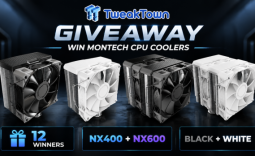 Giveaway: 12 Winners Will Score MONTECH NX400 and NX600 CPU Coolers
 GTA 6 leaks have reportedly led to a morale drop at Rockstar, with Netflix frustrated as well
 The Blood of Dawnwalker won't hit 60 FPS on any console, PS5 Pro tops out at 40 FPS
 AMD claws back ground against Intel in the CPU market, climbs to 35% share in desktop CPUs
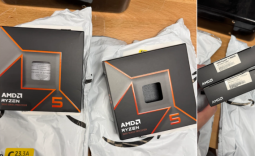 Redditor receives not one but TWO empty boxes of Ryzen 5 9600X from Amazon
 Xbox Series X25 Limited Edition Console is priced at $900, arrives November 2026
 Dave Bautista officially cast as Kratos in Amazon's 'God of War' TV Series, replaces Ryan Hurst
 Take-Two begins the hunt for GTA 6 leaker CyberLeek, subpoenas Microsoft and Discord
 PlayStation 6 handheld not expected to stay under $600, warns leaker
 AMD confirms the Radeon RX 9050 4GB will have a tiny 64-bit bus and just 16MB Infinity Cache
 Intel 'Nova-Lake-S' 28-core CPU with bLLC reportedly draws 296W at PL2
 Cooler Master MasterFan A120 Fan Review
 GIGABYTE MO27Q2A Gaming Monitor Review: 1440p, 280Hz, and QD-OLED is a winning combination
 Cooler Master V8 ACE 3DHP BLACK CPU Cooler Review
 ASUS ROG Strix XG129C Review: A $199 Gaming Monitor You Don't Play Games On
 Cooler Master HAF II 500 Mid-Tower Chassis Review
 Corsair HS35 v3 Wireless Gaming Headset Review - An Affordable Winner
 D-Link F518 5G Wi‑Fi 6 AX1800 Mobile Hotspot Review: All-Day Mobile Hotspot
 Bose Lifestyle Ultra Speaker Review - Impressively Detailed Room-Filling Sound
 MSI Z890 Gaming Plus WIFI6E Review - Z890 for under $200
 Mortal Kombat (1995) 4K Ultra HD Blu-ray Review
 Using Multiple Monitors? Change these Windows settings for a Better Experience
 Windows Sandbox is The Windows Security Feature Most People Never Use
 I ditched the Windows 11 context menu for this open-source tool, and here's why
 Windows 11 may be encrypting your drive already, and I checked where my recovery key went
 GIGABYTE's 40 Days of INFINITY celebrates 40 Years of Innovation with stunning GeForce RTX graphics cards and rewards
 I swapped File Explorer for this free file manager and finally got the layout I wanted
 How to tell if someone has been using your Windows PC without your permission
 6 Task Manager tips for troubleshooting Windows performance problems
 ASUS ROG's 20th Anniversary Line-up of Premium PC Gaming Gear has Arrived - Here's Everything You Need to Know
 Six File Explorer tips every Windows user should know